
“Color Book” premiered at the 2024 Tribeca Festival and has garnered over 20 jury and audience awards at festivals, including the Austin Film Festival, Deauville American Film Festival, Chicago International Film Festival, Denver Film Festival, and others. Director David Fortune has also been nominated for the 2025 NAACP Image Awards for Outstanding Breakthrough Creative. His short film “Us” was selected as a winner of the Netflix Content Creators Program, while his film “Shoebox,” produced through the Indeed-Hillman Grad’s Rising Voices Program, was acquired and distributed by HULU.
Fortune is a Morehouse writer and director from Atlanta, Georgia. He was named one of Variety’s 10 Directors to Watch in 2025 and received the AT&T Untold Stories Award, which provided a $1 million grant to direct this feature film.
THE PLOT
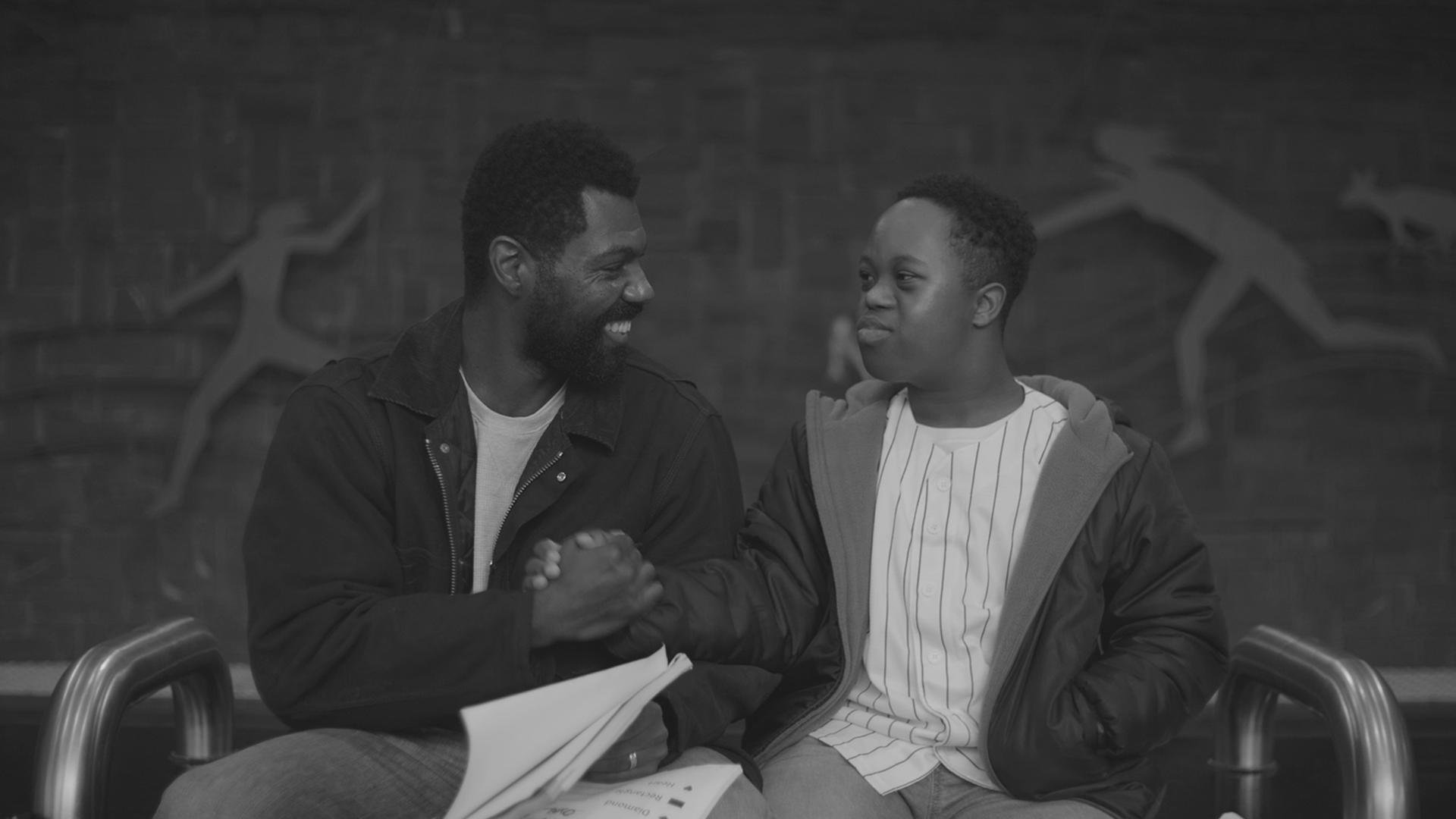
Fortune chose as his two leads, Will Catlett as Lucky and Jeremiah Daniels as Mason. They portray a Black father and his developmentally disabled son. Writer/Director Fortune’s time as a camp counselor at a camp for Downs’ Syndrome children served him well as preparation for “Color Book.” His desire to shine a light on children with disabilities and, specifically, on children with Down’s Syndrome, had not been seen onscreen previously.
In addition to the story of a father and son dealing with grief and adversity, Fortune also wanted to depict a healthy father/son relationship in the Black community, something, he says, which has not been prevalent in film. As he told PopCulturalist, “People want to see truth, love, and themselves onscreen.”
BLACK & WHITE
The decision to film “Color Book” in black-and-white was fitting for the somber subject matter. While this is a depiction of a healthy father/son relationship, the young Mason’s (Jeremiah Daniels) mother, Tameeka “Tammy” Hutchinson (Brandee Evans) has recently been killed in a car accident. Dad Lucky decides to take his son to a baseball game, buys a car to replace the one involved in Tammy’s accident, and the car almost immediately breaks down. That puts the pair on public transportation. Most of the scenes take place on or near the train carrying them to the game at Trust Park in Marta. Director of Photography Nikolaus Summerer has done a great job with the train footage. The music, by Dabney Morris, also works.

Jeremiah Daniels and Will Catlett as Mason and Lucky in “Color Book.”
THE LEADS
What really carries this film, however, is the relationship between the two leads, especially Will Catlett as the ironically named Lucky. When the camera focuses on Catlett, he conveys the necessary gravitas of a father struggling to remain on an even keel, himself, and trying just as hard to care for his son.
The 43-year-old Catlett has appeared in many television and film roles, including as Verton Freeman in 2020’s “Lovecraft Country.” As long ago as 2013 he was appearing in “The Mentalist” as a patient. He has the look of an actor ready to carry a film as the lead. Writer/Director Fortune told Will Catlett, whose first lead this is, “You’re going to be the captain of this ship.” Fortune explained, “I don’t direct them (the actors). I allow them. I give them the freedom to color within the lines.”
Catlett himself spoke of picking up many cues for his impressive performance from his co-star’s real-life parents concerning how to portray the father of a Downs’ Syndrome son, giving credit to Terrence and Joy. Of his masterful handling of the role Catlett said, “I just was present. I just show up and be and exist.”
CONCLUSION
The film was a sensitive, if slow-moving, somber slice of life. As a first feature-length film, it was touching and compassionate and showed much promise. The film runs about two hours (115 to 139 minutes, depending on the information source). It is not until 50 minutes in that real tension arises. Lucky falls asleep on the train and temporarily loses Mason. (Mason has wandered off after a balloon vendor. Balloons feature importantly in key scenes). Maybe I am being overly critical of today’s audiences’ attention spans, but films today must provide necessary tension and conflict early on to retain audience interest.
The moment when Lucky awakens and realizes that his son is outside the train, following a stranger who is a balloon vendor up an escalator, while his helpless father, (still only half conscious), is being whisked away onboard, will grab the attention of any parent who has ever been in charge of a child gone missing— even if only for a few moments. I can remember a similar moment at a public swimming pool when I couldn’t find my then elementary-school-aged son for less than five minutes. Panic ensued. I wanted this moment of crisis to emerge earlier. I also envisioned many alternative avenues for the resolution of Mason’s disappearance, especially when police are summoned.
But Will Catlett’s name as a lead is one I will look for again, and hopefully soon. I’m not sure what sort of demand will exist for young Jeremiah’s presence in future films. It reminded me of the only person in history—also a non-actor in his first role—Harold Russell—who won not one but two Oscars in 1947.
SIGNIFICANT OSCAR PERFORMANCE ONE-OFFS
For those of you too young to remember, Russell won the Best Supporting Actor Oscar in 1947 for his part as Homer Parrish in “The Best Years of Our Lives.” Russell, a real-life amputee following an explosives malfunction during military training, portrayed a veteran who lost both hands in WWII. The Academy, not anticipating that the non-actor would actually win the Academy’s vote as the most impressive acting performance of the year, voted him a special Oscar for “bringing aid and comfort to disabled veterans through the medium of motion pictures.” Then, in a surprise move, Russell actually won the real vote and, therefore, earned a second Oscar.
William Wyler, the film’s director, said, at the time, that it was the single best performance onscreen he had ever seen. But he also advised Russell to go back to school and get a college degree, saying that, in the future, there might not be much call for a guy with no hands in the motion picture industry. Russell agreed with Wyler and gave up on whatever additional acting aspirations he may have had. He did become the first actor to actually sell his Oscar, however, for $60,500. (It was bought by Lew Wasserman, a studio executive, who gave it back to the Academy.) Russell actually kept the honorary Oscar, selling the one meant for an actor, which he was not.
While on the subject of actors who did a great job in a role—even Oscar-level performances—but the Oscar did not substantially boost their fledgling careers, we might mention the 2010 Best Supporting Actress Oscar that Mo’Nique won for her role alongside Gabourey Sidibe in Lee Daniels’ “Precious.”
Only time will tell if there will be more onscreen opportunities for Jeremiah Daniels, which does not detract in any way from his fine work in “Color Book.” What almost everyone agrees is that Writer/Director David Fortune is a talent to watch. And I would second that prediction for Will Catlett.
[“Color Book” screens at the 56th Nashville International Film Festival on Friday, September 19th, from 6:30 to 8:30 p.m. at Regal Green Hills Theater #4.]