Welcome to WeeklyWilson.com, where author/film critic Connie (Corcoran) Wilson avoids totally losing her marbles in semi-retirement by writing about film (see the Chicago Film Festival reviews and SXSW), politics and books----her own books and those of other people. You'll also find her diverging frequently to share humorous (or not-so-humorous) anecdotes and concerns. Try it! You'll like it!
Director Oliver Laxe helmed this official Spanish entry into the Best International Feature Film Academy Awards competition. The synopsis for the film reads:”After a young woman goes missing in a rave, her father and brother brave the arid Moroccan landscape searching for her in a world on the brink of collapse.” It showed at the 61st Chicago International Film Festival.
CANNES ACCOLADES
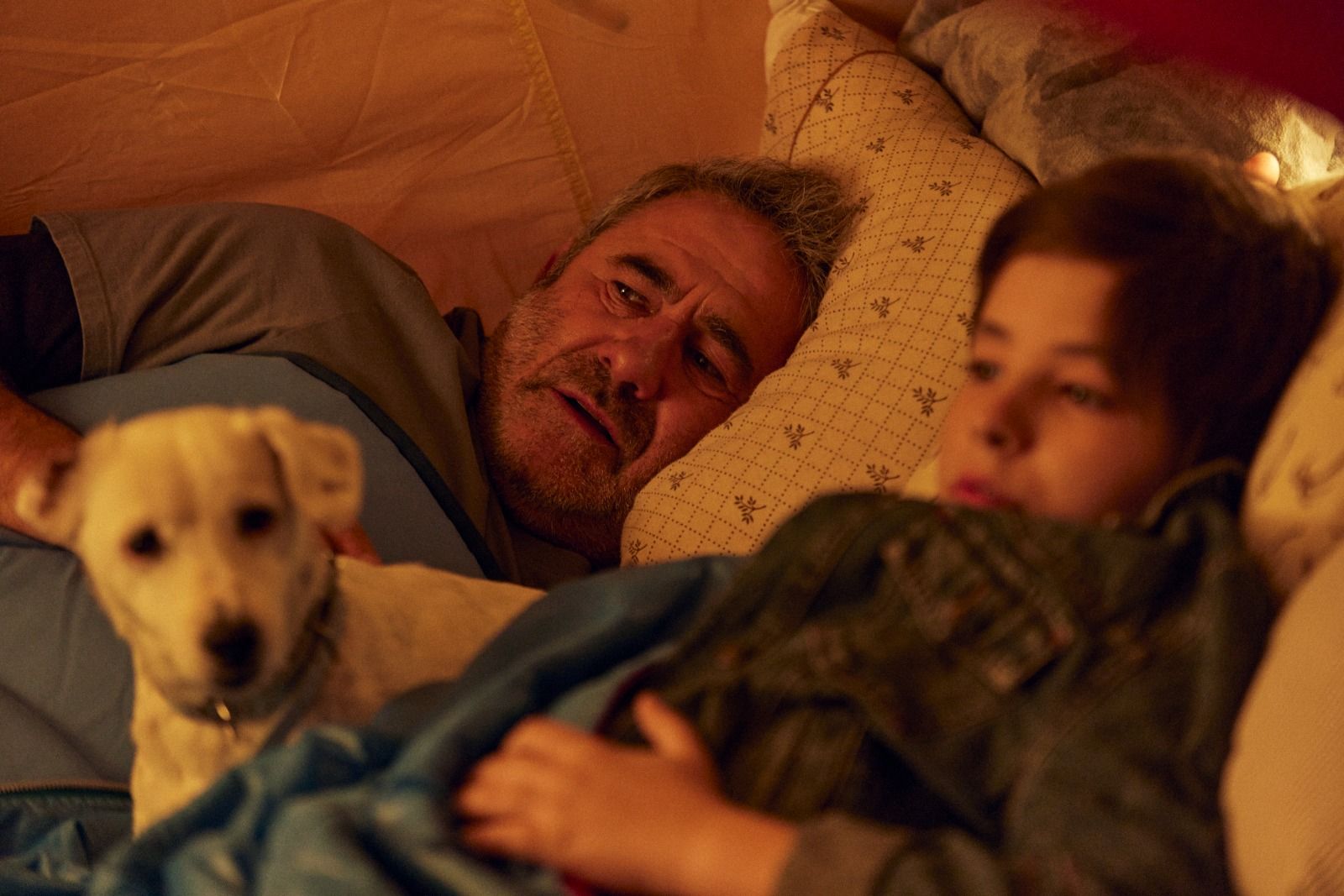
Sergi Lopez (“Pan’s Labyrinth”), Mar’s father Luis, has his young son Esteban (Bruno Nunez Arjona) with him and Esteban has brought along his dog, Pipa. Pipa, a Jack Russell Terrier, and a second dog, Lupita, a Podenco mix, actually won the Palme Dog Jury Prize at Cannes. “Sirat,” the film, won the Jury Prize at Cannes.
CAST
The rave participants (and Mad Max film doubles) that we meet are:Jade Oukid as Jade; Stefanie Gadda as Stef; Joshua Liam Henderson as Josh; Tonin Janvier as Tonin; and Richard “Bigui” Bellamy as Bigui. I do think it was Bigui who left his LSD-permeated feces unburied in the desert so that Pipa ate it and nearly croaked, although Bigui denies it. (These things happen; the incident is another example of the film’s black humor).Thoughts are expressed about choosing one’s own familty being preferable to being stuck with those bound to you by blood. Mar is not a run-away. She is an adult who chose to leave and has been missing for 5 months, as her little brother confirms.
Two of the men have missing limbs. One has no right hand; one has no left leg and uses a peg-leg prosthetic contraption. At one point, when the prosthetic limb is removed, the amputated knee joint appears to sing a song about deserting the army, which qualifies as entertainment when you’re stuck in the desert and adds to the film’s dark humor. It certainly sums up this group’s attitude towards the military, a group which is constantly shown threatening to break up the raves or take over the world or start WWIII. (One doesn’t know, for sure, what their exact goal may be.)
DIRECTOR
Director Oliver Laxe (who stands 6’ 6 and ¾” tall) has made four feature films. This one was quite engrossing. It is “Mad Max-style shit” as another viewer said to me as we exited. All of the participants at the first rave, shot in Rambla Barrachina, Teruel, Aragon, Spain look like extras from a George Miller “Mad Max” film. Their clothes (“Freaks” tee shirt, an homage to the 1932 film), hair (or lack of same), tattoos— are in style for an apocalyptic thriller. The group that Luis throws in with includes 2 Mad Max style vehicles, with 2 women and 3 men in the group, as named above.
PLOT
The first rave is dispersed by the military. That leads Luis to beg the 5 Mad Max-like characters to take Luis and Estaban along, leading the way to the next rave further into the desert near Mauritania. Luis’s financial contribution to purchasing gas is probably the clincher for the eventual yes vote.
Initially, the 5 ravers say no, because Luis is driving a Family Truckster van (as I call the one my own spouse drives.) They are going to have to ford a stream at one point (Laguna de Tortjada, Tortajada, Teruel, Aragon, Spain). The troupe correctly predict that Luis’ vehicle will have trouble making it across that stream. Indeed, that turns out to be one of many death-defying adventures that the troupe will have as they press forward. The mountainous terrain makes driving treacherous.
DIRECTOR’S STATEMENT
In a Cannes interview, Director Luxe said, “I think we were very bold. We were very daring. We didn’t measure things. We didn’t calculate. We just leapt into the abyss.” That’s for sure. As the not-that-merry troupe proceeds into the abyss, for 115 minutes we will see one after the other crash and burn in various ways. There are explosions. There are crashes. There is the threat of nearby armies that may descend at any moment.
HUMOR
This trip through Hell reminded some of “The Wages of Fear” (source material for William Friedkin’s “Sorcerer” film) but, for me, it was Mad Max Redux with occasional bleak humor (like the aforementioned amputated leg singing a song), or the recitation by one of the troupe that his father’s last words were: “Fuck! This is serious.”
As Jade has mentioned about the large speakers she recycles, “You never know if this is the last sound it will make.” She’s right about that for the speakers, and she’s right about that for all of them, as they attempt to navigate from the first disbanded rave to a second one. Jade will long be remembered, post film, for her words, “Blow it up!” requesting more volume from the huge speakers the group sets up in the middle of the desert.
CONCLUSION
This 115-minute Spanish submission for the Best International Feature Film Oscar list, is not a boring movie, like an earlier submission from a Nordic country. It holds your interest. It may well blow you away.
“A Useful Ghost” screens at the 61st Chicago International Film Festival.
“A Useful Ghost” is Thailand’s official submission for the 98th Oscar ceremony for Best International Film Feature. The film is the first feature length effort by Ratchapoom Boonbunchachoke, after his shorts “Red Aninsri” and “Tiptoeing on the Still Trembling Berlin Wall.” The director, who writes for Thailand television, is competing for the Gold Hugo award at the 61st Chicago International Film Festival. The film won the Critics’ Week Grand Prize at Cannes and was picked up for distribution (releasing in the U.S. on October 19th) at the Toronto International Film Festival.
PLOT
The synopsis reads, “Vengeful ghosts, possessed vacuum cleaners, and a supernatural sense of justice converge in this charmingly absurd fable of memory, loss, and grief.” Asked about the inspiration for the film, which was written during Covid and began shooting in 2023, the director told interviewer Pamos Ko-lzathanasis (Asian Movie Pulse) that the double meaning of the term “dust” in the Thai language ( dust= a person who “doesn’t matter, has no power”) intrigued him. Bangkok is known for its dust pollution. There is more coughing in this film than any movie I’ve seen in a long time, kicking off with the death of a worker named Tok in a Bangkok factory. When Tok dies, he is coughing up blood. He subsequently blames the factory and its owner, Suman (Apasiri Nitibbon) for his death, saying, “Your damn factory killed me!”
REVENGE
So, is the main plot a story of a ghost taking revenge on a factory he feels contributed to his death? Yes and no. Tok is but one of several ghosts in the film. The main ghost is a beautiful young woman named Nat (Davika Noorne) whose husband, March (Wisarut Hummarat) is grieving following her death. She returns as a ghost trapped in a vacuum cleaner. There is a part of the film where she becomes “solid” again, which was confusing, since that process is not well-explained, other than to link it to the loved one’s memories of the departed (i.e., the more vivid the memories, the more substantial the ghost appears, but the method for becoming human again? Not explained or addressed in the film.)
Nat’s job (for Paul, a government minister) is to administer electroshock therapy to people who are being visited by ghosts in their dreams, allowing those individuals to forget the spectres that are disturbing their sleep. [The idea of erasing memories made me think of Jim Carrey’s 2004 film “Eternal Sunshine of the Spotless Mind,” but “A Useful Ghost” is played more for laughs and with a much less serious tone.]
MAY 2010 UPRISING
Another series of vengeful ghosts referenced are those killed in a Thailand uprising/civil war that took place in May of 2010. The Thai military cracked down on the UDD (United Front for Democracy Against Dictatorship). The protesters wanted Abhisit Vejjajiva to dissolve Parliament and hold elections. Eighty-five protesters were killed and 2,000 injured in the response to their protests by the armed military, who fired into the crowds with live bullets. There were still 51 additional protesters missing a month later. One sympathizer with the Red Shirt protesters, a former military man in Thailand, Khahiya Sawasdipol, was shot in the head by snipers on May 13, 2010, and died on May 17, 2010 while being interviewed by the New York Times when he was shot! It is not surprising that the script has this line: “Younger people are more obsessive about the past than older people.” The political implications of the character of Paul, plus the line about the May, 2010, political killings show that this near civil war is obviously still on the director/writer’s mind.
There is a political message here, (although the director indicated he had no problem with government censors over the film in an interview). The character of Paul represents a Trump-like figure whose influence is everywhere. In fact, it appears that Paul—who at first appears to be a good guy—was responsible for the death of a character named Krong (Wantop RungKumjad), who also becomes a vengeful ghost seeking revenge for his drowning at Paul’s direction. His feet are missing, which is something that the director discovered is frequently the case in representing ghosts on film.
GHOSTS
The director was asked about his cinematic depiction of ghosts. He admitted that, when he was first asked that question, he had to research how ghosts are depicted in cinema, going back to films like “Poltergeist” and “Beetlejuice.” He came up with the idea of making the main character (Nat) become increasingly translucent as she faded from the memory of her husband and others, and it worked. This was well done by cinematographer Pasit Tandechanurat. [On the matter of costuming, however, the shoulder pads that Nat wears went out in the eighties. Every time she made an entrance, I was struck by the huge shoulder pads, which did nothing for the timeliness of the film. Maybe they are still in fashion in Thailand, but the other female characters did not seem to be wearing huge shoulder pads.)
HUMOR
There is a Thai legend involving a female ghost that the director referenced as one inspiration for his female ghost, Nat. “My initial inspiration for the story is the legend of Mae Nok, which is a forbidden love story between a female ghost and her living husband.”He said he was also fascinated by the idea of ghosts in everyday objects, but admitted that a vacuum cleaner won out over a TV or washing machine, if only because of its ability to move about and, potentially, contain a ghost. It also led to some truly absurd humorous lines. March’s mother, when she comes upon him in the hospital hugging his vacuum cleaner, says, “I’m less worried about the fever than about the fact he made out with the vacuum cleaner.”
SEXUAL CONTENT
The film opens with Nat’s brother, Moss, telling us he is “an academic ladyboy.” While it is obvious that Moss means that he is gay, it was not a term I ever heard in the U.S. The sexual tryst between Moss and Krong, is another recent homosexual love story, a la “Kiss of the Spider Woman” and “On Swift Horses.”
DREAMS
There is much discussion of dreams, which Boonbunchachoke described as being “our most personal intimate space.” He related a plot where there is a Ministry of Dreams and one’s dreams are examined for signs of treason. Ghosts and dreams are not unfamiliar territory for me. I wrote 6 books about ghosts set along Route 66. (“Ghostly Tales of Route 66.”)
SCRIPT
Boonbunchachoke likes actors to stick to the script in his films, but leaves enough flexibility for some improvisation. Humor is quite prevalent throughout, and the director said, “Humor works best when you don’t expect it.”
GHOSTS IN PROTEST
The film says of ghosts, “Their return is an act of protest…Ghosts are those that don’t give in to death, but have no power to change things.” We also hear one character saying, “Someone must remember. No one will remember me. No one will remember what I and the others fought for.”
CONCLUSION
Writer/Director Ratchapoom Boonbunchachoke at the 61st Chicago International Film Festival.
When I attended a press showing of ‘’A Useful Ghost,” I remembered that Cannes seeks “a great big pole-vault over the barrier of normalcy by someone who feels that the possibilities of cinema have not been exhausted by conventional realist drama.” (Peter Bradshaw’s review of the Cannes film “Holy Motors” in “The Guardian,” 2012.)
“A Useful Ghost” falls into that category. I had the same reaction to “A Useful Ghost” as to “Holy Motors” thirteen years ago. As the author of at least 6 books on ghosts, I felt some review expertise for this one. “’A Useful Ghost’ does not try to frighten or scare the audience. Instead, it provokes them to think about the relationships between humans and ghosts in our society,” said its writer/director, Boonbunchachoke.
“A Useful Ghost” won the Critics’ Week Grand Prize at Cannes. Its writer/director will be present with the film in Chicago when it screens on 10/19 (8 p.m.) at the Gene Siskel Film Center and on 10/21 at the NewCity AMC at 2 p.m.
The last three days of the 61st Chicago International Film Festival have been three days of an embarrassment of riches, with the screenings of Gus Van Sant’s “Dead Man’s Wire”, Kelly Reichardt’s “The Mastermind,” Yorgos Lanthimos’ “Bugonia,” and Noah Baumbach’s “Jay Kelly.”
Writer/Director Kelly Reichardt of “The Mastermind.”
Reichardt and Van Sant are present in Chicago in person to accept awards. A retrospective of Reichardt’s films is one of the highlights of this 61st Chicago International Film Festival. Reichardt has won awards at Cannes, Lucarno, London and Rotterdam. “First Cow” (2020) is one with which I was familiar, but I’ll be going back to “Old Joy” (2006) and “Showing Up” after this. Reichardt’s latest film, “The Mastermind” opened October 17th.
“THE MASTERMIND” PLOT
Set in 1970 in Framingham, Massacusetts, we follow James Blaine Mooney (Josh O’Connor, “Challengers”), art school dropout, unemployed would-be carpenter, father of two young boys and husband to the long-suffering Terri (Alana Haim) as J.B. masterminds the heist of four valuable Arthur Dove modernist paintings from the Framingham Art Museum.
James enlists three accomplices, a rag-tag gang of small-time thugs, played by Eli Gelb (Guy Hickey), Cole Doman (Larry Duffy) and Javion Allen (Ronnie Gibson). The group could serve as the cast of The Gang Who Couldn’t Shoot Straight. A late replacement in the trio, when the driver bails, Ronnie, turns out to be particularly unreliable. He brings a gun when told not to and, soon after the art heist, holds up a bank. When caught, Ronnie Gibson (Javion Allen) immediately gives up the entire group. James leaves town and is on the run for most of the rest of the movie.
INSPIRATION
“It’s an aftermath film, an unraveling film,” said Reichardt, its Writer/Director. “In the 90s I thought about doing an art heist film on Super-8,” Reichardt remembers, “so it’s been cooking in the back of my mind for a long time. A couple of years ago, I came across an article about the fiftieth anniversary of this art heist at the Worcester Art Museum in Massachusetts, where some teen girls got swept up in the robbery. That was a fun image and was kind of the first seed.” Locally legendary, that event took place on the afternoon of May 17, 1972, when armed men pilfered two Gaugins, a Rembrandt, and a Picasso.
Thematically, the plot reminded of the 2018 Evan Peters/Barry Keoghan vehicle “American Animals,” written and directed by Bart Layton that also had a clueless band of thieves who ripped off a museum and did so haplessly. Said one of the real thieves featured in that 2018 film, Warren Lipka : “You’re taught your entire life that what you do matters and that you’re special. And that, there are things you can point towards that would… which’ll show that you’re special, that show you’re different, when, in all reality, those things… don’t matter. And you’re not special.” Some of that philosophy shows up in Reichardt’s examination of another botched robbery and the impetus for it.
THE MUSEUM
The film opens with James escorting his family through the Framingham Art Museum, where he is a frequent visitor and pilfering a small object. In reality, there is no Framingham Art Museum. “Tony Gasparro and the art team built the interior of the museum from the ground up in an old warehouse,” Reichardt said. For the museum’s exterior scenes, Reichardt’s team shot at the Cleo Rogers Memorial Library in Columbus, Indiana. Completed in 1969, the facility was designed by architect I. M. Pei with an eye to revitalizing the town’s center.
JAMES BLAINE MOONEY
James Blaine is unemployed and has a generally entitled attitude, as his father—well played by Bill Camp—is Judge Bill Mooney. The would-be “mastermind” seems to have had a respectable middle-class upbringing, making his decision to become a criminal even more interesting. The family dynamic is central to the film. The actors portraying J.B.’s two young sons, Tommy and Carl are well-played by two fraternal twins from Louisville, Kentucky, Jasper (Tommy) and Sterling Thompson (Carl). “They’re twins, but they are different boys with very different personalities.”
Josh O’Connor, urging Tommy, his son, to secrecy in “The Mastermind.”
Both boys were hilarious and excellent in their roles. One of the best lines from the film may be at the conclusion of one hellacious day when J.B. turns to Tommy and says, “Let’s keep today to ourselves.” (Ilaughed outright; it’s a great scene.) Said Reichardt, “It’s a heist movie, in a sense, but the family and friend dynamics are kind of the main thing. Mooney is blowing up his world and the heist is how he goes about it, consciously or unconsciously.”
MURPHY’S LAW
The entire robbery represents a life lesson in Murphy’s Law where, if anything can go wrong, it will go wrong. The plot can be summed up with this scripted line from Guy Hickey (Eli Gelb) said to would-be mastermind J.B., “Honestly, I don’t think you thought things through enough.”
That line is a major understatement. J.B. was somehow involved with fencing the stolen paintings through his association with former art school Professor Pruitt, but the entire fiasco goes up in flames almost before it even gets underway, beginning with the defection of get-away driver Larry (Cole Doman).
FAVORITE SCENE
My favorite sequence among many good ones was watching James Blaine hauling the paintings, one-by-one, up a ladder to the loft of a barn, to hide them. Then somehow, while a hog is shown rooting around beneath the ladder, J.B. manages to knock the ladder over so that getting down (after 4 or 5 trips up the ladder with each individual painting) becomes a logistical nightmare. Keeping the paintings proves even more difficult than stealing them was and J.B. has the paintings taken from him by three large gangster types. Mooney goes on the run, first stopping in the countryside where old friend Fred (John Magaro, “The Big Short”) and wife Maude (Gaby Hoffman, “Field of Dreams”) give him temporary lodging.
Maude gardens and Fred works as a substitute teacher at the local middle school. Fred is star-struck at the thought that his childhood friend, whom, he says, used to “nibble around the edges” of crossing society’s lines has now, in his own life, “blown it up.” Fred seems quite impressed with news coverage of his old buddy’s exploits, which Maude finds upsetting. He suggests that J.B. might want to think about a commune in Canada only 58 miles across the Canadian border as his hide-away, joining Fred’s own draft-dodging brother. This is the 70s theme of conscription into the war in Vietnam, one which my own spouse narrowly avoided due to my pregnancy at the time. (Scriptedline from the commune: “I got to Paris Island and things got real.”) My generation remembers Vietnam well. Maude approaches James privately. She tells him bluntly to move on and never contact her husband again, saying, “I don’t want you ruining our lives, too.”
James Blaine Mooney (Josh O’Connor) in “The Mastermind” at the 61st Chicago International Film Festival.
J.B. takes off for Cincinnati and, ultimately, for Canada. He plans to join a group that Fred described to him as seventies dissidents, druggies, draft dodgers: “You know, nice people on the run.” We hear James Blaine calling home on the phone during his escape, once again asking for a financial hand-out from someone (in this case, not his Mom Sarah but his wife). Once again, we wonder why Terri Mooney doesn’t give her MIA spouse a World Class chewing-out—especially when he protests, “Everything I’ve done was for the good of our family.” Terri remains silent.
CAST & CREW
Reichardt often works with many of the same actors. She has cast some very recognizable and seasoned actors and actresses in “The Mastermind. In addition to Bill Camp and Gaby Hoffman, you’ll recognize Amanda Plummer (“Pulp Fiction”) as Louise and Hope Davis (“Synecdoche, New York”, 2002; “About Schmidt”, 2008) as J.B.’s Mom Sarah. These are proficient character actors film-goers will recognize from years of past excellent work.
Cinematographer Christopher Blauvelt has provided great camera work for the production. The musical score by Rob Mazurek—(which, at one point, was random acoustical percussion noises)—also adds to the overall mood and augments the directing and writing by Reichardt.
CONCLUSION
Reichardt has crafted an engrossing look at a loser who has outdone himself this time. The film ends with a whimper, not a bang. As Reichardt put it, “James Blaine is a man smart enough to get into trouble, but not smart enough to get out of it.” See it if it plays near you.
I saw Guillermo del Toro’s “Frankenstein” today, in a screening room packed with critics. I’m very glad I did see it on the big screen because it is only going to play in theaters beginning October 17th through November 5th and then will head to Netflix on November 7th.
I am going to share some personal history with the Writer/Director of this amazing project, Guillermo del Toro, and with the lead actor, Oscar Isaacs, who plays Victor Frankenstein. After these two personal bits of my own film history over the 55 years I’ve been reviewing, you get a synopsis of the press notes that testify to the amazing effort this film represents, from having actually built the ship that is featured in one section to the color schemes and what they represent. Fascinating stuff.
But first, a couple of true stories.
Oscar Isaac and me in 2013 at the 49th Chicago International Film Festival, as the 61st Chicago International Film Festival is about to kick off tomorrow (Oct. 15-26, 2025.)
Back in 2013, Oscar Isaac was an unknown, coming to Chicago to promote the Coen Brothers film “Inside Lleweyn Davis,” which co-starred Carrie Mulligan. He was the nicest, most cordial, pleasant star I’ve met since 2008. Somehow, hours after the film screened (and became his break-through film) I was at the post-party at the City Winery, if memory serves, in Chicago. He was so kind and thoughtful and nice to me that I became an instant fan.
You just knew that someone this nice and this talented, the Julliard graduate who did all of his own playing of the songs in that film, a true talent, was going to go far. He was 34 years old. Oscar is 46 today and is still five feet, eight and one-half inches tall, versus Jacob Elordi’s freakishly tall (by comparison) six feet five inches.
The year that Guillermo del Toro came to town for the Premiere of “The Shape of Water,” which I absolutely loved was 2016. He came with his good friend and frequent collaborator Ron Perlman. Again, there was a party somewhere, which, in those days, Press occasionally lucked into (not any more).
He, too, was such a nice, kind gentleman. My favorite moment was when he was being ushered down the Red Carpet. I had published a collection of reviews from a “real” newspaper ( Quad City Times) entitled “It Came from the 70s: From The Godfather to Apocalypse Now.” Knowing of his fondness for monsters and with an emphasis on horror films of the decade I gifted him with a copy. [I had been writing a novel trilogy entitled “The Color of Evil” and was, at that time, an active voting member of HWA]. He was genuinely enthused to receive the book, so much so that he stopped dead in his tracks and did not budge in his progress down the Red Carpet. His handlers returned to guide him.
At that point, one of those assisting him noticed his shoe was untied. Guillermo said, “Oh, no! Fat man with untied shoe!” and laughed while his handlers assisted him in retying and moving down the Red Carpet. Later, at the after-party, he was very genial and kind and nice. I can’t say that of all talent who have walked the Red Carpets.
Oscar Isaac in 2022.
Both are huge talents who know what they are doing and do it well. In the case of Guillermo’s films, you can tell that no effort or expense has been spared. That remains true of this version of “Frankenstein.”
Below are some of the Press Notes (synopsized) from the 2025 new version of “Frankenstein.” Guillermo has envisioned a super-strong “Frankenstein” with Terminator tendencies. “Frankenstein” will show at the Music Box Theater at 6 p.m. on Friday, 10/17, and again on Monday at the New City AMC (10/20) at 1:30 p.m. See it on the big screen, if you can. “Bravo!” once again to these two formidable talents. There will be many costume and set design Oscar nominations and it will qualify for most of the other Oscar categories, as well, so don’t miss it in its big-screen glory.
Tomorrow night, at the iconic Music Box Theater, the opening film of the 61st Chicago International Film Festival at 6:30 p.m. will be “One Golden Summer” about the 2014 Chicago Jackie Robinson West Little League team that became the first all-Black team to win the U.S. Little League Baseball Championship.
PRESS NOTES FOR “FRANKENSTEIN”
This sprawling epic takes audiences from the remote reaches of the Arctic to the bloody battlefields of 19th-century Europe, as Frankenstein and his Creature go on their own search for meaning in a world that can seem quite mad. Also starring Mia Goth as the luminous Elizabeth and two-time Academy Award®-winner Christoph Waltz, Guillermo del Toro’s “Frankenstein” is a reminder of how, at heart, we are all creatures, lost and found.
I was given this Oscar Isaac doll for Christmas, the year he appeared in the “Star Wars” episodes, because my family likes to give me a hard time about my chance encounter with Oscar Isaac.
Oscar Isaac stars in the new adaptation of Mary Shelley’s classic sci-fi/horror novel as Victor Frankenstein, with Jacob Elordi as The Creature, Mia Goth as Elizabeth Harlander, Christoph Waltz as Heinrich Harlander, and Felix Kammerer as William Frankenstein.
“I’ve lived with Mary Shelley’s creation all my life,” del Toro says. “For me, it’s the Bible, but I wanted to make it my own, to sing it back in a different key with a different emotion.”
Since making his feature film debut with 1993’s Spanish-language vampire tale “Cronos,” the visionary writer-director has repeatedly conjured visually stunning, magical stories, all of which celebrate the beauty that can exist within darkness. With such films as “The Devil’s Backbone” (2001), “Hellboy” (2004), “Pan’s Labyrinth” (2006), and “The Shape of Water” (2016), del Toro has forged a reputation for a nuanced portrayal of all types of beings — be they monsters and demons, ghosts, or even an amphibious river god saved from extinction by a mute cleaning lady.
“Ever since I was a kid, since my first Super 8 movie to now, I’ve dreamt of making two movies, “Pinocchio” and “Frankenstein”… I thought we were telling the same story: what it is to be human, what it is to be framed in a life by eternity and death, both forces. I wanted to make Frankenstein as personal as it could get.”
Having spent decades contemplating his vision, del Toro had a fully conceived approach to the film, which he set against the backdrop of the Crimean War. After undertaking an extensive scout across Europe to find the most ideal settings for the project, he began filming “Frankenstein” in Toronto in early 2024, later visiting numerous sites in the UK for location and miniatures filming.
Oscar Isaac as Victor Frankenstein in “Frankenstein” directed by Guillermo del Toro. Photo Credit: Ken Woroner / Netflix
The House of Frankenstein is actually four different residences: Gosford House in East Lothian, Scotland; Burghley House in Lincolnshire, England; Dunecht House in Aberdeenshire, Scotland; and Wilton House in Wiltshire, England. The elaborate staircase at Wilton House is also used and Stanley Kubrick filmed in one of the castles used, which gives it a special prominence/significance.
During the 100-day shoot, del Toro pored over every detail with thoughtfulness and passion, rooted in love and respect for Shelley’s novel. “The subject matter is humanistic,” says producer J. Miles Dale, who also collaborated with del Toro on “The Shape of Water” and “Nightmare Alley,” among other projects. “This is existential, about life and death. When you talk about legacy movies, this is that for Guillermo. Having been on his mind for most of his life, he’s seen this movie in his head — we’re not leaving anything on the table in terms of what we’re doing, who we’re doing it with, how we’re doing it, and what the result will be. We wanted to make an old-fashioned, beautiful production of operatic scale made by humans.”
This culminates a cycle — operatic, ornamental, camera moving very precisely — all those things [are] out the window from now on a little bit, at least is how it feels.
THE MONSTER
Jacob Elordi plays the monster. His head and shoulders alone required 12 separate, overlapping silicone rubber appliances — additionally, Elordi’s eyebrows were glued down and a bald cap was placed over his hair. The actor is 6′ 5″ and del Toro wanted a tall creature (which he got).
ALEXANDRE DESPLAT SCORE
“To have a good score,” Desplat says, “you have to find the soul of the film and create another dimension of sensation, of poetry, of spirituality, that follows the film and amplifies the emotions.”
LIMITED RELEASE IN THEATERS UNTIL NOV. 5 (On Netflix Nov. 7th)
The film is only playing in theaters from October 17 – November 5, which would make sense given it’s coming to Netflix just two days later. It is in limited release in major cities, only. If you’re not near a big city, good luck in finding this visual feast to see it on a big screen, which is definitely the best way for a movie like this, if only for the fantastic costuming.
Said one reviewer,“Frankenstein is absolutely breathtaking, with imagery and set pieces that instantly embed themselves in your memory. It showcases del Toro’s strength as a filmmaker, creating immersive worlds that enhance what he does best: championing monsters and their tragic humanity instead of using them to scare us.” (“Bloody Disgusting” review).
“Frankenstein” was the second favorite audience favorite (runner-up) at TIFF in Toronto. What beat it? This year’s winner, and the first filmmaker to take home two People’s Choice Awards, was Chloé Zhao for her “Hamnet,” which is also playing in Chicago. (The filmmaker previously won in 2020 with her “Nomadland.”)
Count me as liking this beautiful film a lot. Specific observations after October 17th.
“Luisa” at the 61st Chicago International Film Festival.
Luisa, which is showing at the 61st Chicago International Film Festival, follows the path of a resident of a home for people with disabilities. Written, directed and produced by German director Julia Roesel on a budget of $10,000, the lead character, Luisa Shulze (Celina Scharff) is, herself, a person with developmental issues and mild disabilities. The very unusual step of casting 10 residents who were actually developmentally disabled and 10 who were not makes this group home very authentic.
PLOT
Luisa normally has a 100-watt smile and even has a boyfriend, Anton (Dennis Seidel), with whom she shares her unit. The plot establishes that Anton, a Downs Syndrome adult, is infertile, so the question of the film is, “Who impregnated Luisa?” Sexual abuse does occur in group homes. Was this sexual abuse, and, if so, who is responsible and what will be the consequences for the individual and for the group home?
CHARACTERS
Many suspects could be guilty and, yes, we finally do learn who the culprit is, but we also learn that the Headmaster had been warned much, much sooner about this individual’s inappropriate touching, by Alex (Lina Strothmam) but dismissed the complaint as confusion on the resident’s part. The most prominent residents, besides Luisa and Anton, are Otto (Michael Schumacher), Gisela (Melanie Lux) and Monika (Noa Michalski).
CONCLUSION
This one hit all the right notes. Prior to shooting, much research into actual group home problems and situations was done. It shows. “Luisa” is showing at the New City AMC on Sunday, October 19th at 3 p.m. and on Monday, October 20th at 12:15 p.m. at the 61st Chicago International Film Festival, which starts officially on October 16th and runs through October 26th.





 There is a political message here, (although the director indicated he had no problem with government censors over the film in an interview). The character of Paul represents a Trump-like figure whose influence is everywhere. In fact, it appears that Paul—who at first appears to be a good guy—was responsible for the death of a character named Krong (Wantop RungKumjad), who also becomes a vengeful ghost seeking revenge for his drowning at Paul’s direction. His feet are missing, which is something that the director discovered is frequently the case in representing ghosts on film.


