Welcome to WeeklyWilson.com, where author/film critic Connie (Corcoran) Wilson avoids totally losing her marbles in semi-retirement by writing about film (see the Chicago Film Festival reviews and SXSW), politics and books----her own books and those of other people. You'll also find her diverging frequently to share humorous (or not-so-humorous) anecdotes and concerns. Try it! You'll like it!

Category: Texas Page 13 of 14

Camp Sandy Shenanigans & Other Promotional Things at SXSW

I thought readers might enjoy seeing some photos from one of the promotional things that went on during SXSW in Austin, Texas.

This particular promotion was sent to me as Press and involved the sponsors (a local whiskey and Turtle Wax) being willing to send an Uber to pick me up in Austin and ferry me out to Camp Sandy, which, I can personally attest, is way-the-hell-and-gone out in the middle of Hill Country, but has a spectacular view.

Downtown Austin  (TX) mural.

A couple of the other shots were simply things that caught my eye as I was walking (for miles) around downtown Austin (it is, by actual mileage count, nearly 2 miles from the Conference Center to the Paramount theater).

But back to Camp Sandy. I RSVP-ed that I would come to hear “the band in the van.” The concept here is that the band is INSIDE a van and the listeners watch the band on screens mounted on the outside of the van. (Weird). Low Cut Connie was supposed to play, complete with a piano (“the first time a full-sized piano has been inside the van!” said the e-mail).

Note the small tan Prius on the right of this picture (mine) at Camp Sandy.

If you had a car, they would Turtle Wax your car for free, although this turned out to be incorrect.

I RSVP-ed and asked for specific parking and navigational directions and got nothing, but I had the address, so I set off in my trusty Prius (one of 5 in the family since 2002) and found this out-of-the-way place, high up in hill country with a spectacular view. I parked alongside the driveway in, which turned out to not be that smart a move, as someone driving a humongous tank-like vehicle pulled in and left their vehicle smack dab in the middle of the ONLY way in or out. (It took about 15 minutes to find out who had left the painted van blocking the only exit or entrance.) I only had one hour before I had to be standing on a Red Carpet somewhere, but Camp Sandy sounded interesting, if weird. And, of course, there was the matter of that promised free Turtle Wax.

Except that, when I showed up, it sounded like several cars were ahead of me in a “scheduled” fashion and, therefore, there would be no Turtle Wax for the Silver Fish (as I call my Texas Prius). That was okay, but when I learned that Low Cut Connie had also bailed, I did a quick tour of the premises and left.  That turned out to be quite difficult with the blocking van and, after the van moved, I could get no signal on my GPS and would have been totally lost. The organizer who greeted me said, “If you drive to the top of the hill, you’ll probably be able to get a signal.” (Yikes! Let’s hope so!)

Still, here are some “local color” shots of the venue and of downtown Austin, Texas, during SXSW.

Camp Sandy.

Interior, Camp Sandy.

View from Camp Sandy.

Sponsor of Camp Sandy.

Patrons viewing “the van” at Camp Sandy.

Typical crowd around the block waiting for admission.

The van at Camp Sandy.

View from Camp Sandy, Austin, TX, SXSW.

The Meaning of “Us,” Jordan Peele’s New Film


I saw “Us” here in Austin, where it premiered on March 8th. Don’t read any further if you don’t want to have plot details ruined (spoiler alert).

I’m still letting my thoughts on “Us” and its meaning percolate. Here are 10 possible explanations for plot points in “Us.”

  1. It has been pointed out by someone other than me that “Us” is, basically, “U.S.”, i.e. United States.
  2. There seems to be a rather large not-very-veiled message about racism in America. This isn’t surprising, since the main cast is African American. I’ve read that Jordan Peele admires Spike Lee, who is outspoken in his films and in his life, and speaks and writes bluntly about the black experience in America. It’s clear that Spike feels that the black race has been put down and short-changed; I’m not arguing with him. (I actually heard him speak “live” once at Augustana College and just a quick look at his films will support me here. Personal observation: I think it’s one of the reasons Spike Lee didn’t even get an Oscar nomination until this year and didn’t win for Best Picture (although the script did snag an Oscar). Spike’s been making movies—-some of them terrific—-for 30 years or so, but has never been recognized until this year, and he is a somewhat prickly character known for a few famous feuds. He was even prickly during his speaking engagement and “does not suffer fools gladly.” In fact, I remember reading that Spike Lee got the assignment to do “BlackKKlansman” because it was first offered to Jordan Peele, hot off of “Get Out,” who suggested it would make a great Spike Lee joint film. A line from late in the film (when what passes for an “explanation” of the doppelgangers is being given): “Your people took it for granted. We’re human, too, you know.” Given the United States’ history with slavery, the concept of a “race” of people relegated to living in subterranean squalor while those above ground live the good life seems to fit, historically. Here’s a line that Lupita Nyongo’s character speaks: “The tethered saw that I would deliver them from their misery.” And the Lupita Nyong’o double says, to the girl who encountered her in the fun house all those years ago: “You could have taken me with you.” Here’s another line regarding the red-robed figures who seem to have risen up in some sort of terrorist overthrow of the city of Santa Cruz (and beyond, judging from the uninterrupted line of them, holding hands, that we see stretching into the distance of the mountains with helicopters hovering overhead): “I didn’t need to just tell you but to make a statement that the world would see. It’s our time up there.”
  3. There is much made of a Bible verse in the film: Jeremiah 11:11 (King James Version) “Therefore thus saith the Lord, Behold, I will bring evil upon them, which they shall not be able to escape; and though they cry unto me, I will not hearken unto them.”Not only is the verse held up by a random man on a placard at the beginning AND the end of the film, at one point Lupita’s son points to the clock in his room, which is on 11:11 at that time. Fits in with Point #2, as to how African Americans, who were brought over on slave ships and forced to work in the cotton fields of the South and treated inhumanely, feel it is “their” time. It also has a nice duality.
  4. What about the rabbits? [We have to assume that they aren’t just left-over props from “The Favorite.”] They’re white. One of the doppelgangers cuts the head off a small white rabbit doll. Draw your own conclusions. Here in Austin, on the Red Carpet, Jordan Peele claimed that he finds rabbits very creepy, with eyes like a psychopath.
  5. As has been said, “We have met the enemy and he is us.”
  6. What about the “hands across America” 6.5 million strong of May 25,1986? It was largely a symbolic gesture, since it raised $84 million, but, after expenses, only $15 million was actually donated. In this way, it falls in line with a lot of other “symbolic” but largely ineffectual gestures that we, as Americans, participate in, like the record “We Are the World.” (Remember, at one point, Lupita’s red-robed character says, “We are Americans.”)
  7. There is also the matter of the house of mirrors changing, by film’s end, from having an American Indian atop it with the words “Shaman’s Vision Quest:  Find Yourself” to a Wizard figure with a different name. Treatment of American Indians goes into the “shameful” category, along with slavery and Japanese interment in WWII. In this way, the use of the Indian imagery but the change later seems to “gloss over” America’s crimes of conscience in the same way that hyped “feel good” events like “We Are the World” or “Hands Across America” were ineffectual gestures that did little to solve real problems or stop real abuses, but were offered up by the PTB (usually, white men) as stop-gap feel-good largely symbolic and self-congratulatory gestures.
  8. The red-robed killers remind of nothing so much as “The Handmaid’s Tale” on Hulu, outfits which signal repression and injustice; both sexes wear these red outfits. Supposedly, like the pods in “The Invasion of the Body Snatchers” movies, there is one red-robed thing for every inhabitant of the U.S. [This seems extreme and unlikely. What does a doppelganger do all day underground? How does a doppelganger secure sustenance beyond raw rabbit meat? Unlikely that this movement of this magnitude could be kept secret and one of the weaker plot points,—-if that is, in fact, a plot point.] The speculation centers on the U.S. government having had some sort of “pilot” experimental program to duplicate every citizen, which was scrapped when it was discovered that the person’s “soul” could not be cloned.
  9. The doppelgangers who have been “kept down” have lost their voices entirely or are barely able to speak in a whisper. They aren’t heard. They aren’t listened to; they are essentially inarticulate. There is speculation that the reason Lupita’s character does all the for the group of four in a hoarse croak is that she “remembers” how to speak from before. (If you don’t know what I mean about “from before” think of the twist ending of the film.)
  10. Now, how does the “surprise” ending of the film fit with Point #2, above? As I was walking to my car, a young man was talking and said, “How does all of this fit, now that we know that the bad one is the good one and vice versa?” How, indeed. (Don’t say I didn’t warn you about “spoilers.”)
  11. It has also been pointed out that the main message of the film doesn’t have to be racial, but can also be simply “haves” vs. “have nots.” Very true.

So, see it and figure out what YOU think it all means and let me know.

Trump Twitter Museum Is Launched at SXSW

As President Donald J. Trump continues to castigate a fallen war hero 7 months after his death, it seemed particularly timely to post the photos of the Presidential Twitter Library that Trevor Noah’s “The Daily Show” people put up at SXSW on the mezzanine of the Driskill Hotel in downtown Austin.

There are counts of how many times DJT mentions President Obama; how many times he mentions various Fox News People (Greta Van Susteren won that one); how many times he mentions each of his children. (Tiffany snagged only 5 mentions, total).

There is the gold-plated toilet room—where you could have had your picture taken on the gold-plated throne.

And there were tweets—lots and lots of tweets.

Government by tweet. Insult by tweet. Etc., etc., etc.


Trevor Noah introducing visitors to the Trump Twitter Library on the mezzanine level of the Driskill Hotel during SXSW. (Photo by Connie Wilson).

“Raise Hell: The Life and Times of Molly Ivins:” Documentary on the Journalist at SXSW

(*Named an Audience Favorite Documentary at SXSW)

Documentary “Raise Hell: The Life and Times of Molly Ivins” at SXSW. (SXSW Press Photo).

“Raise Hell: The Life & Times of Molly Ivins” showed at the Paramount Theater in Austin as part of SXSW. It premiered at Sundance Film Festival in January. Director Janice Engel has culled footage of the legendary Texas wit and journalist to entertain and inform us of her skill as a humorous columnist, a talent which was often compared to that of Mark Twain.

Ivins’ column was carried by 400 newspapers through syndication at the time of her death from cancer in 2007. Ivins, the former co-editor of the Texas Observer, who also put in time at the esteemed New York Times, was known for calling George W. Bush “Shrub” and telling her public that Dan Quayle was so stupid that if his brain were transplanted into a bumblebee, the bee would probably fly backward.

She wrote about Texas politics and Texas politicians and was a close friend of famous Texas Governor Ann Richards. Ivins once described a particular politician as having an I.Q. so low, “if it gets any lower we’ll have to water him twice a day.”

Ivins grew up in River Oaks, went to St. John’s and was a child of Texas oil and gas privilege. Much of her character was formed in conflicts with her strait-laced Republican father, who was known as General Jim or Admiral Jim because of his stern authoritarianism.

Ivins enrolled in Scripps College in 1962 but was not happy there, and transferred to Smith College in 1963. She became romantically involved with Henry “Hank” Holland, Jr., a family friend and student at Yale whom she later referred to as “the love of my life”. After he was killed in a motorcycle accident in 1964, her friends said that she never seemed to find anyone else who could replace him. They suggested it was why she never married. She spent her junior year at the Institute of Political Science in Paris and received her B.A. in history in 1966, earning a master’s degree from Columbia University‘s School of Journalism in 1967.

Her first job after college was with the Minneapolis Tribune.  Molly Ivins became the first female police reporter at the paper. Ivins joined the Texas Observer in the early 1970s and later moved to The New York Times. The New York Times was not a good fit and Ivins moved back to Texas, becoming a columnist for the Dallas Times Herald in the eighties and then the Fort Worth Star-Telegram when the Times Herald was sold and shuttered. The column was subsequently syndicated by Creators Syndicate and carried by hundreds of newspapers nationwide.

The new documentary contains footage from Ivins’ numerous appearances on television, but also interviews with many of her longtime friends and acquaintances. Her witticisms are front-and-center, as when she said, “I’m not anti-gun; I’m pro-knife” or “You got to have fun while you’re fighting for freedom, ‘cause you don’t always win.”

Janice Engel, Director of “Raise Hell: The Life and Times of Molly Ivins” at SXSW. (SXSW Press Photo).

Director Engel told interviewer Charles Ealy in an Austin American Statesman piece: “She’s not only a prophet; she’s the voice of now. She is more relevant today than she probably was when she was alive.”

The struggles of Ivins to go it alone in what was then substantially a man’s world and to overcome alcoholism and cancer are part of this engrossing documentary. As Ivins herself said of her fierce battle against cancer: “Having breast cancer is massive amounts of no fun. First they mutilate you; then they poison you; then they burn you. I have been on blind dates better than that.”

This one is both poignant and hilarious at the same time, and well worth a watch.

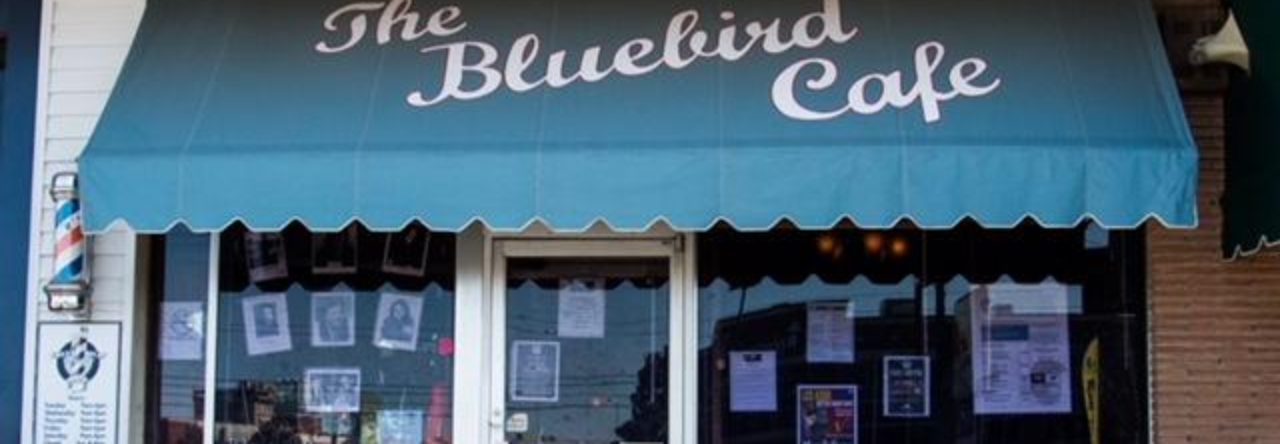
“Bluebird” Is SXSW Documentary about Nashville’s Bluebird Cafe Launching Pad to Songwriting Stardom

Director Brian Loschiavo of “Bluebird.” (Photo by Connie Wilson).

“Bluebird” premiered at SXSW on Thursday, March 14th, with Director Brian Loschiavo and many of the crew in attendance, including the now-retired owner of the 1,000 foot café in Nashville on 16th Avenue, Amy Kurland. Director Brian Loschiavo, a Philadelphia film school graduate, spent 10 years in Los Angeles as a freelance screenwriter and Senior Producer with Disney, ABC, and other TV networks, until signing up to be involved in the show “Nashville,” which made him into a believer. He moved to Nashville permanently and was soon tapped to film this documentary about the Bluebird Café.

The Bluebird is a small café in Music City that helps provide a place for songwriters to perform their songs and has launched the careers of megastars like Garth Brooks, Taylor Swift and Faith Hill. Other well-known names (Trisha Yearwood, Maren Morris, Vince Gill, Jason Isabell, Steve Earle, Connie Britton, Charles Esten) appear, but the magic of the place is that the unknowns behind famous songs—those who actually wrote the words and lyrics—have a place where they can perform and become known for their talent.

Amy Kurland, founder with daughter Barbara of the Bluebird Cafe in Nashville, at SXSW. (Photo by Connie Wilson).

As Thom Schayler called it, “The Bluebird is a place to come and be found.” Owner and founder Amy Kurland, with her daughter Barbara, did not originally intend for the Bluebird to be a music venue. It opened in 1982, not in mid-town, not in downtown, but in a strip mall next to a beauty shop and a dry cleaners, featuring all kinds of music.

Owner Amy described it, originally, as “A place for women to come to eat after they had their hair done. Minnie Pearl came to eat at the Bluebirt after she had her hair done.” She added, “When we first opened, it was all kinds of music,” and shared that they would sometimes put on the Talking Heads at max volume to drive out those lingering over a late lunch.

Said Amy, “The goal was to hear not a star, but a great songwriter.” Over time, the proscenium stage gave way to playing in the round in the center of the small room. Thom Schuyler described it as “The most fun I ever had with my clothes on.”

Brian Loschiavo of “Bluebird.” (Photo by Connie Wilson).

Snippets of the greatest Nashville songwriters of the day are heard, performed in some cases by the artists who made them famous, but more often by the songwriters who initially poured their heart and soul into the song to create the piece. Over the years, the Bluebird became known as a place to give aspiring songwriters a chance. Said one veteran: “They nurture the songwriter as an artist. I learned in that room that being a songwriter is a legitimate job.  Sometimes the performance by the writer of the song is more intimate than the famous version.”

With Open Mike on Monday nights, 60 singer/songwriters audition on Sunday night. Garth Brooks was one such aspiring singer/songwriter who had been turned down by every major label but was discovered by someone in the audience at the Bluebird. Taylor Swift was another who joined forces with her manager in that space, as he was just starting out with his own label and she was an 8th grade songwriter from Pennsylvania. (*Full disclosure: my daughter, a music business graduate of Belmont in Nashville, worked for Taylor Swift for 2 years.)

After the screening, talent producer Shawna Strasberg, who had to line up all the famous folk to appear, said that it “took six months to a year to figure out Taylor Swift’s schedule.” She added that most artists said yes “because it was the Bluebird.”

Props were also given to the elaborate set recreating the interior of the Bluebird, built for the TV show “Nashville,” which has popularized the place. The goal was to make you feel like you were in the room. Previously, as one cameraman said, “The opening scene was shot under a table, through someone’s legs with a handheld camera the whole time. It’s a challenge to shoot music.”

Founder and former owner Amy Kurland, who was present the night of the premiere, described herself as someone who grew up on Broadway musicals. She was so dedicated to having the Bluebird remain a place for up-and-coming songwriters to potentially get their shot that she signed over the café to the NSAI Nashville Music Association to make sure that it remains a launching pad for talent now that she has retired.

She looked back over her time since 1982 and said, “Those first few years I knew we were legitimate when Don Everley agreed to come play there.” Given a standing ovation by the appreciative crowd, Amy said, “I didn’t take a salary for a long time. If you’re in it to make a killing, I’d have been better off with a sports bar” to laughter.

It was the success of the TV show “Nashville” that took the struggling café from break-even to money-maker. Now, large crowds gather outside and, while approximately one-third of the café’s revenue comes from merchandise sold, there are routinely 200 to 300 people in the parking lot seeking entry to the small 90-seat venue. (A $25 cover charge is mentioned by the doorman at one point.)

“Bluebird” musicians close out the March 15th World Premiere showing at the Paramount Theater at SXSW. (Photo by Connie Wilson).

Director Brian Loschiavo acknowledged during the Q&A that “The hardest decision, hands down and a great challenge, was that we had to be stewards of the story.  A lot of cutting room stuff we had to lose.” With former owner Amy Kurland smiling and saying, “I really didn’t expect it to be so lively. I’m so grateful” a six-piece band onstage serenaded us as we departed.

Truly a heart-warming, entertaining, and informative film—especially if you dream of becoming a songwriter and wonder how to go about getting your big break in Music City (Nashville).

“Sunset Over Mulholland Drive” @ SXSW Proves You’re Never Too Old to Be Creative

“Sunset Over Mulholland Drive” is a behind-the-scenes look into the Motion Picture and Television Relief Fund’s Hollywood retirement home and grounds. The piece was a German entry into the documentary spotlight at SXSW, directed by Uli Gaulke with writing assistance from Marc Pitzke. It was produced by Helge Albers. When I failed to gain entrance to “Us” (Express passes at SXSW went in 9 seconds!) this 97-minute documentary having its North American Premiere here was Plan B.

A look at the retirement community that is home to many of Hollywood’s former leading men and women sounded like it would be right up my alley. Director Gaulke admitted, in the Q&A after the film, that he was thinking about himself when he decided to make the film after he read an article about the motion picture retirement community in California. And now the documentary has had its North American premiere at SXSW. He had hit a bad patch, endured a divorce, and he was hitting mid-life.

The odd thing about the entire project is that it was made by Germans. (What’s up with that?) Uli read the article, contacted the home and, roughly 4 years and 70 to 80 hours of material later, after shooting for a year with 6 people traveling between Berlin and Hollywood,  it premiered here at SXSW. The film inspired the director who said, “They were very open to telling me their stories.  Then I found Jerry (Selby Kaufman), my favorite…They were not only thinking of their own past, but the most important part was to follow them and to see that they can be creative when they are old.”

[Whew! THAT was a load off my mind!]

(L to R) Producer Helge Albers and Director Uli Gaulke of “Sunset Over Mulholland Drive” at the North American Premiere in Austin, Texas at SXSW. (Photo by Connie Wilson).

The Q&A after the film was delightful because, besides speaking excellent English, Uli would punctuate his remarks at key points with a “Ya?” that was reminiscent  of “Fargo.”

Uli said, “I always learn something. For me, personally, in my mid forties and fifties, I was glad to learn that life becomes a little more interesting, but that it is a continuation and that stamina is the key.” He added, “The challenge was getting them (the residents) to be working together and that was where the UCLA scriptwriting class helped.”

This reference was to a creative writing class that asked the residents to think of Ilsa and Rick from “Casablanca” and what they might be like if they met again twenty years in the future. This brought out a veritable plethora of ideas from the creative community. We also see the residents shooting a short film directed by Jerry (a former director) that is called “Santa for All Seasons,” where Santa’s close friends and wife and co-workers talk about him frankly.

One of my very favorite anecdotes in the film was provided by Joe Rosen, who became an apprentice film editor in 1957. He had a meeting with then-studio head Jack Warner and, during the course of their conversation, the subject turned to which actor should play a serious part then up for casting. Although Jason Robards was available, Jack Warner wanted to cast Troy Donahue, instead, causing Joe to say, “You have to be incompetent to make a statement like that!”

Joe Rosen was subsequently banned from the studio grounds.

(R) Director Uli Gaulke of Berlin, Germany, at the North American Premiere of “Sunset Over Mulholland Drive” at SXSW. (Photo by Connie Wilson).

We hear Wright King, now 94, telling us that he had wanted to be an actor since the age of 6 and that he once looked at Vivian Leigh onscreen in “Gone with the Wind” and said, “Some day I’m gonna’ kiss her onscreen.” And he did, in “On the Waterfront,” which we see in a brief film clip.

There is the charming older couple (married 62 years), Joel and Deborah Rogosin. Deborah is legally blind and Joel is obviously devoted to her, but he talks non-stop and she largely ignores him. One of the most touching moments in the film is when Joel sings “Always” to his bride: “Days may not be fair always. But I’ll be loving you always. Not for just an hour. Not for just a day. Not for just a year, but always.”

Joel finishes up that lovely serenade by saying, “I forget.  Did you use the word ‘obey’ in our marriage ceremony?”  Deborah responds that she most certainly did not, and Joel says, “Well, that accounts for it!” A gifted writer, Joel and Deborah have been working on a book together for most of their 62 years of marriage, entitled “How to Stay Married Without Killing Each Other.” They bicker over the title and the contents of each chapter. At one point, as they remember a long-ago romantic dance in the rain when they were young, Joel writes: “I wish that special glistening rain would fall and make us young and beautiful again.”

The entire documentary was delightful and charming. In retrospect, I’m glad I saw it instead of “Us,” (which opens wide soon.)

I highly recommend this stroll down memory lane in “Sunset Over Mulholland Drive.”

Celebrities Hit the Red Carpet for “The Beach Bum” at SXSW in Austin, TX

Isla Fisher at the premiere of “The Beach Bum” at SXSW. (Photo by Connie Wilson).

Jimmy Buffett at the premiere of “The Beach Bum” in Austin, Texas, at SXSW. (Photo by Connie Wilson).

Star of “The Beach Bum” Matthew McConaughey with wife Camille and his mother on the Red Carpet at SXSW. (Photo by Connie Wilson).

Jimmy Buffett and Martin Lawrence at the Red Carpet for “The Beach Bum” at SXSW. (Photo by Connie Wilson).

Harmony Korine, Director of “The Beach Bum” on the Red Carpet at SXSW. (Photo by Connie Wilson).

While the flow of movie stars to SXSW continues, the Red Carpet opportunities seem fewer than in previous years.

Nevertheless, there have been some names showing up and here are a few of the celebrities who walked the red carpet for “The Beach Bum.”

Much of the action this year seems to be in the Convention Center for panels involving politicians who all seem to have a goal of running for President in 2020.

Here’s a rogue’s gallery of a few famous faces that have appeared for films like “The Beach Bum” (Matthew McConaughey, Jimmy Buffett, Martin Lawrence).

And then there was Scott Rogowsky for H.Q. trivia “live,” for the first-time ever.  Camp Sandy in the Hill Country pitched us with a free Uber ride, a free Turtle Car Wax if you drove your own car, and Music in the Van. (I went out to Camp Sandy for Low Cut Connie and Wyclef Jean, but the other Connie had lost his voice singing outside in the rain. He performs again for free on Friday night outside in downtown  Austin.)

“For Sama,” Named Best Feature Documentary at SXSW: Behind the Scenes of the Siege in Syria


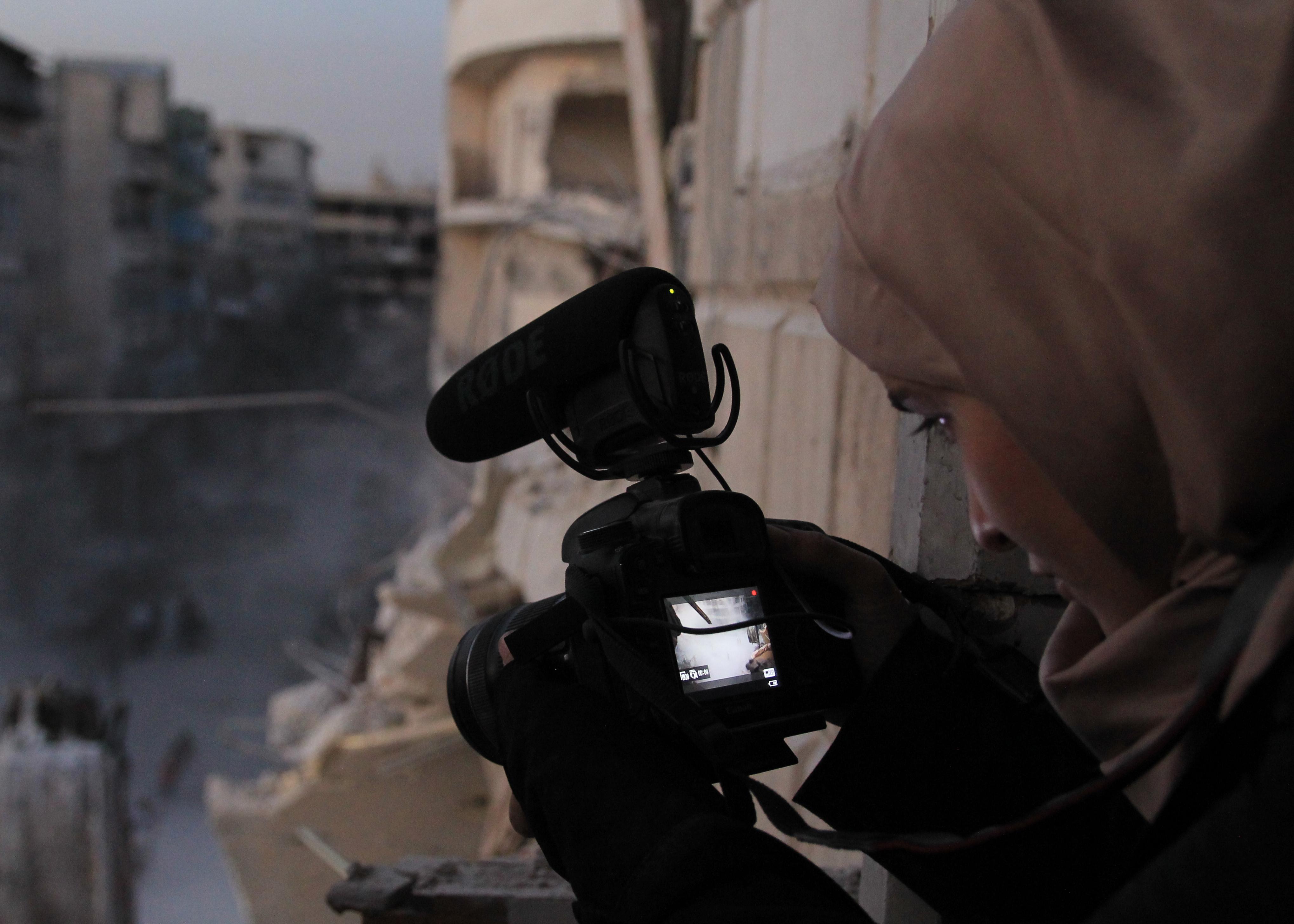
https://images.sxsw.com/OmkWk_NPatsx2ymZWMOMnGzSbME=/878x0:4955x2912/images.sxsw.com/57/e1a26cc7-d574-4707-8f13-52848b9384e8/under-a-falling-sky-142452 Photo of Waad al-Kateab, documenting the violence in Aleppo, Syria (SXSW Press Still)

“For Sama,” Waad al-Kateab and Edward Watts’ searing documentary about the Syrian crisis, was named Best Documentary Feature at SXSW on March 12th. Said the judges, “This extraordinary and harrowing documentary captures an epic personal story of a mother’s love for her daughter and a wife’s love for her husband through the lens of the bloody and brutal siege of Aleppo.”

Waad al-Kateab stayed in Aleppo, where she had been a student in the fourth year of an economics degree at the university. When the rebellion against Assad’s corrupt regime broke out—much of it initially fomented by university rebels—the protesters were hopeful. Waad al-Kateab, a photo-journalist who continued filming for the duration, said, “To try to live a normal life in this place is to stand against the regime.”

Waad al-Kateab’s husband, Dr. Hamza el-Koteab, was one of only 32 physicians who chose to stay in the besieged city to care for the remaining residents; it is clear Aleppo’s remaining residents feel abandoned by the world. “We’re crying out to the world: Help us! ..But no one does anything to stop the regime.”

During the time that Waad al-Kateab spent in Aleppo  across a 5-year span and during 6 months of constant bombing, she and Hamza fell in love, got married, and had their first child, Sama. The film is entitled “For Sama,” their daughter, because Waad wanted to let her daughter know what they were fighting for in staying behind long after others had fled. As Waad says, “Our new life with you felt so fragile…as fragile as our life in Aleppo.”

The family eventually ends up actually living in the hospital, but the hospital is constantly being bombed by the Assad regime with Russian air support. At one point,  8 of 9 hospitals in East Aleppo have been destroyed; Hamza’s is the only one left, seeing 300 patients a day. Waad al-Kateab and Hamza had one hospital bombed while they were out of the facility, which killed 53 people, including the doctor who delivered Waad’s daughter.

There are many heart-rending scenes of adults and children being brought to the make-shift hospital only to die there or be declared DOA. There are dead bodies literally everywhere within the hospital;  one of the most ghastly scenes is of the victims of a mass execution, all of whom were civilians but showed signs of torture and had been shot in the head. Their bodies—at least 30 corpses— laid out in the street as a warning. The burial pit that forms their mass grave instantly summons memories of Nazi Germany. The scenes of the hospital being bombed evoke the “Sixty Minutes” segment that visited Aleppo hospitals  while they were under fire. One heart-warming but tragic moment is of the emergency C-section of a 9-months pregnant woman. Her child is saved, with difficulty; the mother is beyond help.

Ultimately, after 6 months under siege (December, 2016) the United Nations calls Dr. Hamza, who has become a voice for the Syrian people and whose face has become known to the world saying, “If you surrender, they will spare your lives.” The couple faces a harrowing decision regarding their small daughter. The  thought is this: She has a better chance of making it if they (the authorities) don’t know that you are her parents.

Waad al-Kateab cannot leave her daughter behind, however. The couple and their neighbors, who have three children, attempt the perilous journey out of Aleppo and into exile. As they drive, sharp shooters shoot at the ambulance. Waad says, “The silence makes you feel the city is dead.” Each check-point is dangerous. Will they all make it out alive?

The bombed ruins of a once-beautiful city confirm the diagnosis that the city, along with many of its inhabitants, is dead. Waad’s husband, Dr. Hamza says that in 20 days they saw 6,000 patients and performed 890 operations.

This is a must-see story of survival under siege from directors Waad al-Kateab and Edward Watts which had its World Premiere (financing by the UK) at SXSW. Hopefully, it will air soon on PBS.

Beto O’Rourke HBO Documentary “Running with Beto” World Premiere on March 9, 2019, at SXSW: Crowd Wants to Know: Is He Running for President in 2020?

(L to R) Amy, Molly and Beto O’Rourke on March 9, 2019, in Austin, Texas at the World Premiere of HBO documentary “Running with Beto.” (Photo by Connie Wilson).

Beto O’Rourke (Photo by Connie Wilson).

“Running with Beto,” the HBO documentary that will air on HBO in early spring (May 28 release date), was screened at a World Premiere at the Paramount Theater in Austin this morning (March 9 at 11:30 a.m.) and a rapt crowd of supporters got to see Beto O’Rourke, his wife Amy, and their daughter Molly (as well as all those associated with the film) up-close-and-personal during a Q&A after the film.

I was seated in the third row on the right for “Running with Beto” when a large group of people began ascending the stairs that lead to stage right. The tallest of the group, hunched over so as not to block the credits then running, was Beto O’Rourke, who managed a small wave to those of us who noticed his entrance with family and campaign workers and Director David Modigliani.

All spoke to us after the film. Director David Modigliani described his goal as “wanting to capture a moment in Texas where there’s a real political re-awakening going on. It’s never too late or too early to get involved in politics.”

The crowd outside the Paramount Theater in Austin, Texas, at SXSW, waiting for the World Premiere of “Running with Beto,” an upcoming HBO documentary, on March 9, 2019 at 11:00 a.m. (Photo by Connie Wilson).

Modigliani had creative control of the film, however, saying that the 700 hours of footage they shot in nearly final draft format was cleared as his project (others wanted the job, as well) with Beto over lunch in Austin.  Beto protested, “I didn’t realize it would be THIS involved. I am very Begrateful that you did this with us.  The audience was probably wondering why Shannon Gay wasn’t the candidate.”

Shannon Gay was a particularly feisty blonde worker on the campaign (and in the film) who fought for Beto’s win to promote veterans (among other issues). She was seen crawling around on her roof to tack down a large campaign sign in a prominent spot. When asked what her reaction was to being onstage this day,  Shannon’s response was typically Shannon: “I wish I had a vodka IV,” (which got a laugh). She is shown in the documentary saying “Tough as Texas, my ass” (an allusion to Ted Cruz’s campaign slogan) and “I want so desperately to hear Beto tell Ted Cruz ‘pack your shit and get the Hell out of Dodge.’” Easy to see why Shannon’s outspoken advocacy will catch your eyes—and ears.

(L to R) Wife Amy, daughter Molly and Beto O’Rourke onstage in Austin, Texas, on March 9, 2019. (Photo by Connie Wilson).

When Amy O’Rourke (Beto’s wife) was asked her reaction to the rough draft that “David was kind enough to show us in advance,” she said her reaction was that it was “Very powerful. We knew this was their (HBO’s) film and we trusted him (Modigliani) at every turn.” She also added, to the crowd’s amusement, “The only thing I asked was ‘Could you take out some of the expletives?’” The film was separate from the campaign. It was being edited up until six months before the election.

In an Austin “American-Statesman” article that ran the day of the World Premiere (March 9th) Modigliani said, “The film is about people responding to crisis in democracy and allowing themselves to be vulnerable and allowing themselves to participate in politics in a new way.”

David Modigliani, Writer/Director of “Running with Beto.” (Photo by Connie Wilson).

Modigliani went on to say, “I felt it was brave of Beto to give us the access that he did. There is real conflict and tension and there are moments where he doesn’t always come off as a prince. It just shows the realities of the stress on the campaign trail, the realities of stress and tension within the family.  It has a realness that we were able to capture because of the access we were afforded. They were committed to running a no-BS campaign and we wanted to make a real no-BS film that captured that experience.” Modigliani, a Massachusetts native who is a graduate of the Michener Center for Writers at the University of Texas (and the director of the 2008 documentary “Crawford,” about George W. Bush’s effect on that small Texas town) added from the stage during the Q&A his suspicion going in that Beto’s campaign was going to be interesting, that O’Rourke was a total long shot, and that he was unlikely to win.

However, said, Modigliani, “I felt like there was going to be a national conversation that was going to run through the middle of this race.”

O’Rourke was asked point blank, from the audience (in the Q&A following the show), if he was going to run for President. He bobbed and weaved on that one. You can sign up to be one of the first to find out at info@betoorourke.com. [Sounds like a yes, to me.]

When the turnout in Harris County in Texas increased from 26,000 to 60,172 in the last election cycle, you know something is happening at the grass roots level. The possible candidate, onstage after the film, said, “Thank you to everyone who allowed themselves to hope and to dream.  I am grateful. I was like, what can we talk about up here that will not make me cry.” (laughter) He added, commenting on the many candidates who subsequently drew inspiration from his unsuccessful attempt (and have begun campaigns of their own) that he visited every one of Texas’ 254 counties. The O’Rourke campaign brought the Democratic party alive in Texas like it had not been in over 25 years. Said Beto,“Turn hope into action.”

Texas Film Awards Held on March 7, 2019, with Stars in Attendance

Director Richard Linklater (“Dazed & Confused,” “Boyhood”) at the Texas Film Hall of Fame Awards on March 7, 2019 in Austin, Texas. (Photo by Connie Wilson).

The Austin Film Society was founded in 1985 by filmmaker Richard Linklater (“Dazed & Confused,” “Before Sunrise,” “Boyhood”). Its mission is to empower the community to make, watch and love creative media while shining the national spotlight on Texas filmmakers. The Texas Film Awards followed.

The Texas Hall of Fame awards were founded  by Evan Smith and Louis Black in 2001 and the award is given to those who have made a significant contribution to the advancement of the Texas film and creative media industry.

Now in its 19th year, the Texas Film Awards bring together legends of cinema and television and inducts industry icons into the Texas Film Hall of Fame. Proceeds from the evening benefit the artistic and educational programs of the Austin Film Society, a 501c3 nonprofit.

(L to R) David Herman, Gary Cole, Mike Judge and Richard Linklater at the Texas Film Hall of Fame Awards on March 7, 2019. (Photo by Connie Wilson).

The Texas Film Awards brought out a star-studded crowd, which included many of the cast of “Office Space,” who reunited on the 20th anniversary of that 1999 cult classic. Present from “Office Space” were David Herman (Michael Bolton in the film), Gary Cole (Bill Lumbergh) and Writer/Director Mike Judge (“Beavis & Butthead”).

Also an honoree was John Lee Hancock, the writer director who guided “The Blind Side” film about a black football player nurtured, in the film, by Sandra Bullock’s character, a role for which Ms. Bullock won an Oscar as Best Actress in 2010.

(Below) Oscar-winner Kathy Bates.

Present to cheer on the honorees (including actress Brooklyn Decker, Writer/Directors John Lee Hancock and Mike Judge, Actors Gary Cole and David Herman) were Oscar-winner Kathy Bates (“Misery,” “American Horror Story”), Marc Maron (“Glow”), and Brooklyn Decker and June Diane Raphael, who play the daughters of                                                                                        Jane Fonda on the TV series “Grace &                                                                                    Frankie.”

Director Richard Linklater (“Boyhood,” “Dazed & Confused”) with his 14-year-old twin daughters at the Texas Film Hall of Fame Awards on March 7, 2019. (Photo by Connie Wilson).

Austin Film Society set for the dinner and awards ceremony on Thursday, March 7, 2019 in Austin, Texas.

Richard Linklater (referenced as “Rick” by the locals) was accompanied by his 14-year-old twin daughters and many volunteers and donors to the Austin Film Society were in attendance at a dinner party and an awards ceremony held at the AFS Cinema on I35 North of Austin, Texas.


Page 13 of 14

Powered by WordPress & Theme by Anders Norén