Welcome to WeeklyWilson.com, where author/film critic Connie (Corcoran) Wilson avoids totally losing her marbles in semi-retirement by writing about film (see the Chicago Film Festival reviews and SXSW), politics and books----her own books and those of other people. You'll also find her diverging frequently to share humorous (or not-so-humorous) anecdotes and concerns. Try it! You'll like it!

Category: Reviews Page 62 of 73

“The Next Big Thing” Connects Writers & Answers the Question: What Are You Writing Now?

I was invited by fellow author and HWA and ITW member Brian Pinkerton to participate in this blog Q&A about the new book (or books) we are working on.

I am supposed to link to 5 other authors.

Yesterday, I took part in a Southpark Mall (Moline, IL) signing with 15 authors present, and I distributed the directions to many of the authors present. None took me up on it, but I’m waiting for Cathy Scott to get back to me. Aside from Cathy, who does not live in this remote area on the border of Iowa and Illinois, and possibly Cathy Mitchell (who lives in Canada), I spent a fair amount of time explaining what a Virtual Tour was to three of the authors present, so it is perhaps not too surprising that nobody jumped at my offer to participate in The Next Big Thing.

So, far, I have ZERO authors to link to, but I would like to give credit to Brian Pinkerton, whose novel “Rough Cut” is truly good(yes, I have read it, and I liked it), and whose new one (which he writes about on the Goodreads blog below) is, no doubt, equally good.

Here is a link to Brian’s post:

http://www.goodreads.com/author_blog_posts/3330032-tag-i-m-it

And author Cathy Scott will be posting on this blog the first week in December: http://www.womenincrimeink.com/

Question 1: What is the working title of your book?

The working title of the second book in a 4-book series is “Red Is for Rage.” The first book, “The Color of Evil,” came out in paperback in March and is the winner of an E-book Award from Jenkins group, as well as a Silver Feather from IWPA (Illinois Women’s Press Association). The second book in the series is “Red Is for Rage.” There will be two more books, the way I have it currently planned.

Question 2: Where did the idea for your book come from?

The basic story premise of a small boy with the power to see “auras” around others that tell him whether someone is good or evil was contained within a short story in my first “Hellfire & Damnation” collection, which won an ALMA (American Literary Merit Award) award. Tad McGreevy can see colors around others and, at night, he has nightmares in which he vividly relives the crimes of the evil-doers. However, he has no way to harness this power and it is not necessarily “predictive,” as he doesn’t know if the crimes are happening now, about to happen, or have already occurred in the past. The original story title was “Puffer-Fish.” That was changed to “Living in Hell” when I used the story within the first of my “Hellfire & Damnation” (www.HellfireAndDamnationTheBook.com) series. I felt guilty at leaving Tad in a bad place, so I decided to jump him forward 8 years from his 8th birthday party ( he is completely recovered and is a junior in high school) and give him a fighting chance to survive in this battle of Good versus Evil.

Question 3: What genre does your book fall under?

My book is variously classified as dark suspense, thriller or horror. I prefer dark suspense. It is a YA (Young Adult) novel aimed at older teenagers who are at least juniors in high school or older and on into the early twenties. It is currently “recommended” on a preliminary ballot in the YA Novel category for the Bram Stoker (R) which means nothing, since there are many others similarly “recced.” Still, it is nice to know that someone liked the book, and I was interviewed by Cyrus A Webb for his radio show, indicating he had read (and enjoyed) the book. I am currently a member of both ITW (International Thriller Writers) and HWA (Horror Writers Assocation).

Question 4: What actors would you choose to play your characters in a movie rendition?

I would let the casting directors find fresh, young new talent. This is a novel about high school-aged protagonists and I’m sure there are plenty of new Megan Foxes and Tara Reids just dying to play a role like Tad McGreevy (the hero), or Jenny SanGiovanni (his blonde crush) or Stevie Scranton (a role not unlike Stifler in “American Pie”).

First proposed cover, some of which has been cut off…no idea why.

Question 5: What is the one-sentence synopsis of your book?

“Carrie” meets television’s “The Medium” meets “The Fury.”

Question 6: Will your book be self-published or represented by an agency?

I am represented by AAA Agency (Nancy Rosenfeld) of Chicago, but the last book I self-published after a major house sat on it for ONE FULL YEAR, so I’m inclined to self-publish the sequel, as well. I’ve already contracted for the cover art, and I’d really like readers to let me know which of the two covers I picture here is “best.” Write me back and let me know which one you prefer. Both are by Paula Phanback, who is working with me on the covers for the remaining books in the series.

Question 7: How long did it take you to write the first draft of your manuscript?
It took me about a year to write “The Color of Evil” and I’m 15,000 words from being “done” with “Red Is for Rage.” Since the best output I can hope for is 4,000 words a day, I have to finish “Ri4R” before we get on a plane and fly to Sydney to visit our daughter in Australia and New Zealand. That is January 12th, so the second book will be done in a year, also, and out in early 2013 (some time in Jan/Feb./March). The Beta readers are poised and my editor is standing by.

Question 8: What other books would you compare this story to within your genre?

I can only report that reviewers have compared my writing to Philip K. Dick, Stephen King and Dean Koontz. I am trying to write the way I write, and to do the best job I can do, after teaching writing for 33 years, so I’m just trying to be the best “me” I can be. (Which sounds like an Army recruitment slogan!). I do not have any other book I can point to that reminds me of this, except, as mentioned, the “Carrie,” “The Fury” type plots of early King.

This is Proposed Cover #2. Let me know which you prefer. I am not sure why it is cutting off some of the cover (the part with my name, mainly) but if it is just losing my name, it is a small loss.)

\Question 9: Who or what inspired you to write this book?

I taught writing for 33 years at various colleges and at the junior high school level, and I started writing for my hometown newspaper (the Independence Bulletin Journal & Conservative) at the age of ten. I am very familiar with students this age and with the area in which the book is set (Cedar Falls, Iowa and towns nearby) plus I interviewed Sam Amirante (John Wayne Gacy’s attorney) for various quirks of serial killer John Wayne Gacy’s speech, since there is a Killer Clown in the story that Tad inadvertently meets on the occasion of his 8th birthday party.
I’ve also had 5 students on Illinois’ Death Row at the same time, so I have a pretty good feeling for the less desirable students and how they might act and think. Plus, I grew up in a small town in Iowa that housed the largest mental institute in the state (Independence Mental Health Institute).

Someone once said to me, upon learning this, “You were just born to write this stuff, weren’t you?” I laughed, and then I thought about it and answered, “I guess so.”

Question 10: What else about your book might pique the reader’s interest?

If what I’ve written above doesn’t pique your interest and you aren’t interested after visiting www.TheColorOfEvil.com, you probably aren’t my audience, but keep reading. There are other writers I may be linking to who write completely different things. And please be advised that THE COLOR OF EVIL will be FREE as a Kindle download on Amazon on December 10, 11, 12, 13 and 14.

I should also add that my writing does not dwell on gore for the sake of gore. It is more psychological horror, a la Hitchcock, with “Sixth Sense” endings something I strive for in short stories. You might wish to try reading the 99 cent short story “The Bureau” online (e-book) or the collection of short stories just out, “Hellfire & Damnation II,” which has received good reviews, if you’re not willing to commit to the long haul with Tad McGreevy and friends in 4 novels. There’s also a lot in the book about tetrachromacy, whcih I will not attempt to explain here, but let’s just say it’s something that has just been discovered and was fascinating to me when I learned about it.

“Cloud Atlas:” Read What the Directors Had to Say About It

The trans-gender Lana (previously Larry) Wachowski pictured on the Red Carpet with Chicago Film Festival founder and director Michael Kutza on October 16th, 2012.

The Brothers Wachowski— (who are now brother and sister, as the 47-year-old Larry has become Lana)—allied with Director/Composer Tom Tykwer (“Run, Lola, Run”) and friends since 1999 when “The Matrix” and “Run, Lola, Run” came out, visited the Chicago Film Festival to screen the festival’s centerpiece film, “Cloud Atlas.” The movie opens wide on October 26, 2012.

Tom Hanks (wearing what looked like a woman’s shawl) and Halle Berry in “Cloud Atlas.”

A sweeping tale based on an equally ambitious 2004 book by David Mitchell, the movie has attracted critical praise tempered with some criticism of its execution. Executing it at all required the trio to travel to Costa Rica and lay out index cards on the floor, in an attempt to reconfigure the way the novel is written.

When Mitchell wrote the sweeping epic, it was puzzle-like. It takes 6 interwoven storylines and spans 500 years and several genres. The novel recounts the 6 interrelated story lines chronologically until the middle of the book. In the middle of the book, the sequence reverses.

Lana Wachowski makes a point during the Q&A that followed the screening of “Cloud Atlas.” (Oct. 16, 2012).

Lana Wachowski read the book and felt it would be a good project for the 3 filmmakers who had been looking for a joint project. Ultimately, filming took place in Germany, Scotland and the Spanish island of Majorca, beginning in September 2011.

Among the pluses for the film: its stellar cast, which includes Tom Hanks, Halle Berry, Hugh Grant, and Korean star Doona Bae playing multiple roles. The minuses? Cohesion of the story line and financing. As Andy Wachowski told the Chicago “Tribune” in an October 14th interview, “People were blown away by the concept and blown away by the cast, but they wouldn’t give us any money.” Ultimately, the directors had to ante up 10% of the $102 million-dollar budget.

Brother and sister Lana (47) and Andy (44) Wachowski appear during the Q&A after “Cloud Atlas.”

The division of labor for the interwoven story lines broke down to Tykwer directing the early 20th century composer plot line, the 1973 thriller, and the contemporary caper about an aging book publisher, which provides the comic relief in the film. (When the elderly gentleman, who is intent on escaping from a nursing home his brother—played by Hugh Grant— has committed him to passes the window, he shouts, “Soylent Green is people!” from the Charlton Heston film; one of the many previous sci-fi films whose ideas are recycled, along with “Logan’s Run”.) The Wachowskis handled the 1849 sea story and two stories set in a futuristic world of 2144, which uses “Logan’s Run” Carousel concept of the doomed thinking they are going to their great reward, when they are really scheduled for death. The aerial shot of the look-alike Korean clones reminded of “Metropolis” cinematically.

The 6 story lines were:

1) Dr. Goose (Tom Hanks) administering medicine onboard ship to naïve traveler Adam Ewing (Jim Sturgess) in 1849 in the South Pacific. The slave trade flourishes at this time and a stowaway slave figures in the plot. Not my favorite of the plots

2) 1936 Scotland where Robert Frobisher (Ben Whishaw), a poor musician, reads Ewing’s journals from aboard ship while working for a noted composer. The “Cloud Atlas” composition that Frobisher composes (and the elderly composer attempts to steal) is quite lovely and was actually composed by Tom Tykwer and his regular musical collaborators, Johnny Klimek and Reinhold Heil. Among my favorites of the sub-plots.

3) Luisa Rey (Halle Berry) is a journalist investigating a nuclear reactor and becomes the object of an assassination attempt by Bill Smoke (Hugo Weaving). She hears “Cloud Atlas” in a record store in California in 1973. An interesting plot.

4) Timothy Cavendish (Jim Broadbent), a vanity publisher trying to escape the nursing home his brother (Hugh Grant) has consigned him to in 2012 Scotland. He is considering publishing Rey’s story. The film’s only humorous character.

5) Sonmi-451 (Doona Bae), a Korean clone who toils in Papa Song’s diner in 2144. She sees a TV movie on the life of Cavendish and, from there, goes on to become a revolutionary and, in the primitive island on which one version of Tom Hanks lives, worshipped as a Divine Being.

6) Meronym (Berry) and Zachry (Hanks) on an island in 4th century Hawaii where civilization is primitive, cannibals roam, and Sonmi is worshipped as a Goddess. Needs subtitles.

If comparisons to other films are made, among those mentioned is “Babel” by Alejandro Gonzalez Inarritu, which was critically acclaimed for its complicated storylines that intersect (Brad Pitt and Gwynneth Paltrow starred), but only earned $35 million in profits. Others might mention Daren Aronofsky’s “The Fountain,” which earned $10 million. On the positive side, Christopher Nolan’s “Inception” earned $292 million, so perhaps there is hope for the film to earn more than just plaudits. Another film I would compare this one to is “Magnolia,” that had seemingly random events contributing to plot developments and earned Tom Cruise an Oscar nomination. Others might include last year’s Terrance Malick film “Tree of Life” in the category “artistic films that took on big themes and tried to translate them to the big screen, with mixed results.” [While a critical success, the film was not a commercial success.] As the moderator of the Q&A put it, “An uncompromising work of artistic integrity.” (They probably also said that about “Holy Motors,” one of the worst films ever, but winner of some big awards.)

In the Q&A following the film, here is what the directors shared:

Q: What convinced you to put in 4 and ½ years making this film?

A: (from Lana) We wanted to spend time with one another, so it was actually fun! (She went on to say that the trio had been searching for a vehicle for the 3 of them since 1999). Andy Wachowski interrupted his sister with, “We wanted a movie that tested the most stalwart bladder.” (The film is 164 minutes long).

Added Lana: The book—there was something about it that took my breath away, that was so delicious, that we wanted to savor it. The book touched us because we kept trying to connect. This book speaks to the implied desire to connect and to speak to the future and to be in dialogue with the past…David Mitchell loves literary forms so much. He has this post-modern energy. There’s this way to love storytelling. He has energy and a narrative drive, but he is still trying to explore the human condition in a philosophical way. But you can also make it a thinking and entertaining movie. These don’t have to be separated. You don’t have to say, “This is a thinking movie; this is for people who don’t like to think.” As Lana Wachowski told Rebecca Keegan of the Chicago “Tribune” in the December 14, 2012 interview: “There was a time when movies were funny and sad and dramatic and slapsticky and challenging and thought-provoking all at the same time. That would be one movie. Now you break that all up into a comedy, a romance, and a drama. With ‘Cloud Atlas’ we were thinking: It could be everything.”

Tom Tykwer, the co-director said: We felt very attracted to it because there were a multitude of voices. It was an experiment. If we failed, then we failed. If we can write together, we feel we can do anything together. Identifying ways to get into the novel was a step-by-step process.

This led Lana Wachowski to describe the Costa Rica index card method, (with the cards on the floor.) She said, “We had to re-arrange the way the novel is written. The novel is in bigger chunks. It will have 60 pages with one character and then jump to another character. We felt that would not work in the movie.”

Andy Wachowski: “The whole process was this act of love for the book and our love for each other and that carried us all the way to the end.”

The moderator commented on the line from the film, “Isn’t an ocean a multitude of drops? “ He referenced the many acts of kindness in the film.

Lana: If something so horrific as the Second World War and the Holocaust can’t kill kindness, you will never kill kindness. Extend yourself. This idea is what has really propelled us. Still, as pessimistic as we can be, we don’t think of Pollyanna endings. You believe that there is someone that is going to be affected. It’s a great reason to believe in the future.

The first question from the audience was from a woman who had a good friend who underwent sex change surgery. She asked Lana Wachowski: “Is there a certain significance in your gender change affecting your artistic choices?”

Lana: “This is getting very personal right away.” She went on to say, “David Mitchell is not transgender. The novel is not about transgender identities. But we have always been interested in material that transcends convention. And I was probably the first one to say, ‘Hey! That male character can actually play this female role over here.’ (Which occurs when Hugh Grant plays a Nurse Ratched sort in a nursing home). I may have had an attraction to specifically transcending the idea of gender in this film.”

Q: How did you pick who directed what?

A: (Lana) “ In the deconstruction of the stories, the experience is not the same. During that time, your mind is making all these connections. We would find all this interconnectivity in the stories.”

(Andy) “Our feeling is we all directed it together. (Lana made a joking comment about the Directors’ Guild not being quite as flexible, at this point.) It was a four-year process. We shot it together. We wrote it together. We edited it together. We were only apart for 3 months.”

(Tom): “You’re playing a genetic stream, a string in the film.” (There is much talk of déjà vu and the idea of reincarnation would certainly play into the film’s themes.)

Q: Do you experience emotion watching your movie again?

A: (Lana) “It’s a P.R. situation. I would have been crying and my make-up would run.” (She pantomimed crying at the movie “Fried Green Tomatoes”). Lana digressed to point out the Wachowskis’ parents in the theater (the duo is from Chicago) and say, “We’d cut school and go to triple features.”

A: (Tom) “It’s considered to be embarrassing to still like your own movie. There are moments where I think, ‘That’s my—or our—influence.’ The last 1/3 of the film Doona Bae was so unbelievable in the last 20 minutes. There’s this weird way of being touched. I feel like we sort of set the stage. I can still watch it as though I’ve never done it. There were things that the actors offered to us that were really beyond our expectations. I’m still touched.”

Q: What was most daunting: making the book into a screenplay or making the screenplay into a movie?

A: (Lana) “Showing it to David Mitchell.”

A: (Andy) “Making the film was staggering. It was an independent film, with money coming in from all over the world.”

A: (Lana): “Four days before we were to start, another financier went under, and we all had to put up our own personal money. Ten percent of the contingency was our money.”

A: (Andy): “Four days in Halle Berry broke her foot.”

A: (Lana): “It was daunting, but we couldn’t NOT make the movie. It was such an act of love for the material and the actors. It was strangely joyful, even in the midst of everything falling apart.”

A: (Andy) “For every bad thing that happened, a good thing would happen.”

There was some discussion of how excited David Mitchell was to be involved in helping design the futuristic spaceships in the film’s futuristic sequence.

My take:

I enjoyed the film, but I also found it difficult to follow and often confusing. The weakest performances, overall, for me, were from Tom Hanks. His Dr. Goose played like broad farce, and his native on the island seemed to be wearing a woman’s knitted shawl. His gangster (Hanks unleashed the “F-bomb” on live TV on ABC while supposedly speaking in character) was unconvincing. The language created for Hanks and the island natives was also difficult to decipher without subtitles. (I did better with the movie from Iceland that had subtitles.)

The parts I enjoyed most seem to have been supervised by Tom Tykwer (“Run, Lola, Run”) whose “Cloud Atlas” music—so central to the plot— was lush and lovely. His portions of the story were, for me, the best. (I especially enjoyed the comic relief of the nursing home escape featuring Jim Broadbent).

Having said that, the sets and spaceships and futuristic touches that the Wachowski Brothers gave us in “The Matrix” (back when they were still two brothers) were matched here by the visual effects portraying clones in the year 2144 (Method Studios Visual Effects, Vancouver, B.C.)

It will be interesting to see if the film makes back its investment, but at least the Wachowskis —who have been notoriously loathe to promote films at festivals in the past—can now say that their film played the Chicago Film Festival, because they revealed during the Q&A that they submitted student films many years ago that didn’t make the cut.

“The Sessions” Screens at Chicago Film Festival with Helen Hunt in Attendance

I’m of the generation that remembers polio. My best friend’s mother died of polio when she was only 33 years old. Pam (my best friend) was just old enough—not even yet of school age— to remember seeing her mother for the last time, inside an iron lung.

Helen Hunt at the screening of “The Sessions” on October 20th in Chicago.

Pam and her older sister Sally peeked through the basement window of the hospital isolation area to see their mother imprisoned in the grim cylinder. It was the last time they would ever see their mother alive. We both remember that people were so afraid of the disease that, when funerals were held, food for the grieving family was often left on the porch step. Friends and neighbors were afraid to hand it to the survivors in person. Swimming pools closed, for fear of “catching” the disease.

I remember visiting Anne Marie, my twenty-something music teacher, who spent the rest of her life in an iron lung with a mirror-like attachment above it. The visits to her were awkward as the noisy metal cylinder filled the entire living room. As far as I knew, she rarely was removed from the metallic cylinder that pumped air into her lungs at 15 pounds per square inch. If a patient were committed to a nursing home for care, the average life expectancy was only 18 months. Patients like Mark O’Brien of this film, who were kept at home by their families, lived longer.

The above is by way of introduction to the film “The Sessions” about a real poet named Mark O’Brien who lived in an iron lung in Berkeley, California, until he died at age 49. The disease paralyzed him at the age of 34. The film is set in the year 1988. I remember thinking, “It has to be set at least 20 years ago, because the last time I saw an iron lung, it was in a museum.” (Right next to it in the 60’s display was my electric typewriter, which I was still using in my office to fill out forms.)

The plot of “The Sessions” focuses on Mark O’Brien’s (John Hawkes of “Winter’s Bone”) hiring a sex surrogate to have sex with him, and the sex surrogate is played by a very fit (and often nude) Helen Hunt, who appeared before the film to accept a Lifetime Achievement Award. Said Hunt, “I hope this is an award for the halfway point in a person’s career, and I will be very happy to leave this movie behind.”

Despite the nudity and frank sexual discussions, it is not a lascivious film. Far from it. It is a film that testifies to the will and endurance of the human spirit. “Today,” says Mark, “I ask if I’ve found a place among the rest.” Mark was able to leave his metal tomb for 3 to 4 hours a day. It was during those 3 to 4 hours that the married sex surrogate Cheryl Cohen Green (Helen Hunt) tried to turn Mark into “a made man” because, as he says, “I think I’m getting close to my ‘use by’ date.”

William Macy (looking much as he looks in his television series “Shameless”) plays a priest, Father Brendan, in whom Mark confides. When asked by the devout O’Brien, a church-attending Catholic, whether having sex out of marriage will be a sin, the priest says, “In my heart, I feel that He’ll give you a free pass on this one.”

Mark (Hawkes) explains to Cheryl (Hunt) that, “I’m not paralyzed, but my muscles don’t work so well.” In other words, he can feel and experience and maintain an erection, although, at first, with many instances of premature ejaculation, Mark says, “God wasn’t actually denying my sexuality. It was just as though He were pointing out how useless it is.” Deep down, Cheryl feels, Mark doesn’t feel he deserves sex. His sister Karen died young, at age 7. Mark feels that maybe it is his fault. His parents spent too much time taking care of him and his sister died. (Ah, good old Catholic guilt: the gift that keeps on giving!) He also says, “Maybe intercourse would prove I’m an adult.”

Mark is essentially “a dynamo voice in a paralyzed body,” as the script by Writer/Director Ben Lewin puts it. Despite what O’Brien referenced as “years of unendurable crap,” his poetry and writing (the movie was based on O’Brien’s article “On Seeing A Sex Surrogate”), including “Love Poem for No One in Particular” which is read at his funeral (“Let me touch you with my words, because my hands are empty gloves.”) are part of what made Mark O’Brien’s life journey so remarkable.

While the topic sounds grim, there are humorous moments. One comes when the paralyzed man and his therapist are in a rented motel room and Mark’s caregiver (played by Moon Bloodgood as Vera) is waiting in the lobby, chatting with the hotel clerk. He has asked her what the “guy on the gurney” was doing. Vera told him, honestly, that the guy on the gurney was seeing a sex therapist and they were now having sex. She adds, “Today, they’re working on simultaneous orgasm.” The male clerk (who has just asked Vera out on a date) says, “What’s that?”

Helen Hunt accepted a Silver Cleo Career Achievement Award from Chicago Film Festival founder Michael Kutza on October 20th, 2012, at the 48th annual Chicago Film Festival screening of “The Sessions.”

The acting by John Hawkes (“Winter’s Bone”) has been praised as Oscar-worthy. Helen Hunt’s performance is equally gutsy, especially since she appears in much of the film in the buff.

As a sex therapist with a husband (played by Adam Arkin) and a teenaged son, Cheryl does not continue to see patients beyond 6 visits. It is obvious that she is emotionally affected by Mark’s plight when they conclude their sessions, however, and she has dictated into her tape recorder that, “Mark has deeper emotional needs that are beyond the scope of my capability to help him.”

The film has a happy ending of sorts, involving Susan Fernbach, the volunteer Mark meets in the hospital 5 years before his death with whom he forges a relationship. Both women are thanked in the credits.

I stayed to find out where, in heaven’s name, did they FIND an iron lung in this day and age? The answer? Rancho Los Amigos National Rehabilitation Center. I’m so glad that iron lungs are nearly impossible to find in 2012 because the scourge of polio has been vanquished

Helen Hunt and John Hawkes in “The Sessions.”

. A film like this makes you grateful for the Salk vaccine and for the ability to enjoy life in good health.

VIRTUAL TOUR SCHEDULE for “Hellfire & Damnation II”

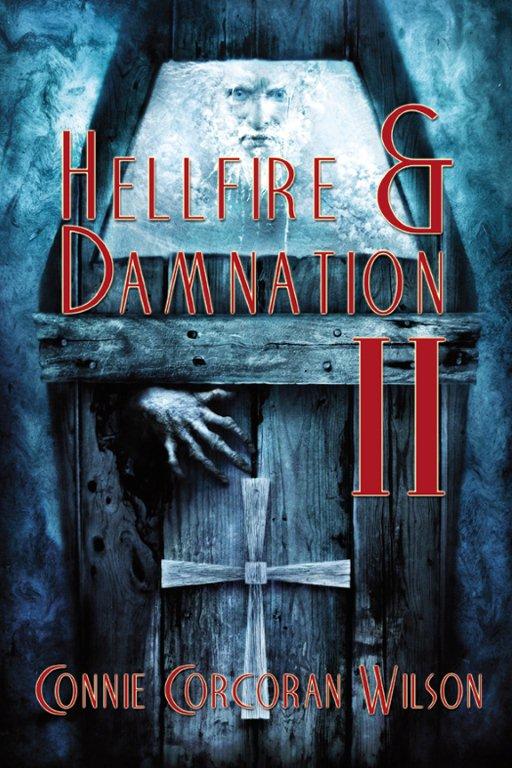
Hellfire & Damnation 2 Cover

“Hellfire & Damnation II” short story collection; cover art by Vincent Chong of the UK.

Hellfire and Damnation II Web Schedule

Little Black Marks Oct 11 Review
Little Black Marks Oct 12 Interview
The Wormhole Oct 12 Review
The Bookworm Oct 15 Review
Rhodes Review Oct 16 Review
J.A. Beard’s Unnecessary Musings Oct16 Interview
Joystory Oct 17 Review
Joystory Oct 18 Giveaway & Interview
Turning the Pages Oct 18 Review
Turning the Pages Oct 19 Interview
Over Cups of Coffee Oct 22 Review
Over Cups of Coffee Oct 23 Giveaway & Interview
Mom in Love with Fiction Oct 23 Review
Books & More Books Oct 24 Review & Giveaway
Celticlady’s Reviews Oct 25 Review
Em Sun Oct 25 Review
Peaceful Wishing Oct 26 Review
Butterfly-o-Meter Books Oct 26 Giveaway & Guest Post
Sweeps for Bloggers Oct 30 Review & Giveaway
Alexia’s Books and Such… Oct 31 Review

The tour has begun. Remember: “H&D II” will be FREE as an E-book on October 27, 28, 29, 30 and 31, 2012, as a Book Tour Launch. Please download it, so it moves higher on the list of Kindle offerings.

Here is what the 1st Tour Stop blogger had to say:

“I love scary books. Among the first adult books I ever read were Stephen King and Dean Koontz. However, these days I find it hard to find good scary books—ones that don’t make me feel like I’ve read this before–and then I was asked to read ‘Hellfire & Damnation II.’ Connie Corcoran Wilson takes us by the hand and leads us through the 9 Circles of Hell, whispering to us the tales of those we find there and the events that have led them to this nightmarish place. From the first story set in Limbo (“Cold Corpse Carnival”)—giving me yet another reason to not want to be bured—to the final circle of the treacherous and “The Bureau,” the reader will be checking behind doors, under the bed, and sleeping with the lights on.” (Bev at “The Wormhole”)

Second blog stop: Kylie at “Little Black Marks”: “To begin this short review of the book ‘Hellfire & Damnation II,’ I just to state that I have never before been so affected by the Introduction in a book. I was struck by the very first phrase and by the time I had finished reading the Introduction, there was absolutely NO way that I would not read this book. I actually went online and bought a copy of ‘Hellfire & Damnation’as I had not read Book #1 yet. The Introduction was so well written that I just knew the book would be even better.
I was not disappointed. This collection of short stories is fabulous. The writing is wonderful; the word selection, the pacing, the structure, everything just works. Her writing draws you in emotionally and you feel as if you are a part of it all. The charactrrs are first-rate in all of the stories. She mixes humor with the horror in just the right dosage.”

Check out the next tour stop on October 15th and remember to download a FREE Kindle copy in the 5 days leading up to Halloween.

Janesville, Wisconsin Documentary Plays Chicago Film Festival

Director Brad Lichtenstein talks about his documentary “As Janesville Goes” at the 48th Chicago Film Festival on Saturday, October 13, 2012.

The documentary “As Janesville Goes” by Director Brad Lichtenstein took a measured view of the demise of the Janesville GM plant, which, in closing in 2008, took down 7,000 good jobs in that city of 63,575 people. Eighty percent of the homes in one neighborhood were inhabited by General Motors workers, who made a good middle-class living with jobs that averaged $28 or $29 an hour.

With the closing of the plant by Detroit during the 2008 economic collapse, at least eleven thousand workers at the plant or related industries lost their jobs and only 750 employees were offered transfers to plants in Fort Wayne, Indiana or elsewhere. In 2005 there were 308 foreclosures in Janesville. By 2009, that number jumped to 487 with 1300 pending.

The film opens with the words of President Barack Obama: “The promise of Janesville has been the promise of America.” The film goes on from there to document Governor Scott Walker’s union-busting tactics, complete with the protesters bearing signs with messages like, “I never thought I’d miss Nixon” and “We will not go gently into that good night. Rage, rage against the dying of the light.”
The light, in this case, would be the gains won by unions over the years, which Walker and the Republican Tea Party members set out to destroy.

Director Brad Lichtenstein takes us into the lives of both veteran Democratic Senator Tim Cullen (24 years in office), one of the few legislators who seemed to make much sense and/or be willing to compromise, and that of workers and business people in the community. Of his fellow Republican legislators, Cullen said, “Every vote is 19 to 14. It’s sheer partisanship. There’s no interest in compromise. They’re not conservatives; they’re radicals.”

Among the workers profiled was Gayle Listenbee, a black single mother with 24 years of seniority at GM, who accepted employment in Fort Wayne, leaving her 18-year-old son behind and relatively unsupervised. When her son, D.J., an admirer of Detroit muscle cars, was involved in a serious car accident, Gayle blamed herself and was plagued by guilt over her decision to take the transfer. She was (also) initially fired by her new employers. However, her union representative, managed to get her reinstated, pointing out that she had never pulled against her sick leave in 24 prior years of employment.

Another African-American mother of two girls, aged 9 and 12, whose husband retired from G.M. on disability, took the transfer as well and is heard saying that her only hope is retirement or the lottery, and that she thinks winning the lottery is more likely than early retirement.

Cynthia Deegan, who had spent 11 years in the military and had worked for Frito-Lay prior to taking her General Motors job, has a health scare that almost drives her from the federally-financed retraining program, which eventually lands her a job at $10 or $11 an hour at a hospital, part-time, for a 20-hour week at Beloit Memorial Hospital. Cynthia says of her seemingly never-ending job search, “I didn’t think it’d be this hard to find a good job.”

Meanwhile, across town, we see the Republican moneyed CEOs and bankers trying to mount pitches for more jobs in Janesville (“Ambassadors of Optimism”) and welcoming Republican Governor Scott Walker (especially CEO Dianne Hendricks, whom Walker hugs while not affording her less slender female counterpart a similar warm welcome.) Hendricks would go on to make the single largest political contribution to Walker’s campaign ever made in the state: $510,000.)

We hear Scott Walker saying, “You have an ally in the Governor’s office,” but causing what is referenced as “a point of change” with his attacks on unions representing teachers, firefighters, and policemen. As a result of Walker’s budget cuts, 200 teachers are laid off. Walker’s
Budget Repair Bill is referred to as “a watershed moment.” (Hence the film’s title). When the president of the teachers’ union sits down to plead the case for education, he is told that he should just be grateful that Janesville isn’t Providence, Rhode Island because Providence lay off 2,800 teachers. The glee with which the Ambassadors of Optimism regard the low wages that prospective incoming businesses will be able to pay, cannot be concealed. Gone are the days of good salaries. As the film says, “We’re not an auto town any more.”

Time and time again we hear the “us against them” theme repeated. The phrase is used, “Who shall govern us: the people or the money?” in reference to the tremendous amount of money spent by the millionaire Koch brothers to keep Governor Walker in power. ($45.6 million by the Republican incumbent versus $20.8 on the Democratic side, in July, 2012).

At the end of the film, the City Council votes to give 20% of the city budget to a new business (Shine Medical Technology) which has no hope of returning on the investment prior to 2015.

“As Wisconsin goes,” so goes the nation.

Three Films from the 48th Chicago Film Festival

Three films I’ve seen since Opening Night: “Benji,” the story of the tragic death of Benjamin Wilson, a young black Chicago basketball player senselessly shot and killed. Very good documentary, which I will speak about at greater legngth later.

“The Sapphires:” An Australian film with a Killer Soundtrack and featuring Chris O’Dowd (“Bridesmaids”) as the manager of a Supremes-like group of Aborigine girls who tour Vietnam during the Vietnam War and battle racism at home. Great performers. Great music. Great film.

“Holy Motors:” a joint French and German film (with subtitles) that represents all that is bad and pretentious about art. Incoherent. Boring. OVerlong.

Opening Night of 48th Chicago Film Festival Features Film with Al Pacino, Christopher Walken, Alan Arkin, Julianna Margolies

Al Pacino at the 48th Chicago Film Festival, Thursday, Oct, 22th, 2012.

The Opening Night of the Chicago Film Festival—the oldest film festival in North America—was Thursday, October 11, at the Harris Theater, with Al Pacino, Christopher Walken, Alan Arkin and Chicago native and Director Fisher Stevens present. Also present onstage was Bon Jovi, who wrote two original songs for the film.

Appearing in the film, but not present on Opening Night, was Julianna Margulies, better-known for her roles on television’s “E.R.” and “The Good Wife.” Newcomers who graced the stage with the legends were Addison Timlin, (who played Alex, Walken’s granddaughter, in the film), and Vanessa Ferlito, (who plays a girl found nude in the trunk of a car.)

If I had to compare Pacino’s lead role here with his previous performances, I’d place it on a par with 2008’s “Righteous Kill,” where Pacino played Rooster, running around in track suits with an over-the-hill Robert DeNiro. If you want to talk previous comic roles (not Pacino’s forte) there is 1985’s “Revolution,” in which Pacino played Tom Dobb. Also not his finest hour.

The film was quite similar to the plot of last year’s opening night film, “The Last Rites of Joe May,” which co-starred Dennis Farina and Gary Cole. That film, even if it had less well-known stars, was better. Each film’s plot involves old guys getting out of prison (a la Michael Douglas in “Wall Street: Money Never Sleeps”) and wanting to get the old gang together one more time.

As scripted by first-time script writer Noah Haidle, there just wasn’t much to cheer for at this World Premiere. With actors as fine as Pacino, Margulies , Walken and Arkin, it could have been a good film, if the words they were given to speak were good. They weren’t.

It’s sad to watch actors try to play parts that they are too old to play. [“The Expendables” are expendable, in my movie-going life.] Watching Pacino visit a whorehouse known as Miss Dee’s after his release from prison wasn’t a good idea. When he can’t get it up, he takes too many Viagra (and other substances) and ends up in the emergency room with Julianna Margulies (playing Alan Arkin’s daughter) treating his chemically-induced priapism.

The entire fixation with the Miss Dee scenes comes off as though it were written by a male fixated, sexually, at about the age of sixteen. And why must all the hookers be in their twenties, when the male members (pun intended) are in their seventies? There are no prostitutes in their forties or older? Is that the message? Does not sound plausible.

For me, watching one of the greatest serious actors of our time play comedy was just uncomfortable. The lines weren’t funny. The humor was strained and juvenile and the vehicle, overall, was not worthy of the talents of the cast. The “best” role probably belonged to Alan Arkin as Hirsch, but even Arkin’s time onscreen ended up making me feel embarrassed for him, when considered next to his great comic turn alongside Peter Falk in the (original) film “The In-Laws.”

Perhaps it’s just me, but I pray that Al Pacino sticks to more appropriate role(s) (he’ll be 73 in April) in films like his brilliant turn as Jack Kevorkian in that recent made-for-television movie (“You Don’t Know Jack”), rather than having an Opening Night audience watching him squander his considerable talents on drivel with lines like “You still got it, buddy,” and “Those were the days, my friend.” (Christopher Walken).

The added tension—which is very low-key—comes because Walken was hired by Claphands (Mark Margolis) to kill Pacino for the accidental murder of Claphands’ son 28 years earlier. The denouement (when it limps into view) seems as though it would have occurred to the duo as a course of action much earlier in the film.

Okay. Time to hang up the action pictures, Mr. Pacino. Time to portray the intense King Lear-type roles that have always suited an actor like Pacino . No more “Expendables” or “Space Cowboys” or other drivel casting aging stars as guys who can still hang with the younger crowd. It’s sad to no longer be in your “Glory Days.” But there are still age-appropriate roles for actors as talented as these three, and I hope I see them in some soon. I don’t want to see more miscasting like Michael Caine playing a soccer star in “Victory” (1981). And I want to hear better lines than the ones I heard in this vehicle, because the script really does matter.

One line (repeated twice) is supposed to be clever: “We’re either going to kick ass or chew gum..and I’m fresh out of gum.” (Groan) Another line: “Claphands is the kind of guy who would take your kidneys out and not even sell ‘em.” [Ha, ha…not.]

Even “more cow bell” would have been stronger scripting than was heard on October 11, 2012, in “Stand Up Guys’” World Premiere at the Chicago Film Festival.

Prince Plays Chicago’s United Center: September 24, 2012

Prince in Chicago, 9/24/2012.

Prince had not played Chicago in 8 years, but his first of 3 shows on Monday, September 24, 2012, was well worth the wait. If you’re going, make sure that you don’t bail before the final third encore, either, or you’ll miss all his Big Hits. There were many naysayers complaining about the long delay before he reappeared, in a different plain black outfit, to play his big hits, because it was a work night and at least half of the crowd had gone home. There was also disappointment at the House of Blues, where the rumor was that Prince would be present and play. He was present, but he didn’t play. For me—someone who didn’t have to go to work early in the morning—I was willing to wait (Maybe it’s all the waiting you do at political rallies that has me conditioned.) There was a long wait at the beginning of the concert and the delay between the end of the first encore and my move to the floor and all the “hits” was substantial: also more than an hour. So, it was midnight before the evening ended, after the 8 p.m. ticketed start time was also delayed.

Prince takes a bow before the first of 2 encore periods.

I saw Prince play at the (Moline, IL) Civic Center years ago, when he was fighting with his record label, had just started using the symbol and played only one recognizable “hit” from his catalogue: “Raspberry Beret.” Although the 6 of us waited all night for “Little Red Corvette” or “1999” or “Purple Rain” or “When Doves Cry,” I don’t remember that we heard any of them. There were 2 large Chow dog-like statues set up on each side of a proscenium stage that reminded me of a fancy Chinese restaurant. There was none of the dancing that I had heard was so mesmerizing in his act.

When Prince played the United Center in Chicago on the first of 3 nights of shows on Monday, September 24, 2012, there was lots of dancing. The stage, itself, was the now-familiar Prince emblem. The Purple One was clad in black and white, in a half-white (left side) and half-black (right side) suit that made me think of an old Cesar Romero role…[it may have been the Joker, on television]…where his face was painted half-white and half-black.

Overview.. Symbol-shaped stage.

The singer was accompanied by a 20-member ensemble and, my seat-mate said, was either rolled in or carried in in a box. (I missed this, as the smoke machines and the fake sound of a rainstorm projected against the Prince symbol with lightning on the giant overhead screen had practically obscured the stage to the point that I was afraid Prince was having trouble finding the stage.)

The concert was scheduled to start at 8:00 p.m. I was nearly an hour late but missed nothing. There was no “lead-in” band, but there were many fancy electrical things and color changes for the stage, onto which were projected swirling patterns and polka dots at other points in the show. At several points, Prince climbed atop the electrified grand piano to sing and dance.

For this show and the extra one added on the third day of his performances in the “Welcome to” format he has used in other cities, 11 horns fill the arena, giving the band a large sound. Prince has said, “My favorite instrument is the band,” which he fine-tuned during rehearsals in his 70,000 square foot headquarters southwest of Minneapolis.

Prince last performed in Chicago in 2004, pulling in more than $87 million and reviving his career. Now 54, he has not released an album since 2010 because, as he told Gregg Kot of the Chicago “Tribune,” in a September 23rd interview, he doesn’t see much point in releasing albums when: “We’re in a singles market again. It’s crazy for me to walk into that with a new album. Young people have decided they like to listen to music in a certain way, through earbuds, and that’s fine with me as long as it doesn’t bother them that they’re not hearing 90% of the music that way.” He adds, “But I don’t have to record to eat or to get out of debt or to pay my taxes.  I looked forward to the day I could do this. Freedom is an interesting thing.  You have to work really hard to get free.”

Prince did many covers during the show— (too many, according to my seatmate, since Prince’s own catalogue is so deep) —and some were surprising (“Don’t Stop Till You Get Enough,” “The Arms of an Angel”). There was a semi-odd gospel song featuring the 3 female back-up singers and Prince was extremely generous in sharing the stage with a bald African-American female singer named Shelby. Shelby was an unusual choice, compared to Prince’s other female protégés over the years. She sang well, but we all paid to hear Prince and Shelby got a lot of his onstage time.

There were also some minor technical glitches where the amplifiers were heard to hum and drone. At one point, Prince tossed the guitar with the leopard-skin strap over the edge of the stage to a stagehand. Shelby’s microphone did not not work properly at one point, so Prince gave her his.

But, more than anything, Prince seemed to want the crowd to enjoy themselves, constantly cheerleading with phrases like, “I can’t hear you” and “Right now, I’d like to hear my favorite sound in the world—you!” He instructed the 3 back-up singers to go out into the crowd and bring audience members up onstage to dance. He also danced a lot in tiny red heels (I’ll bet his feet hurt at the end of the long show) and if you want(ed) to hear “Little Red Corvette,” “1999” and the songs I had come for, you had to stay till the very end, ending at midnight and enduring a 20-minute wait while Prince changed and many moved from the nosebleed sections to the floor as people departed before the final set.

As usual, I was seated next to a Bobblehead who howled and danced like Randy Quaid might have danced in the National Lampoon movie “Vacation.” I thought he was going to hurt either himself or me.

Prince knows the sound he wants from his big band. He told Gregg Kot: “Remember the scene in the movie ‘Amadeus’ where he’s dying, and he’s hearing the music in his head?  It becomes impossible to explain.  He doesn’t have the vocabulary.  Now, I’m short—literally and also when I speak—and it’s easy to get all ‘Can’t you hear this? Can’t you hear what I’m hearing?’  And so I use humor when I feel my blood pressure going up.” He attributes his longevity as an artist to being a practicing Jehovah’s Witness for the past 20 years.

Of earlier times, he said, “I nearly had a nervous breakdown on ‘The Purple Rain’ tour in 1984 because it was the same every night. It’s work to play the same songs the same way for 70 shows.  To me, it’s not work to learn lots of different songs so that the experience is fresh to us each night.” He also attributes his longevity to personal changes in his life since the 80s and 90s.

“The world is so jagged. I like smooth waves.  It’s the way I live now.   In the 90s, we had a lot of crazy people in here.  Now, no one argues, no one swears, no one smokes, and no one talks harsh.  We all enjoy each other.  You don’t know what that’s like till you start living like that, because, for a long time, I didn’t.  It was affecting me in my head, which, in turn, affected me in my throat. I changed the way I operate.  A lot of my contemporaries didn’t. That’s the reason I’m still here and a lot of them aren’t.”

The show was very enjoyable, especially when I think back to the snoozer I saw at Moline, Illinois’ Civic Center (“The Mark of the Quad Cities” it was called then). This one was up-tempo and lively and designed to please and entertain. As Prince reminisced with Gregg Kot of the “Tribune,” that’s the way he likes it:  “I remember those Park West shows in Chicago that I played when I was just starting out.  I’ll dream about the Park West sometimes.  I can see it so clearly in my dreams. That wide-open look from the stage, the people right up on you.  Those were life-changing shows.”

“Live” Radio Interview for New York City Radio Station

http://www.blogtalkradio.com/middayconversations/2012/09/12/author-connie-wilson-on-conversations-live

Check out this “live” interview about “The Color of Evil” done by Cyrus A Webb of Brooklyn on September 12, 2012.
John Saul was “up” as a guest, and Joan Collins’ sister, Jacqueline Susann, and a famous model, so I obviously must have been mistaken for someone else.

ALMA Award (American Literary Merit Award) Arrived Today

Dear Connie Corcoran Wilson,

American Literary Merit Award for “Confessions of an Apotemnophile,” which appeared within “Hellfire & Damnation,” the original book. “Hellfire & Damnation II” is out now and will be FREE on Kindle for the 5 days leading up to Halloween as an E-book. I will also be launching the book at a book signing to be held at the Book Rack in Moline on the Saturday before Halloween, October 27th, from 1 p.m to 4 p.m. COME ON DOWN!

Congratulations! Your story “Confessions of an Apotemnophile” has been recognized by American Literary Merit Award and awarded an ALMA! American Literary Merit Award’s mission is to recognize talented short story authors and promote the short story genre. Thank you for sharing your story with us.

Attached is your digital ALMA medal. You are granted permission to display your ALMA medal on your website, social media pages and any promotional print materials. You may state in your promotional materials that your story is an ALMA award winner and you may promote yourself as an ALMA recognized writer. A link to your story will be posted on our website within a week.
Thank you for your contribution to our favorite genre! We all wish you continued writing success.
Sincerely,
American Literary Merit Award
(*The Berkeley Fiction Review wanted this one, but I kept it for the first-in-the-series set of short stories organized around Dante’s “Inferno” and the sins/crimes punished at each level. Check out the 2 books, so far, at www.HellfireAndDamnationTheBook.com).

Page 62 of 73

Powered by WordPress & Theme by Anders Norén