Welcome to WeeklyWilson.com, where author/film critic Connie (Corcoran) Wilson avoids totally losing her marbles in semi-retirement by writing about film (see the Chicago Film Festival reviews and SXSW), politics and books----her own books and those of other people. You'll also find her diverging frequently to share humorous (or not-so-humorous) anecdotes and concerns. Try it! You'll like it!

Category: Reviews Page 54 of 73

All-Star “Spotlight” Is One of the Year’s Best Films

The Tom McCarthy-directed movie “Spotlight” makes me remember why I wanted to become a reporter after I graduated from high school. I did, in fact, go off to the University of Iowa on a Ferner/Hearst Journalism Scholarship. I had visions of becoming a female investigative reporter like Rachel Adams’ character of Sacha Pfeiffer in this compelling drama about how a team of four reporters known as “Spotlight,” working as a special investigative unit within the Boston Globe newspaper, broke wide open the decades-old story of pedophiles in the Catholic priesthood. Not everyone in predominantly Catholic Boston appreciated their efforts, least of all the Catholic Church.

At the conclusion of the film, the screen is filled with three screens of the names of cities where pedophile priests have been “outed.” I noticed Davenport and Dubuque among those cities scrolling by. I seem to remember that one of those Dioceses declared bankruptcy in the wake of the punitive damages awarded victims by the courts.

In 2002 over 600 stories were published about the pedophile priests just in Boston (87 is the number there) and, ultimately, 249 priests who had molested over 1,000 survivors were found guilty in courts of law. This was, indeed, a story on the scale of that icon of investigative reporting,  “All the President’s Men.”

The cast here is uniformly great. In fact, the ensemble won a Gotham award and  it was named the Audience Favorite at the recent Chicago Film Festival I covered. To name just the familiar faces: Mark Ruffalo (who may well score an Oscar nod for his part as Mike Rezendes), Michael Keaton as Walter “Robby” Robinson, Rachel McAdams as Sacha Pfeiffer, Liev Schreiber as the new Jewish editor from Miami, Marty Baron, John Slattery (“Mad Men”) as Ben Bradlee Jr., Stanley Tucci (“The Hunger Games”) as lawyer Mitchel Garabedian, Billy Crudup as lawyer Eric Macleish and Jamey Sheridan as public defender Jim Sullivan.

The film has the unenviable task of making the tough work of backgrounding the news (a class I once took at the University of Iowa) and interviewing subjects seem riveting, when it is more often a task that takes place in a room full of filing cabinets and computer terminals. Yet it succeeds.

A disembodied voice that sounds so much like character actor Richard Jenkins (“Six Feet Under”) that, if it isn’t him, it should be, gives us some background on pedophiles in the priesthood. The voice belongs to a psycho-therapist who works with pedophile priests in a treatment center. He tells the investigative quartet that only about 50% of priests honor their vow of celibacy. The Jenkins-sound-alike voice (I could not find the name of the person who is heard on the phone in the credits) tells the team that 6% of priests act out sexually with minors. If Boston has 1,500 priests (as it did at that time in the seventies), 90 would be the 6% figure. (The team finds 87). He says, “Pedophiles are a billion-dollar liability” to the church, but attorney Billy Crudup later lays out the liability, per case: $20,000 limit for molesting a child with a 3-year statue of limitations. In other words, the deck is stacked in favor of the molesters.

With lines (scripted by Director Tom McCarthy and Josh Singer) like, “If it takes a village to raise a child, it takes a village to abuse one,” and “Knowledge is one thing; faith is another,” the audience understands the bind the Boston-based newspaper is facing in a town so thoroughly Catholic that they seem to control everything. A disgusted survivor who has formed a therapy group called S.N.A.P. for those abused by priests puts it bluntly: “What this is is priests using the collar to rape kids.” Young boys are more often the targets, because a young boy, embarrassed, is less likely to reveal the molestation, but girls were not immune. One family had 7 children molested by the local clerics.

Probably the most intense acting is turned in by Mark Ruffalo as Mike Rezendes because he has a great scene opposite Michael Keaton as is boss, where he is urging that action be taken faster. However, it is difficult to single out one outstanding member of a cast this good in a movie this good. Look for this one to get lots of Oscar nods on February 28th.

Michael Moore’s New Film “Where to Invade Next” Steals Good Ideas of Other Nations

One of just three showings in the country of Michael Moore’s new documentary, “Where to Invade Next?” took place in Chicago during the 41st Annual Chicago International Film Festival on Friday, October 23, 2015.

What has lured Michael Moore, the documentary genre’s most entertaining rabble-rouser, back to feature films after a six-year hiatus? Only the future of his country, naturally. Where To Invade Next is a light-hearted, informative, and subversive comedy in which Moore, playing the role of “invader,” visits a host of nations (Tunisia, Iceland, Germany, France, Italy, Slovenia, et. al.) to learn how the U.S. could  improve in coping with similar problems. The director of Fahrenheit 9/11 and Bowling for Columbine is back with this hilarious, eye-opening call to arms. Where To Invade Next demonstrates that the solutions to America’s problems already exist in the world; those solutions are just waiting to be co-opted by the U.S..

The newest documentary offering from Moore—whose films have been among the most profitable documentaries ever produced—won the Founders’ Prize at this year’s Chicago Film Festival. Moore was present to accept it in person on October 23rd.Michael Moore in Chicago.

Attired in his usual rumpled just-fell-out-of-bed baseball cap, tennis shoes and casual gear, Moore looked over the group assembled at the AMC Theater on Friday, October 23rd at 7:00 p.m. and, noting the balcony, said, “It’s like aerobics to get up there.” He proceeded to say this was the first time a Midwestern audience had seen the film, as it had previously shown in the Hamptons and at the Toronto Film Festival, where it was widely praised (only 3 showings, to date).

As the film has not yet opened wide, the capsule above will suffice as a sneak peek, while the Q&A he offered to filmgoers on Friday, October 23rd, gives a look at Moore’s mindset now, 26 years after his film “Roger and Me” about the crash of the Detroit auto industry was filmed with the $58,000 Moore won in a settlement from “Mother Jones” magazine following his termination as its editor (for putting a fired auto-worker on the cover, rebelling against orders not to do so).MichaelMoore2015 004

Q1: How can we in the United States get back our greatness?
A1: Sometimes it’s as simple as voting for a guy from Chicago whose middle name is Hussein. Seventy-eight % of this country is composed of women and minorities. You can turn off the angry white guy vote and concentrate on what this country is becoming.

Q2: (from Chaz Ebert, widow of Roger Ebert, functioning as moderator) Your film seems very patriotic…
A2: Will they say that on Fox News? (Laughs) I get death threats all the time. I get death threats and I’m happy to get them, because that means I can prepare. An AK47 went off in Rockford from some guy who wanted to assassinate me. His assassination list included Hillary Clinton, Janet Reno, and Rosie O’Donnell: a list of lesbians and me! I’m proud, but I’m puzzled.

Q3: You seem to be a one-man band. How much autonomy do you have in making your films and releasing your films?
A3: “Bowling for Columbine” was a Canadian release. “Sicko” was the first film  made with American money out of the gate. Before then, from 1989 to 2007, money didn’t come to me. Then, the Weinsteins and Paramount got into distributing my films. Now, these are entities that I don’t believe in. Money is the most important thing to them. I’ve done nothing but make them money—half a billion dollars worldwide. What is that old saying: “A capitalist will sell you the rope to hang yourself if it makes them a buck.” For this film, my agent broke the Number One Rule for agents, which is not to invest in your clients’ films and his company loaned me the money to make the film.

Q4: You and Steve James (“Hoop Dreams”) started showing the industry that a documentary could be entertaining. Do you have any advice today for documentary filmmakers?
A4: I hate the term documentarian. It’s just a film. We need to honor that. We need to tell a story, as with “An Inconvenient Truth” or Errol James’ work. I’m always making this for the audience. This isn’t finished without them. I’m just their stand-in. It’s just really not what I wanted to do with this body (laughs), making myself 50 feet high. I didn’t make my first documentary until the age of 35. Because of Roger (Ebert0 going to the mat for us, the world of making documentaries changed. Both Gene and Roger teamed up in 1989 and supported me and Spike Lee’s “Do the Right Thing.” I was discovered by Roger at Telluride. He was supposed to be going to the Opening Night film, “The Cook, the Thief, His Wife and Her Lover.” They put up opposite the opening night movie in a tiny theater at 1:00 p.m. (the Nugget). But Roger and I found each other at the food in the middle of the street. I begged him to come see my film and he seemed to be offended that I’d pushed so hard, as this was its world premiere, but when he came, he looked at me and said, “Don’t say a word. I’m only here because there was a crazy look in your eyes. Ebert took this picture of me (my first fan picture) with his little camera. The next day, in the Chicago paper, he wrote that “Roger & Me” was “One of the best films I’ve seen in the last 10 years.” So, I really owe a debt of gratitude to Roger Ebert, your late husband.

Q5: Why did you choose to make this movie?
A5: People would say to me, “You point out all the problems we have, but you never point out the solutions.” A documentary is to give information. I wanted to show what’s wrong in the U.S. but none of the film is shot in the United States, except for the archival footage. And I wanted to pick the flowers, not the weeds. It’s been really well received. People say, “It’s a happier film. Mike’s in a better mood…” I think it’s going to reach a lot of people. Obviously, there are 20% on the far right who will never like anything I do. I think I didn’t make this film for a long time because it’s so unbelievable when you go out and find out how other countries deal with the same problems we face. Check my website for factual accuracy.

Michael Moore and producers on the Red Carpet on Oct. 23 in Chicago.

Michael Moore and producers on the Red Carpet on Oct. 23 in Chicago.

Q6: What will your next film be?
A6: I’ve written 2 screenplays and my next film may be a fiction film.

Q7: You visit Germany in the film. What did you think about Germany’s austerity, vis-a-vis Greece?
A7: There’s no Paradise among these countries. My personal opinion is that Germany has been a little bit harsh on Greece, but it’s amazing what the Germans are doing to take in refugees. They are doing some of the most amazing things, including teaching their young people about the Holocaust. They actually have little plaques embedded in the sidewalks outside the homes that were confiscated by Nazis in World War II giving the names of the original Jewish owners. They are not trying to keep their past secret, they are trying to change. If they can change their way of thinking around, certainly we can; we’re not Nazis. I don’t want that to be our new national motto: “We’re not Nazis! We can do better!” (laughs)

Q8: You support the union and there are union logos at the bottom of the screen at the end of the film. Are your films all staffed by union members?
A8: All my films have been made with union workers. During the film on “Capitalism”, I was finally able to convince the camera and sound people to join their unions. I’m a big supporter of people joining unions. There is a tip of the hat in the film to May Day and Chicago, because  Chicago in 1886  was the birthplace of the union movement.

Michael Moore, recipient of the Founders' Award, at the 51st Annual Chicago International Film Festival.

Michael Moore, recipient of the Founders’ Award, at the 51st Annual Chicago International Film Festival.

Sarah Silverman Shows She Has Dramatic Chops in “I Smile Back”

Comedienne Sarah Silverman showed up at the Chicago Film Festival showing of her serious drama “I Smile Back” on October 16th and answered some questions from the audience following the showing of the film that was one of the best indie films I saw during the 51st Chicago Film Festival.

Silverman portrays Laney Brooks, a mom who is so devoted to her children that she draws pictures on their lunch bags, but so screwed up from her own unhappy childhood, that her attempts to forge a solid nuclear family are sabotaged by self-loathing, addiction(s) to drugs, sex and alcohol, and the fear that “Every moment of beauty, it goes away, it fades…Nobody tells you that it is terrifying to love something so much.”

Director Adam Salky (the film “Dare”) assembled a top-notch cast, headed by Silverman but also featuring Josh Charles (“The Good Wife,” “Masters of Sex”), Thomas Sadoski (“The Newsroom,” “Life in Pieces”) and Chris Sarandon (“Dog Day Afternoon”). The source material is Amy Koppelman’s novel “I Smile Back”, which Koppelman adapted for the screen with the help of her writing partner Paige Dylan (wife of Jakob Dylan). When Koppelman heard Silverman on Howard Stern’s radio program talking about her own experiences with depression, she sent Silverman the novel on a whim. “I write these really small dark books and I just thought she would understand what I was trying to say… It was a miracle she opened it,” Koppelman said in an interview with “Variety’s” Allison Sadlier.

Silverman, herself, came out to introduce “I Smile Back” attired in a tight red dress with small cape-like sleeves and to accept the Breakthrough Award. Her introduction to the movie was, “I don’t like it when people talk before a movie. I think it taints the film.” And then she left, apparently to change into more ordinary clothing and eat spaghetti and French fries.

When she returned, following an impressive performance onscreen as the pill-popping wife, Laney Brooks, of Bruce Brooks (Josh Charles)—a woman who is bi-polar and off her meds— the audience had watched a woman in deep psychological trouble try to deal with her inner pain through self-medicating with pills, cocaine, alcohol and sex with Donnie (Thomas Sadorski), the husband of her pregnant friend and neighbor. She also finally is driven to try Rehab. But, throughout, she attempts to also play the role of perfect suburban wife and mother to two adorable children, Eli (Skylar Gaertner) and Janey (Shayne Coleman).

Laney’s comment, “I don’t see why anyone bothers loving anything. Don’t act like everything’s gonna’ be okay when, nothing is gonna’ be okay” gives a good idea of the film you’re going to see. It’s a film about depression. As we gradually learn, Laney has had issues for years, going back to when her father (Chris Sarandon) abandoned the family and never bothered to contact her after leaving. It is only later in a visit to dear old dad that we learn that her father left her mother because Mom had the same black streak, the same issues with substance abuse.

My only criticism of the film was the “Sopranos”-like ending, which I found unfulfilling. Up to that point, Silverman and the excellent supporting cast were riveting in their roles and held your attention throughout the depressing but realistic film.

As the film progresses, we learn that Laney is feeling dead inside. Without her lithium, she seems incapable of following Nancy Reagan’s advice to “Just say no.” She also feels shut out of her marriage, saying, “We used to be in this together. We used to be on the same team” to husband Bruce. [Silverman is currently in a real-life relationship with Michael Sheen of “Masters of Sex” —and talking about it much less than her previous widely-publicized relationship with television host Jimmy Kimmel).]

Here were some of Silverman’s candid answers to questions asked of her following the Chicago premiere of “I Smile Back,” which opened in select theaters October 23rd and will be available on demand on November 6th. It’s worth a look, containing one of the strongest female performances this year; the film was a sensation at Sundance.

Q1: How did you approach playing Laney?
A1: How you feel about Laney depends on the prism of your own experience—you may feel empathy, compassion or pity. (Silverman then cracked a joke that she now felt “sluggish” after downing spaghetti and French friends while the audience enjoyed the film.)

Q2: How long was the shoot and what was its budget?
A2: It took 20 days to shoot and the budget was $100,000. (The school scenes are shot at Five Towns’ College in Dix Hills, New York) I’m glad it was 20 compact days. It would have been really rough to do that for 3 months. I don’t have easy access to my emotions. I had convinced myself that between scenes it would be fun, but it wasn’t like that. The emotions were on my lap all the time. (Joking: “Try to go to sleep with the gentle tones of soft core murder.”)

Q3: How much did you rehearse beforehand?
A3: We rehearsed before each scene. We didn’t really have dedicated rehearsal time.

Q4: Was your work in comedy a past influence?
A4: Everything I’ve done before this sort of informed everything. It has to do with skills—timing. In my comedy, I’ve enjoyed playing the arrogant, self-involved idiot. Laney is self-loathing. She is self-obsessed because she is living in that future of “what if?” The only thing she really has control of is her own bad behavior.

Q5: How does the family in the film compare to your own family?
A5: I grew up in a house with few boundaries and almost too much freedom. I didn’t really learn to be guarded, to have the traditional family dynamic. I feel that Laney is a woman who gave up her job to marry. She is bored and depressed. Nothing is as idyllic as it seems. This is life behind closed doors.

Q6: What was it like working with the child actors?
A6: I loved working with the kids. Skylar (Eli, the son) is like a young Ron Howard. He was never bored. He was fortified by the set. Shayne, the little sister Janey, wasn’t aware of anything. The conversation she has with Josh Charles about sugar and how it’s bad for you was all Shayne just chatting.

Q7: Do you think you will be doing more serious roles in the future? (Silverman’s cousin asked this from the back of the room).
A7: I’m getting discovered and I’m only 44! (laughs)

First Week of 51st Chicago International Film Festival Brings Break-out Films


As Press, we are not allowed to write a full review of any of the films or documentaries until they are released. We can only write capsule reviews, so I shall write capsule reviews of the 10 films I’ve seen so far. I was unable to take part in viewing any films yesterday (Wednesday, Oct. 21) as I was on a panel in Highland Park regarding writing children’s books. My Toyota GPS took me right past the front of Wrigley Field both going and coming, just as the Cubs were being trounced by the Mets, so, as you can imagine, getting there and back was a lengthy ordeal.

Here are the films in the order in which I saw them, with a capsule review or comment (full reviews later and some Q&A material to follow):

“I Smile Back”

This small budget film features Sarah Silverman proving she has serious acting chops. She portrays Laney, an attractive, intelligent suburban wife and mother of two adorable children who suffers from depression and turns to destructive coping mechanisms. The film electrified this year’s Sundance Film Festival crowds with its unblinking plunge into the nature of addiction and the roots of self-loathing. The routinely excellent cast includes Josh Charles (“The Good Wife,” “Masters & Johnson”) portraying her long-suffering husband, veteran actor Christopher Sarandon as her father, and television’s Thomas Sadoski as Donnie (“Life in Pieces,” “The Newsroom”). Directed by Adam Salky, the film was shot for $100,000 in just 20 days.

“Embers” – Director Claire Carre’s film depicts a world where a neurological epidemic leaves survivors with no long-term memory. (Think a world where everyone has Alzheimer’s disease.) One young woman, quarantined by her father, craves freedom. Two lovers struggle to remember their connection. Described as being “like Memento en masse” this was one of the slowest-moving films of those I screened.

“James White” – Directed by Josh Mond, the best thing about “James White” is the acting by Christopher Abbott (“Girls”) and Cynthia Nixon (“Sex and the City) as a mother dying of cancer. A raw, affecting film that nearly everyone who has ever lost a loved one will be able to relate to, it is as depressing as it sounds. Abbott has the intensity of a young Pacino and Josh Mond has done a great job of translating to the screen some of the emotions he experienced with the passing of his own mother. (“The movie feels like I’m opening up my diary all the time to strangers.”) Q&A from the director and star of the film to follow.

“They Look Like People” – by Director Perry Blackshear. The write-up made the film sound like a modern take on “Invasion of the Body Snatchers,” which is not totally incorrect. However, the film turned out to be less a horror movie and more a disturbing look at a young man on the edge of paranoid schizophrenia. The Q&A following this film featuring Wyatt Goodwin as the lead proved that a talented filmmaker can work nearly alone and produce a film in one month on a shoestring budget. (I can honestly say that, having reviewed film since 1970—45 years, if you’re counting— this is the first time the lead in a movie I am about to attend came down the line of patrons beforehand handing out buttons promoting the film.)

“Howard Shore” – See previous article on the Tribute to Howard Shore and check for it on Saturday, up on ReadersEntertainment.com.

Director Eytan Rockaway of "The Abandoned."

Director Eytan Rockaway of “The Abandoned.”

“The Abandoned” – From Director Eytan Rockaway comes this psychological horror film starring Jason Patric. In a vacant luxury complex, a young woman takes a job as one of two security guards covering the night shift (the complex is actually several New York courthouses). As she patrols the vast hallways, increasingly sinister phenomena threaten her, seemingly born from the building’s catacombs. A claustrophobic, bone-chilling thriller that features sound from the soundman honored for “Gravity.” A confusing ending, but a great beginning and middle.FilmFestival2015 058

“Looking for Grace” – This Australian film from Director/Writer Sue Brooks featured an almost all female group behind making it and the acting of Richard Roxburgh, who cleaned up at the 1st Annual Australian Oscars a few years back. Roxburgh played the lead in the television series “Rake” (which was later made into a tepid, short-lived American version starring Greg Kinnear). The amazing thing about the film is its ability to mix humor with pathos in the story of a rebellious teenager who leaves home by bus without permission to attend a concert several days away. It’s a look at rural Australia (shot in western Australia) and contains not only the story of Grace, the runaway off to see the rock group “Death Dog” with her friend Sapphire (and a pocketed $13,000 from the family’s safe), but also a story of everyday life and how everything can change in an instant. Recommended.

“Brooklyn” – This Ireland/UK film from Director John Crowley tells the story of Eilis (Saoirse Ronan of “The Lovely Bones”), a young Irish immigrant in 1950s Brooklyn who must decide whether to stay in America with her Italian boyfriend or return home to her widowed mother and a romance that develops unexpectedly when she must attend her sister Rose’s funeral. Beautiful cinematography and a well-told tale, but IMHO, they either needed to tell Miss Ronan to take off her high heels or they needed to find a taller male lead. The scenes in Central Park where she is to lay her head on her date’s shoulder are about as awkward as can be, since she is taller than he is, and must practically become a pretzel to pull the scene off at all. Develops slowly, but was enjoyable.

The entire clan came to the World Premiere of "Motley's Law" at the Chicago Film Festival on Oct. 20th.

The entire clan came to the World Premiere of “Motley’s Law” at the Chicago Film Festival on Oct. 20th.

“Motley’s Law” – A documentary from Danish filmmaker Nicole Horanyi, this was the World Premiere of the film and both lead and director were present, so I will be getting some Q&A remarks posted later. A captivating documentary about a former Mrs. Wisconsin, Kimberley Motley, who is the only American allowed to practice law in Afghanistan. Motley defends US and European citizens detained in a corrupt system and finds herself targeted as a foreigner. (A grenade is thrown through her apartment window). Meanwhile, Claude, her husband, back home watching their 3 children, goes to Milwaukee for a class reunion and is shot in the face! More to come on this one.

Kimberley Motley and Danish director Nicole Horanyi at the World Premier of their film "Motley's Law."

Kimberley Motley and Danish director Nicole Horanyi at the World Premier of their film “Motley’s Law.”

“I Am Michael” – U.S. Director Justin Kelly takes on the true life story of a former gay advocate (Michael Glatze) who goes from outspoken champion of the gay community as a writer and magazine editor to become a conservative Christian pastor and “ex-gay” therapist. (Michelle Bachman’s husband might like this one). Zachary Quinto gives a great performance as James Franco’s gay lover. The film was executive produced by Gus Van Sant.

Kimberly Motley of "Motley's Law."

Kimberly Motley of “Motley’s Law.”

“He Named Me Malala” Documentary Shows in Chicago on Sept. 21, 2015

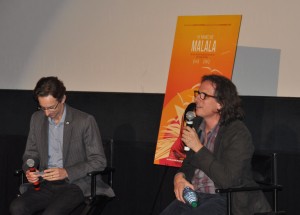
Davis Guggenheim.

Davis Guggenheim.

Sept. 21, 2015 Acclaimed documentary filmmaker Davis Guggenheim, who gave us “An Inconvenient Truth” about climate change and “Waiting for Superman” (about our public schools) appeared at the Chicago AMC Theater on Monday, September 21st, to speak about his latest documentary on Malala Yousafzai, the teen-aged winner of the 2014 Nobel Peace Prize.

Then fifteen years old, Malala was singled out by the Taliban in Pakistan, along with her father, for advocating for the education of girls in the country and the world. The Taliban shooter entered a bus on which Malala and her fellow classmates were riding on October 9th, 2012, called her out by name, and shot her in the left side of her forehead. The attack sparked an outcry from supporters around the world and she was air lifted to Birmingham, England, at the expense of the Pakistani government, where she underwent months in the hospital, recuperating from her injuries.

A crucial nerve that had been cut by the bullet’s trajectory was surgically restored by surgeons at Queen Elizabeth Hospital in Birmingham, re-establishing 90% function (surgeons had hoped for 80%) and a cochlear implant in her left ear attempted unsuccessfully to save Malala’s hearing in her left ear.

Since fleeing Pakistan, the entire Yousafzai family has been unable to return to Pakistan’s Swat Valley and has remained in Birmingham, England where her father Zia and her two brothers and her mother also struggle to assimilate to this new land. The Malala Fund, which has sprung up around her, invests in, advocates for and amplifies the voices of adolescent girls globally, urging education as a way to change the world. As Malala put it: “One child, one teacher, one book and one pen can change the world.”

Although, originally, Malala was speaking to the world via the BBC, undercover, with a pseudonym (Gul Makal), she eventually stepped from the shadows to speak publicly, saying, “There’s a moment when you have to choose whether to be silent or to stand up.”

The film is part standard documentary, part animated movie, as filmmaker Guggenheim explains that the original Malala was a warrior female not unlike Joan of Arc who led her male troops to victory in a battle that took place in 1880. She was given her first name Malala (meaning “grief-stricken”) after Malalai of Maiwand, a famous Pashtun poetess and warrior woman from southern Afghanistan.

Malala 361Filmmake Guggenheim used the story of the original Malala as a launching point and a touchstone for his documentary that both traces Malala’s past, documents her present, and speculates on her future. It is quite clear from the film that Malala’s activist outspoken ways come from grooming by her father, Zia, also an outspoken activist for education who owned and ran a string of schools in his native land (and still wishes he did.)

Following the showing of the film, these questions were asked of filmmaker Guggenheim:

Q1) “What made you want to do this film?”

A1) “Maybe it’s because I have 2 daughters of my own, but I received a phone call asking me if I’d consider doing this documentary and it started there. Education is liberation, your ladder up. I hope that message resonates as much with the citizens of Chicago as it does with the citizens of Pakistan.”

Q2) “Does Malala have any anger towards those who shot her?”

A2) “Sometimes you meet people who have a public life and they are different privately. One of the things I find extraordinary is that Malala is the same. She expresses, in the film, that she is not angry about the shooting. She said, ‘It was not a person who shot me; it was an ideology. They were not about faith. They were about power.’ In the ambulance on the way to the hospital, she worried about the mothers of the boys who shot her. Malala’s family is so full of joy and they live their lives without bitterness.”

Malala 362Q3) “Tell us about the beginning of this remarkable film?”

A3) “Walter Parks and Laurie Mcdonald got the rights to Malala’s story. They called me. I spent 3 or 4 days reading about the story and realized it had many more dimensions. It was about her relationship with her father, which is special. She was actually named after a girl who spoke out (Malala) and was killed for speaking out.

Q4) “Have you spent much time touring with Malala for the film?”

A4) “She Skyped in. She doesn’t like missing school (unlike my children). When she won the Nobel Peace Prize in 2014, she went back to her class to finish her Physics lesson.  At Telluride, her family told me that the act of making the movie was a form of therapy. I met them all when she was 5 or 6 months into recovery. She really feels she’s a spokesman for the 66 million girls who are being denied an education.”

Q5) “What sort of misinformation about her exists?”

A5) “Gossip. People in Pakistan refer to it as gossip. A very strong part of the population in Pakistan loves her and wants her to come back home. However, the Taliban has still vowed to kill her. Some of the hatred is backlash against the West.”
Malala 363Q6) “How did you come up with the idea of the use of animation and illustrations for parts of the documentary?”

A6) “The animation came from problems portraying the Battle of Maiwand, which took place in 1880. Malala is a national folk hero of Afghanistan who rallied local Pashtun fighters against the British troops at the 1880 Battle of Maiwand. She fought alongside Ayub Khan and was responsible for the Afghan victory at the Battle of Maiwand on 27 July 1880, during the Second Anglo-Afghan War. She is also known as “The Afghan Jeanne D’Arc.” We called up Abu Dhabi (which helped finance the film) and asked for more money to animate the movie. The imagery is often scary, repetitive and dark. I wanted to capture that. It was hand-drawn in my office using computers and is like a storybook.”

Q7) “Were there any restrictions placed on you as the filmmaker as to how you could portray Malala?”

A7) “No, but I always show the films I make to people like Al Gore for ‘An Inconvenient Truth.’ There were a few notes given us about how Islam is portrayed. They asked for some clarification in the subtitles. They wanted it to be presented better and their suggestions were improvements.”

Q8) “What is Malala’s favorite subject in school? And will she be going on to college?”

A8) “Physics, which they call Maths. She is going to college and has done very well on her exams. Originally, Malala wanted to be a doctor, but her father’s influence has convinced her that she should become a politician.”

Q9) “How did she keep from being scarred by the shooting?”

A9) “Malala has a big scar running along her neck. Her smile is not 100% returned to normal. Her mother refers to her birthdays as being born again and recently told her Happy Third Birthday. Malala feels a tremendous amount of responsibility for young adolescent girls everywhere and has visited Kenya, Nigeria and, on her 18th birthday, wanted to go to the refugee camps where the Syrian refugees are pouring across the borders into various European countries.”

Q10) “How has film managed to change the national and international conversation?”

A10) “Films that move people can move people to action. It is a very broad message. Malala is speaking at the United Nations next week about re-education for girls. African villages where girls are educated are different and do better in every way, including economically. It starts with theaters like this where people come together, hear an important story, and go home and talk about it. The film will open in 190 countries through Fox/Searchlight, ultimately.”

Malala 365Q11) (From a woman wearing a burkha): “Do you think any part of your identity caused a challenge to making the documentary?”

A11) “I understand what you are saying. Would she react differently to someone like you? Instead, she got me: a half Episcopalian, half Jewish filmmaker with long hair. This is a true anecdote: when we had been working a while, Malala’s father came to me, touched my hair, and asked if it was real or not. (laughter) I think they thought I was some sort of alien, with my shoulder-length locks. Malala’s situation is interesting because, in our society, everyone is telling their own story all the time on Facebook, Twitter, Snapchat, etc. They needed help to tell this story. When I walked in, they wanted to tell their story. The first three hours alone with just Malala and a microphone she told her story. Part of my job is to pull people out. I asked her about her suffering, but she did not give a complete answer in the film.”

Q12) “Is there any one thing that occurred during filming that made you change your opinions?”

A12) “I sat around their kitchen table and it was just like mine, but there was so much joy. They are a tight-knit family. We give lip service in our culture to the concept that ‘girls are equal.’ We say it, but her father acted on it, even putting Malala on the chart of the family tree, as we saw in the film. It’s not just saying that people are equal; it’s believing it and acting on it.”

Q13) “How did a young schoolgirl who started blogging anonymously at eleven and was shot at fifteen find the strength to do what she has done?”

A13) “Malala is a tough and focused person. She gets her sense of mission and her passion from her father. She gets her strength from her mother. She sat with Goodluck Jonathan and told him he must do more to get back the girls kidnapped by Boko Harum. She sat with President Obama and quizzed him about drone strikes in her country. Malala will go to college (an earlier question) and her presence has sparked a nationwide and worldwide movement at Malala.org. The Malala Fund is advocating for girls around the world, a nonprofit devoted to working to empower adolescent girls globally through gaining for them a quality secondary education.”

Palma, Majorca, Spain: Last Mediterranean Stop

Our last day on the one-week birthday cruise to Spain, Italy and France was a stop at Palma, Majorca. (*Note: I’ve seen it spelled as Mallorca, as well.)

Majorca

Majorca

I had always heard the British talk about vacationing there. When I was a People-to-People student at homestays in England (Chislehurst in Kent, Weston-Super-Mare and Birmingham), the locals raved on about how lovely it was on the island of Majorca.

2005 train that traverses the island.

2005 train that traverses the island.

I knew that Michael Douglas and his wife had a place there and asked our guide about it. He said that the place was far away from the only large city on the island (Palma, population 400,000) and that Douglas’ first wife, Deandra, was the one who really liked the vacation home.  His current wife, the Welsh actress Catherine Zeta-Jones, does not like the place as well. According to our guide, the couple (Michael and Deandra) split usage of the home in half and, usually, Michael ends up in hotels, rather than the home he purchased with and for his first wife.

Heart of Palma, Majorca.

Heart of Palma, Majorca.

In order to tour Majorca we had to walk quite a ways to the center of town. It is not possible to drive the tour bus into the heart of the city because the streets are too narrow. In fact, the sidewalks were little more than a foot or two wide, yet cars zoomed down the narrow street putting all of us in peril as we walked to the heart of the city, where a small Cathedral greeted us. 2015-07-24 20.48.52

There is a train that was built in 2005 that you can take around the island. It is the most popular tourist attraction, we were told, and goes through several tunnels that have been built on the island, cutting through the mountains.  2015-07-24 22.39.46

We stopped at a cafe in the heart of the city, right in front of the Cathedral and where the train goes through, and had a Coca Cola and a beer.  The couple seated next to us began chatting with us. He was an I.T. guy from Sweden and she was an elementary school teacher. They used to vacation in Fort Lauderdale, but now have actually bought a place in Majorca, instead.

View from the train en route around the island.

View from the train en route around the island.

Craig said that Majorca was his favorite spot on the tour. That means he preferred it to Rome, Pisa, Naples, Florence, Cannes, Monte Carlo, Monaco, Barcelona, Munich and Pompeii. 2015-07-24 21.24.18

Majorca was not ungodly hot. There was a lovely breeze blowing and it was, indeed, a rustic vacation spot, although it seemed rather sleepy to me, in the same way that Hawaii seems sleepy after  you’ve thoroughly enjoyed the beaches and the beautiful vistas.2015-07-21 01.21.31

Mel Reynolds: The Mighty Have Fallen

There was a time when Mel Reynolds was one of the most promising young politicians in Illinois.

That was before he was sent to jail for having sex with a 16-year-old underage campaign worker. That was before he became a registered sex offender in 1995, forbidden to live within 500 feet of a school. That was before he was charged with failing to file income tax returns from 2009 through 2012. (Each count carries a maximum sentence of one year in prison or a $250,000 fine on conviction.) That was before he was found to have child pornography, tried to sabotage the case against him, and was sentenced to 5 years in prison.

In 1997, Reynolds was convicted, while serving time in prison, of 15 counts of illegally raising campaign cash and defrauding banks out of hundreds of thousands of dollars. For that, he got 6 and 1/2 years in prison.

He served 2 and 1/2 years in state prison and was then transferred to a federal prison, but in 2001, Bill Clinton commuted his sentence hours before leaving office, at a time when Reynolds had 2 years left to serve.

In 2003, Reynolds made several attempts at a political comeback, running against another sterling example of rectitude, Jesse Jackson Jr. in the 2004 Democratic primary. That failed. Ten years later, Zimbabwe would deport him from that African country on charges that he had sexually explicit photos and videos on his mobile phone, in violation of a censorship law…in Africa! Although the charges were reduced to a misdemeanor visa violation, he was sent packing and came back to the U.S., where, on July 31st, while leaving the Dirksen US. Courthouse in Chicago, he was trying to find a place to spend the night.

Reynolds was able to secure a court-approved place to stay on an emergency basis and was ordered to appear in court at 2 p.m. on Friday with a more permanent address. Asked by reporters who he was talking to on his cell phone, Reynolds declined to answer fully, saying only, “This is a one-night deal,” and, of the charges of failing to pay taxes for four years, “The narrative has been that somehow I didn’t pay my taxes. I didn’t file.  By going to trial, this is going to set the record straight.” Mel Reynolds is 63 years old, claims to have a “very sick” daughter in Africa, and is a convicted felon.

Maybe he and Jesse Jackson and Anthony Weiner can start a club aimed at “Redemption” (the sign in the background of the old campaign photo.).Mel Reynolds


Third Day at Sea: Rome

Our first day at sea was spent cruising. Day two found us in either Pisa or Pompeii after docking in Naples.2015-07-21 15.17.05

On day three, we docked in Civitavecchia, Italy at 6 a.m.2015-07-23 15.03.10

Two hours later, our tour of the city left by bus, facing a one and 1/2 hour trip to the city from the docks (and a one and 1/2 hour trip back). (I just LOVE those early morning tours!)2015-07-21 15.14.48

Mainly, we drove past the sights that Rome conjures up, because the wait time to get inside the Coliseum, for instance, was 2 hours. (Only later, after our return, did I learn about the passes one could have purchased in advance that would have let you cut to the front of all lines, but they were primarily for 2 and 3 days, which would not have worked for those of us on an 8 and 1/2 hour tour of which 4 hours was spent on a bus).2015-07-21 15.16.02

After the extensive, exhausting trek through Pompeii (Day 2), the bus was quite welcome in the 100 degree heat. It was also very humid. 2015-07-21 15.31.52

I did some shopping with a fellow tour member, Deborah Matthews of Washington, D.C., and we were able to find a leather goods shop for souvenirs. We also tried the delicious dessert that our tour guide, Luisiana, went on and on about, calling us “my family” and using the phrase “you must know” to mean, “you should be aware that.”2015-07-21 18.35.27

I enjoyed seeing the area where the chariot races took place in “Ben Hur,” and the window from which a new Pope is announced. We were told by our guide that visiting the Treasures of the Vatican Museum would take at least a week and getting in to see the Pieta or anything in the Vatican requires extensive security, (plus, you have to be wearing something that covers both your shoulders and your knees.) Since my husband had on shorts, that was probably out in the first place.2015-07-21 14.48.16

I spent a period of days in Rome way back when, so the failure to be able to tromp around some more in 100 degree heat didn’t bother me at all.

Barcelona

Barcelona

Lollapalooza in Chicago, 2015

While in Chicago to take delivery of 2 new couches,  I attempted to enjoy Paul McCartney “live” from Grant Park, about a block away. It should have worked (it has, in the past), but, instead of live streaming Sir Paul, Gary Clark, Jr.’s set was shown and the Twitter-verse burst out with protests that a talent like Paul McCartney was allowed to be upstaged by someone nobody knew and very few cared about. (The big performer on Friday, July 31, 2015, was McCartney)

On Saturday (today), there was a face-off between Sam Smith on the stage farthest from me and Metallica on the Samsung Galaxy Stage closest to me. At least both were streamed “live” as promised by www.RedBulltv.com.

If you like Florence and the Machine, she plays on Sunday night at 9 p.m. (until 10 p.m.) to close out the festival. At 3 p.m. “Moon Taxi” from Nashville will play, friends of the daughter.

Absolutely perfect evening weather, so far, although a bit hot during the day.

New Documentary “Amy” Is Heart-Wrenching, Tragic, and Oscar-worthy


Amy Winehouse died on July 23, 2011, at age 27.  She died 17 years after another famous self-destructive lead singer, Kurt Cobain, killed himself, causing some to dub this coincidence “the 27 Club.”

In a new documentary, “Amy” that premiered in England on July 3rd and in the United States on July 10th, directed by Asif Kapadia and produced by James Gay-Rees and Universal Music, we learn “the story behind the music” from home video footage and interviews with those who knew Amy best—including Amy, herself.  It is a compelling and oh-so-sad look at one of–if not THE—greatest songwriter of her generation. The film debuted at the 2015 Cannes Film Festival.

The singer’s own song lyrics, projected onscreen, and her own interview statements, provide us with a murky picture of what led to her premature death. She described herself as a happy child until the age of 9, when her parents separated (her father, Mitch, moved in with his girlfriend).  Amy continued to live with her mother, Janis, and to visit her father and his girlfriend on weekends, but Janis, by her own admission, was not a disciplinarian. (“I wasn’t strong enough to say to her: Stop!”) Amy’s father, Mitch, whom she idolized, was not around to say “no” and her behavior from age 9 on seems to be a classic case of “acting out.”  Anything she thought would displease or shock her parents or other adults, she did—whether it was tattoos, piercings, her hair, her style of dress, her make-up, her promiscuity, or her eventual fatal infatuation with drugs and alcohol.

Amy came by her love for jazz legitimately, as many of Winehouse’s maternal uncles were professional jazz musicians and she was encouraged to listen to the greats.  Amy’s paternal grandmother, Cynthia, was a singer, and Amy calls her “the strongest woman I ever knew.” Her Nan’s death in 2006, when Amy was 23, hit Amy hard, at a time when other problems were rapidly building in her complicated life.

In one interview by Garry Mulholland of “The Observor” Amy, when asked about fame, replies, “I don’t think I could handle it.  I think I’d go mad.”  Indeed, there were suggestions that she may have been manic depressive and she suffered from bulimia. She was prescribed the anti-depressant Seroxat after her father left home, when quite young.

From the time Mitch left, Amy was a “Wild Child” and in various sorts of trouble.  Although it is not mentioned in the documentary, there were several charges of assault leveled against her. Even Amy admitted to sometimes hitting husband Blake Fielder-Civil, and one of her songs suggests that “You should be stronger than the woman.”

The entrance of Blake Fielder-Civil into her life seems to have been one of the worst pairings of two troubled people in history.  It echoes the Sid Vicious (the Sex Pistols) murder of his girlfriend Nancy Spungen.  The murder, in this case, was much more insidious, as Fielder-Civil introduced Amy to the worst of the drugs she experimented with and played fast-and-loose with her heart,  breaking up with her to return to a former girlfriend ( inspiring “Back to Black”) and deciding, while in prison on drug and assault charges, to divorce her.  Amy was betrayed by almost ever significant male figure in her life in one way or another.

After Fielder-Civil left her, briefly, to return to his previous girlfriend, Amy wrote, “Now my destructive side has grown a mile wide.”  Fielder-Civil reveals to the camera that, at the age of 9, [the same age as Amy when her father deserted her], he had attempted suicide. Amy is quoted repeatedly saying, “I write songs because I’m fucked up in the head.”

Amy’s father Mitch seems a bit too eager to profit from his daughter’s popularity and to springboard his own entrepreneurial efforts, sponging off her fame and fortune.  The film makes a point of confirming that her father DID say she didn’t need to go to rehab, and the narrator obviously feels it was one of Amy’s last chances to turn her life around.

Amy’s final “Duets” partner, Tony Bennett, is interviewed and says that Amy sensed that she was going to die young; he also gave her huge props as a true Jazz singer.  They are shown in the recording studio working together. It is obvious that Amy is nervous at performing with one of her idols.  Her record of 5 2008 Grammy Awards for “Back to Black” and many other British music awards cements her influence as one of the most important songwriters of her generation. (Amy had to perform via video; she was not allowed to leave the country and enter the U.S. because of drug use charges.)

A change of managers also appears to have been a change for the worse.  Her original manager, Nick Shymensky, became a close friend, starting with her when he was only 19 and she was 16.  Amy left him to go with Metropolis Music promoter Raye Cosbert, who put her on the road when she was ill and overbooked her for performances when Amy would, sometimes intentionally, sabotage her performance, as when she was forced to travel to Serbia to sing. It is related in the documentary that Amy was physically carried to a limo, unconscious from a night of hard partying, and put on a private plane to take her to the concert, where she subsequently refused to sing when called to the stage. [My daughter saw her during a Lollapalooza performance during this period and said she was “a mess.”] On the bright side, she had a great working relationship with record producer Salaam Remi, with whom she shared the Grammy for “Back to Black.”

When asked about the onerous nature of fame, [for which she was ill-prepared], Amy said, “If I really thought I was famous, I’d go and top myself, because it’s scary.  It’s very scary.”  She also says, at one point near the end of the film that she would happily trade her singing talent for the anonymity of being able to walk down the street without being hassled by fans.

After Amy’s Grandmother Cynthia (Nan) died on May 5, 2006, when Amy was 22, things seemed to spiral downward for the singer.  She had a seizure on August 24, 2007 in Camden and medical personnel said, “Her body can’t keep up with this.  If she has another seizure, she’ll die.”  Amy was told to swear off drugs, which she attempted to do and, apparently, had done at the time of her death. Her lung capacity was at only 70% (Mitch told the press she had signs of early emphysema) and her heartbeat was irregular.

However, when Amy was “off” drugs, she substituted abuse of alcohol, drinking heavily. In fact, it was alcohol poisoning that ultimately killed her, combined with the effects of years of drug abuse and bulimia. The film states that the level of alcohol in her system at the time of her death was “45 times the drunk driving limits,” although another source listed it as 416 mg. per 100 ml (0.416%), which is 5 times the legal drunk driving limit.

Her bodyguard at the time said, “This is someone who wants to disappear.”  Amy began to unravel in public.  She couldn’t escape her fame.  As her bodyguard put it, “She needed someone to say no.  She just needed support.”

“I cheated myself, like I knew I would. I told you—I’m trouble—you know that I’m no good.” With two of her romantic interests (Alex Claire and her former husband Blake Fielder-Civil) having sold their stories to British tabloids, the feeling is that everyone, including dear old dad, wanted to ride the gravy train as long as possible. This is a must-see documentary, if only for the wonderful music (original score other than Amy’s songs provided by Antonio Pinto).  It is useful as a cautionary tale, if nothing else, and I can’t believe it won’t garner Oscar nods, come spring.

Ultimately, as Amy predicted in song, “My odds are stacked. I go to black.”

Page 54 of 73

Powered by WordPress & Theme by Anders Norén