Welcome to WeeklyWilson.com, where author/film critic Connie (Corcoran) Wilson avoids totally losing her marbles in semi-retirement by writing about film (see the Chicago Film Festival reviews and SXSW), politics and books----her own books and those of other people. You'll also find her diverging frequently to share humorous (or not-so-humorous) anecdotes and concerns. Try it! You'll like it!

Category: Pop Culture Page 64 of 84

Any trends or popular fads may be described, whether it would be something like the hula hoop or the pet rock or simply new slang.

Jason Bateman’s “Bad Words:” “The End Justifies the Mean”

Jason Bateman is a veteran character actor, familiar to audiences for his work on television’s “Arrested Development,” playing Michael Bluth, straight man to a cast of eccentrics. Bateman attributes much of his success to how he approached that role, saying, “It was a show the industry watched, as opposed to America. The people who hand out jobs watched it.”

And Bateman has been handed a lot of jobs since “Arrested Development.”

To be accurate, young Jason was acting long before that, starting at the age of 12 in 1981 with a recurring role on “Little House on the Prairie,” as well as with roles as varied as some on “Silver Spoons,” “Knight Rider” and “The Hogan Family.”

It was the latter series that gave him his first directorial experience at the age of 18, making him the youngest director in Directors’ Guild history and, also, allowing him to follow in his father’s footsteps. (His father was a director, actor and writer.) Jason’s older sister, Justine, was a regular on the Michael J. Fox sit-com “Family Ties” and he has been married (since 2001) to one of Paul Anka’s daughters, Amanda, (with whom he has two daughters). She plays the role of the National Public Television narrator in the film.

In “Bad Words,” Jason has the opportunity to return to directing
. His work is informed by such dead-pan black comedies as “Being John Malkovich” and “King of Comedy.” Bateman told Michael Phillips of the Chicago “Tribune,” “The comedy I’m most drawn to is a little tougher to market. Even though I’ve been involved with some high concept studio fare (think “Juno,” “Identity Thief,” and “Horrible Bosses”), I’m drawn to something a little more tamped down. A film like ‘Being John Malkovich,’ there’s no pie in the face. We used that one as a tonal example—a tonal and aesthetic example…I knew that because we weren’t spending a lot of money we wouldn’t be asked to wink a lot or to rewrite the script so there’d be some big set pieces they could cut a trailer with. I didn’t want them thinking we’d even have a shot at recouping on the first weekend, because the movie looked glossy or super-commercial.” So, right away, the theater-goer should realize that they’re in for a quirky sort of comedic turn, like Billy Bob Thornton’s “Bad Santa.”

The super-funny “Bad Words” features Bateman as a 40-year-old malcontent who never graduated from 8th grade and has spent the past 40 years “making bad decisions” and proofreading warranties for a living. A lot of his problems stem from childhood issues originating with his father. He has now found a loophole for entry into The Golden Quill Spelling Bee that will allow him to annoy the hell out of Grand Poo Bah Dr. Bowman (Philip Baker Hall) and the woman in charge, aka, the Queen Bee, Dr. Bernice Deagan, played by Allison Janney. [Janney is a well-known face from her work on “The West Wing” and is pitch-perfect in her role of someone just a little bit too fond of rules and regulations. Barbara Bush would say she is a “rhymes with witch” but Bateman/Dodge would just come right out and say she is a colossal bitch].

Bateman’s character is the same glib trash-talking character Vince Vaughan and Billy Bob Thornton have played in countless comedies. He is truly representative of someone who just doesn’t care what other people think or say about him. He is going to have HIS say whether they like it or not.

That, in fact, might well be an accurate one-line summation of the entire plot of “Bad Words.” And many audience members will find that kind of independence and courage liberating.

Sure, there are reasons (revealed as the plot develops) why Bateman’s character Guy Trilby behaves the way he does. A follow-up article in the March 24th Tribune by Steven Zeitchik attributed all the potty-mouthed misbehavior (as well as that of predecessors like Archie Bunker and Jonah Hill) to our current climate of political correctness, where any little joke can spell doom if offense is taken by any group of any kind. It doesn’t matter whether the joke is at the expense of an ethnic group, midgets, or an inanimate object: SOMEONE is bound to take offense. Therefore, characters in films by Judd Apatow, Todd Phillips, the Farrelly brothers, Adam Sandler and others—(all the way back to W.C. Fields)—-say what they’re thinking, which so many of us no longer have the freedom to do, and that is considered subversive in today’s society. Some find it offensive. Some find it liberating and secretly are muttering, “You go, Guy.” (Pun intended)

“Bad Words” was directed by Bateman from a script by a first-timer, Andrew Dodge. Dodge told Zeitchik, “I think comedies have gotten a little vanilla. We’re so afraid of offending, so it’s a reaction to that.” He added, “That makes independent filmmakers more willing to be bold.” The spec script for “Bad Words” kicked around Hollywood for years. A studio executive said to Dodge, “This is funny, but could Guy start helping the kids in the third act?”

Dodge’s response? It’s superhard to make a character likeable enough that you still want to watch him, but hateful enough that it’s still funny.”

Steven Zeitchik postulates that the film is a “Rambo”-like rise of a new type of Superhero: the male hero jerk</strong>. I’m not as convinced that there’s anything “new” to a comic jerk in the tradition of W.C. Fields. I laughed at the clever, smarmy way Bateman pulled off eliminating the other competitors, one by one—even though his methods were underhanded and less-than-honorable. He displayed the kind of psychological warfare that allowed one team to dominate this year’s Super Bowl or allowed Muhammad Ali to defeat the likes of Sonny Liston, 50 years ago. It was strictly, “All’s fair in love and war.”

Still, when Bateman is calling his Indian opponent Chaitanya Chopra (Rohan Chand) “Slumdog” and throwing lines at that adorable Indian boy that sound racist, it can be offputting. In telling the boy not to call a soft drink “soda pop” Guy says, “I’d just say soda. Otherwise, you’re just gonna’ get raped.” You do get the feeling that his young charge really enjoys the adult male attention and that, alone, may be enough of a reason to excuse some of Guy’s bad influence. At least he IS an influence in the lonely young scholar’s life, unlike the rigid father figure who is glimpsed coaching his kid in their own secret strategy to get rid of the competition.

When Guy is placed in a room that is actually the storage closet of the hotel, [a futile attempt to discourage him from competing] and co-star Kathryn Hahn (who plays Jenny Widgeon), the reporter who is his accomplice helping him gain access to the Golden Quill Spell-Off and with whom he occasionally gets it on (while she, all the while, screams, “Don’t look at me!”) asks about her missing underpants, Guy tells her he hasn’t seen them, noting, “I probably would have seen them. I have no sink, no closet and no bathroom.” Guy dubs his miniature admirer “a little Quaker” and, after encouraging him to let loose with some dirty words asks, “And did your soul just burst into flames?”

In other words, Guy is a horrible role model for young children, but his smirky Vince Vaughn-like delivery is hilarious to a slightly jaded and cynical older audience. This is NOT Family Friendly Fare, but the adults should give themselves a chance to feel a little naughty as they watch Guy and his young charge misbehave. Is this a good way to go through life? Probably not. On the other hand, there IS a compelling reason that Guy is the way he is, and you just know that, sooner or later, that will come into play to explain all the previous shenanigans. And maybe some of the more frequent movie-goers will find it a little bit too transparent early on. (“The Sixth Sense” this isn’t.)

The movie definitely is filled with blue language. There are many situations that any self-respecting parent will decry as setting a bad example, just as the employees of “Office Space” were not candidates for Employee of the Year but were funny as hell. For this viewer, the movie was a hoot. It was made even funnier at the Icon on Roosevelt in Chicago by a man a few rows behind me to my left whose loud laughter sounded exactly like explosive farting.

There was a lot of it from my fellow theater-goer on opening night, and even writing that line now makes me smile.

So, if you are not easily offended and enjoy making fun of stuffy, pompous events like The Golden Quill (and, Lord knows, I certainly qualify after my last post), you will find this movie hilariously entertaining. I’d put it in a comic indie category with the film “Cedar Rapids,” which featured Ed Helms and John C. Reilly and was similarly entertaining.

Interviewing Celebrities: Finding Out “Who Is Naughty & Who Is Nice”

EdBurnsCloseUp

Guillermo del Toro, with Ron Perlman in background.

Guillermo del Toro, with Ron Perlman in background.

Kurt Vonnegut
Russell Crowe.

Russell Crowe.

In reading today’s March 21st Chicago Tribune, an interview caught my eye, with comments from television’s Giuliana Rancic. She relates that when she was conducting red carpet interviews and was fairly new at her job she encountered Russell Crowe.

Says Rancic: “Russell Crowe was so mean to me. I had been at ‘E!’ for a year, and I thought, ‘I’m going to go easy because he’s pretty tough.’” (Giuilana might have been referencing the telephone-throwing incident that has haunted Crowe since a New York City hotel stay.)

Rancic:
“Are you excited to be here? Your big movie premiere!”

Crowe: “I’m contractually obligated to be here. What’s your next question?”

Rancic: “OK—um—isn’t it so wonderful to see all the fans?”

Crowe
: “’That’s your second question? One, two, you’re through.’ And then he walked away, says Rancic.

The retelling of a bad interview brought back memories of some, good and bad, that I’ve conducted over the years. Perhaps among the worst was the interview of Kurt Vonnegut, Jr., I conducted when a college sophomore at the University of Iowa.

I needed 2 more hours to transfer from Iowa to Berkeley and it was too late in the semester to sign up for an additional class, so I talked my instructor in “American Humor & Satire” into allowing me to do a special paper interviewing the notoriously crotchety author, who was then teaching on campus at the Writers’ Workshop. I had to get at least a “B” in order to transfer to Berkeley from Iowa. That didn’t happen when the interview subject clammed up and became monosyllabic.

I had been interviewing adults since I was ten, so I had 8 or 9 years of experience interviewing others, but I had never interviewed a celebrity as prominent as Vonnegut.

Nor, as it turns out, as difficult as Kurt Vonnegut turned out to be.

Many years later, I was told that he hated, on sight, “little blonde girls from Minnesota.”

I wasn’t from Minnesota, but I qualified on the other counts.

I had read every book Vonnegut had ever written and was a huge fan. I was also immersed in the writing of other humorists and satirists as part of my “American Humor & Satire” class. We had just completed discussing “Catch 22” by Joseph Heller.

When I asked Vonnegut how he would compare his worldview with Heller he looked very irritated. It was late on a cold, wintry night. At that time, writing classes met in Quonset huts left over from World War II. He looked tired, haggard, cold, impatient, and like he’d rather be anywhere than where he currently found himself. Still, he had agreed to the interview, and I was trying to be properly respectful and had done my research on the Great Man.

Vonnegut fixed me with a tired, baleful glare and said, “There is no basis for any comparison.”

Welllllllllll. If you know anything about the work(s) of these two men, you might say that, at the very least, they deserve comparison because they were of the school of humorists then being dubbed “the black humorists” and were contemporaries.

After that, the interview quickly descended into Vonnegut acting like a bad guest on an old Johnny Carson show, and me beating a hasty retreat to try to make a paper out of few, if any, quotes. No longer could I plug in the author’s Words of Wisdom to the paper I had been working on for weeks, because he had offered no usable quotes of any kind.

The only thing I can say is that later Edie Vonnegut (Kurt’s daughter) ended up in my University Lab School class, never attended, and, therefore, flunked, so maybe there is some sort of Divine Justice.

As I read of Giuiliana’s experience(s) with Russell Crowe, I thought back to other famous celebrities I’ve been placed on the Red Carpet to interview, and how they have treated me as a print interviewer.

First, the good ones: Guillermo del Toro was a dream and so was Ron Perlman, who accompanied him. When I gave del Toro a copy of my book It Came from the 70s: From The Godfather to Apocalypse Now, he actually stopped so long that his handlers had to come urge him to move along. While standing in front of me browsing the book (in which he seemed genuinely interested), he noticed that his shoe was untied and said, with a laugh, “Oh! Oh! Fat man with shoe untied! Not good.”

Ed Burns
(“The Brothers McMahon”) was also very nice, posing with people in a friendly fashion. He was very charismatic. Likewise, Gary Cole was a good guy, but his companion that night (Dennis Farina), who I thought would be friendly and welcoming to any journalist in the Chicago crowd, was not, which surprised me. I expected him to give all of us a moment of his time, but the late Farina headed straight for the TV cameras and gave everyone else short shrift. Likewise, Forest Whitaker was kind and giving (when he finally arrived—quite late).

Among the worst experiences (after Vonnegut) was that of Alan Cumming (Eli Gold on “The Good Wife”). It wasn’t so much that Mr. Cumming was actively rude but that he acted as though anyone who did not have a TV camera on their shoulder was beneath his dignity. The rest of us were invisible. His handlers were actively involved in keeping all print journalists at bay.

As for writers, I’ve yet to encounter one who was as actively rude as Vonnegut in 1965, and I’ve interviewed David Morrell, Jon Land, Joe Hill, Anne Perry, William F. Nolan and many, many others.

Maybe writers are just naturally inclined to act more like “real people” since, in a sense, they ARE real people, known to audiences only because of their fictional constructs. There may be a few who don’t fit that description, but, in general, a best-selling writer can be as much of a celebrity (or as little of one) as he or she wishes, which is one good

M.K. Nobilette Eliminated on March 20th “American Idol;” Returns to San Francisco

The judges have spoken and M.K. Nobilette has been sent back to San Francisco, a town she loves, where a loyal female fan base kept her in the competition until March 20th, 2014. Keith Urban, Jennifer Lopez and Harry Connick, Jr., did not see fit to use their “save” for the baseball-cap wearing Bieber lookalike.

The bottom three this night, (besides M.K.) were Dexter Roberts of Fayette, Alabama, and Sam Woolf of Bradenton, Florida. I’m having trouble coming up with the reasons why the good-looking young Woolf keeps ending up in the bottom three, but perhaps his timid, non-assertiveness is the answer, since Caleb Johnson—a far less attractive youth, but a very confident and talented one—seems to be a big crowd favorite. Yes, this is a singing competition, but, in some ways, it mirrors the “Q” factor ratings that network talking heads are given for how “likeable” the audiences find them. It was a low “Q” rating that doomed Cheryl Tieg’s attempts to become one of those talking heads years ago.

The night featured Jennifer Lopez dancing in a skimpy outfit, backed up by girls half her age, singing “ILuhYaPapi.” She resurrected her “Jenny from the block” image and the song, (which was mainly a choreographed dance number), drew heavily on her Hispanic heritage. On a Yahoo “answer” blog, someone searching for the title of the song was answered by “Noneofurbusiness” with the title (I Luh Ya Papi) and the remark, “Worst song ever and the title puts us Latinos to shame, like we can’t speak English.”

I’m not sure I’d go so far as to say “worst song ever,” but I do wonder how long Jennifer plans to continue with the revealing outfits and the ultra-sexy schtick. She is the mother of 6-year-old twins (Emme and Max) and has been married 3 times. On July 24th, she will turn 45. Madonna is 11 years older than Jennifer and still at it, so perhaps that is the answer.

The other performers this night were a new band from Harry Connick’s part of the world, Royal Teeth, who sang “Wild.” It consisted of a lot of confetti flying and Harry Connick, Jr., saying (just before they performed), “These guys are awesome.” Again, not going there, but they were peppy.

If I were handicapping this race, it would be a good bet that “someone from the South” will win. I say that because, of the remaining contestants—now reduced to only 9—6 of those 9 or 2/3 are Southerners. North Carolina has 2 entries (Caleb Johnson and Majesty Rose), while Alabama has 3 (C.J. Harris, Dexter Roberts and Jessica Meuse.) I’m counting Florida’s Sam Woolf in that number. That means that only Michigan (Jena Irene and Malaya Watson) has an outside chance with a Midwestern win and Alex Preston stands alone as the representative of the East coast (Mont Vernon, New Hampshire). With M.K. Nobilette gone, the west coast has no contestants remaining.

Since C.J. Harris was given a pass despite one of the most out-of-tune performances ever, and has been consistently sharp throughout the competition, he obviously has a high “Q” quotient. His fan base is motivated to keep him in the competition, even when he sang out-of-key for an entire song. I’m less certain that Majesty Rose and Sam Woolf can keep dodging the bullet of the bottom three, but Caleb Johnson certainly has to be considered a front-runner. I’d put Alex Preston in that category if he weren’t so nerdy, overall.

I, personally, would like to see Jena Irene and Malaya Watson hang in there, but they are female and, historically, the voting is done by teen-aged girls. This is not to say that a female contestant cannot win, since many have, but it is to say that perhaps in the years that a female won the competition, they might not have been competing against a powerhouse singer like Caleb.

I could live with the loud showman Caleb Johnson coming in Numero Uno and claiming the crown, but I’ll reserve judgment on who will be the next-to-last contestant standing, [whom barely anyone remembers after the final night.] (Anyone remember the name of the contestant Philip Phillips bested without looking it up? I thought not.) Those singers go on to have careers on Broadway and make a very nice living at it, thank you very much, so kudos to all. We all know that Chris Daughtry didn’t win, and neither did Jennifer Hudson, and they seem to be doing just fine.

I’d look for Jessica Meuse to be eliminated in the near future, and I’m still scratching my head over Majesty Rose and her many brushes with the axe. (Gotta’ get that ‘Q’ factor up, girl!)
strong>

Fifty Years Ago Today (Feb. 25, 1964): Muhammad Ali Fought Sonny Liston


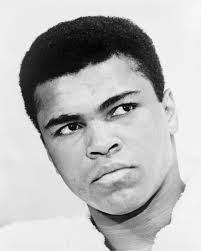
Fifty years ago today (February 25, 1964), Muhammad Ali (born Cassius Clay) defeated Sonny Liston (aka, “the Big Bear”) to win the Heavyweight Championship of the World. It was “the Scowl” versus “the Mouth” in Miami.

Muhammad Ali and me: Iowa City, 1968:

When I read that today was the 50-year anniversary of the Clay/Liston fight (Ali was still known as Cassius Clay, what he called his “slave name,” until after the fight), I remembered the day Muhammad Ali visited Iowa City, Iowa and spoke at the Iowa Memorial Union. I was there. I was one of many students crowded into the room.

His anti-war message against the war in Vietnam was what drew me to his speech. At the time, it did not make Muhammad Ali popular, just as the student protests at Berkeley had made student protest leader Mario Savio much reviled in 1965, three years earlier, when I was a student on campus at the University of California at Berkeley. Today, there is a statue of the (now-deceased) Mario Savio on the campus grounds, and Muhammad Ali’s name is known and revered around the world. And, yes, perhaps reviled by some for being “mouthy” and proving he was as “good” and as “pretty” and as “fast” and as “great” as he always claimed to be. [It’s amazing the insights that time gives to events happening in the immediacy of the present.]

Like many young people of the sixties, I thought it was unfair that speaking out against the war might land the heavyweight champ in prison.
(He was facing 5 years in jail and a $10,000 fine for refusing to serve in Vietnam). Ali was also denied the opportunity to do what he did best—box— and 4 of his prime athletic years were taken from him. He was stripped of his title and banned from fighting from age 25 until he was 29. (March of 1967 until October of 1970). Many sports experts have speculated about how that might have affected his legacy, since he did mount a comeback and fought well past his prime, winning the coveted heavyweight boxing crown three times.

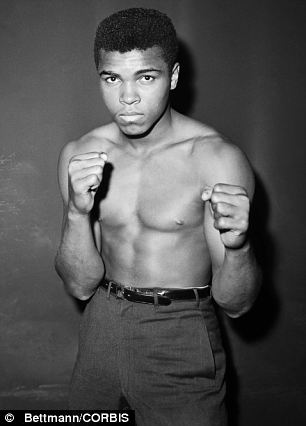
Muhammad Ali (born Cassius Clay)

Muhammad Ali (born Cassius Clay)

Ali’s standing up and speaking out on principle emboldened even Martin Luther King, Jr. to push more strenuously for human rights and racial justice and equality for African-American citizens. Ultimately, the Supreme Court overthrew the previous court decision that denied Ali conscientious objector status, and he was able to return to boxing in 1970, beating Jerry Quarry on October 26, 1970. But when I heard him speak, “live,” his future was very much up in the air. Soon after his return to the ring, Ali lost to Joe Frazier in what has been dubbed the Fight of the Century on March 8, 1971, in Madison Square Garden. I still remember my husband’s excitement when he came home from the closed circuit grainy televised match.

Time frame of Ali’s Iowa City Speech

Ali’s speech on campus happened between March of 1967 and March of 1968, although the University archives say it was 1969. I am fairly certain this is wrong. (I was married and living in the Quad Cities by March of 1968. Ali’s appearance in Iowa City had to have taken place during the first semester of 1967-1968 when I was still on campus and living at 229 Iowa Avenue. I remember being present. I am certain I didn’t drive BACK to campus from East Moline, so it was in the fall semester of school year 1967-1968). I always tried to take in speeches and concerts by any Big Name speaking on campus, which led me to hear Saul Bellow speak, and the Ramsey Lewis Trio play, and Booker T and the MGs perform “Green Onions” and Johnny Mathis (remember him?) sing in the Union. Many years later, I did drive back, to hear former President Bill Clinton speak and to hear Ben Folds (without the Ben Folds Five).

I remember Ali’s message, which was characteristic of the anti-war message he was delivering at a number of colleges across the nation during the time he was not allowed to fight in the ring, but was fighting in court to stay out of jail, be allowed to resume his career, and urging equality for citizens of color
. His rhetoric, which sounded very anti-white, was scary to his elders, but the students of the sixties on campus at Iowa, anyway, embraced his message of liberty and justice for all, just as our forefathers had embraced such radical notions in 1776. It’s unclear whether Ali’s reception was as warm and fuzzy in the South, but I can tell you that it was a very closely packed, interested, respectful and enthusiastic crowd that listened to him speak at the Iowa Memorial Union that day. I remember the room was crowded with students who turned out en masse to see the fighter we saw on television “float like a butterfly and sting like a bee.”

Ali’s Legacy

Young Cassius Clay, later to be renamed Muhammad Ali.

Young Cassius Clay, later to be renamed Muhammad Ali.

His strong suit not being humility, Ali had self-described himself as “the Greatest.” He wasn’t far off in this early self-assessment of his own boxing prowess. Muhammad Ali was named one of the most recognizable sports figures of the past 100 years, with only Babe Ruth coming close to the universal recognition that Muhammad Ali earned. Ali was also crowned “Sportsman of the Century” by Sports Illustrated magazine and “Sports Personality of the Century” by the British Broadcasting Corporation. It’s safe to say that boxing will never see a fighter so good who was so controversial, entertaining and larger-than-life than Mohammed Ali/Cassius Clay, and whose stance on so many important issues of the day resonated in such important ways. He was a showman. The sport will not see his equal and, in fact, seems to have withered and died in favor of WWC and cage matches and other televised fare.
History changed forever when the 6’ 2” good-looking, outspoken fighter with the 80 inch reach bested the rough-and-tough gangster-related Sonny Liston [who would later be found dead from a possible heroin drug overdose on December 30, 1970.] The intimidating Liston was heavily favored to knock Cassius Clay’s block off. I remember thinking that Clay probably didn’t have a chance against a thug like Liston and hoping he wouldn’t get hurt too badly. Some even wondered if the brash youngster would even show up for the fight. Clay took pride in his good looks; the general feeling going into the fight was that Clay might have a hard time preserving his handsome good looks against the brutal beating Liston was about to administer.


The Fight


Liston was a 7 to 1 favorite.
Clay had not really beaten any professional boxers of note, but, instead, had won a gold medal in the light heavyweight division in the 1960 Rome Olympics. In his 1975 autobiography, Ali claimed he threw the gold medal into the Ohio River after being refused service in a white diner in Louisville. Others dispute that version of events, saying he merely lost the medal. [Ali was issued a replacement medal 36 years after the fact, and it was presented to him during a basketball intermission at the 1996 Olympics in Atlanta, an Olympics where Muhammad Ali lit the Olympic torch. Talk about a national change of heart!].
Clay, prior to the fight that would launch his career as the only heavyweight to win 3 lineal World Heavyweight Championships (1964, 1974, 1978) on his way to becoming one of the most recognizable figures in the world, in a typical display of the psychological trash talk for which he became known, said that Liston “smelled like a bear” and that he was “going to donate him to a zoo” after defeating him In the ring. Prior to the fight, he recited this poem: “Clay comes out to meet Liston and Liston starts to retreat. If Liston goes back an inch farther, he’ll end up in a ringside seat…”

At the time, nobody thought the good-looking 22-year-old kid from Louisville, Kentucky, had a chance against the hardened ex-con, who learned to write his name while in a Missouri prison— a career criminal who had been arrested at least 19 times. Liston told Sports Illustrated, “I had nothing when I was a kid but a lot of brothers and sisters, a helpless mother, and a father who didn’t care about any of us. We grew up with few clothes, no shoes, little to eat. My father worked me hard and whupped me hard.”

Ali’s pattern of confidence and taunting his opponents before fights would continue in his career as he took on other fighters, like George Foreman. Ali was also confident and colorful before the Rumble in the Jungle in 1974. He told interviewer David Frost, “If you think the world was surprised when Nixon resigned, wait ’til I whup Foreman’s behind!” He told the press, “I’ve done something new for this fight. I done wrestled with an alligator, I done tussled with a whale; handcuffed lightning, thrown thunder in jail; only last week, I murdered a rock, injured a stone, hospitalized a brick; I’m so mean I make medicine sick.” Ali was wildly popular in Zaire, with crowds chanting “Ali, bomaye” (“Ali, kill him”) wherever he went.

The Boxer and the Beatles

When Liston was offered a chance to pose with a new British band touring the United States at the time (and causing a sensation) Liston refused to pose with “those sissies,” meaning John, Paul, George and Ringo, who were appearing on Ed Sullivan’s TV show on February 16th and February 23rd. Cassius Clay (who would change his religious affiliation and his name to Muhammad Ali after the fight) DID accept boxing promoter Harold Conrad’s offer to pose with the Beatles, bursting through the door of his 5th Street Gym in Miami Beach and shouting to the mop-topped group, “Come on, Beatles! Let’s go make some money!”

The Conscientious Objector Issue

Then came the difficult years. As an outspoken black man advocating black pride and opposition to the unpopular war in Vietnam, Muhammed Ali’s topics of choice were not popular. He spoke at the Memorial Union, attired in a suit. He had just been denied status as a conscientious objector and stripped of his heavyweight title (1967). He did not fight between March 22 of 1967 and October of 1970, years when he was 26 to 29 years old. That was the period of time when I heard him speak at the Iowa Memorial Union. Every state denied him a license to fight.

After his title defense against Zora Folley on March 22, Ali’s title was stripped following his refusal to be drafted into Army service (on April 28, 1967). His boxing license was immediately suspended by the state of New York and he was convicted on June 20, 1967 (by an all-white jury) and sentenced to five years in prison and a $10,000 fine for draft evasion. While his case was on appeal, he was free on posted bond, traveling the country giving speeches like the one I attended, in which he made statements against the Vietnam War and urged that blacks be given racial equality in America. Ali’s conviction was overturned on appeal and, (as he was out on bond despite the threat of 5 years in jail), he served no jail time. He did, however, lose 4 crucial years of boxing eligibility during his athletic prime.

Among statements Muhammad Ali made, woven into his college addresses, were these:

“Man, I ain’t got no quarrel with them Vietcong.” (He would add that no Vietnamese had ever called him the “n” word)…No, I am not going 10,000 miles to help murder, kill, and burn other people simply to continue the domination of white slave-masters over dark people the world over. This is the day and age when such evil injustice must come to an end…Why should they ask me to put on a uniform and go 10,000 miles from home and drop bombs and bullets on brown people in Vietnam while so-called Negro people in Louisville are treated like dogs and denied simple human rights?..My enemy is the white people, not the Vietcong…You’re my opposer when I want freedom. You’re my opposer when I want justice. You’re my opposer when I want equality. You won’t even stand up for me in America because of my religious beliefs, and you want me to go somewhere and fight, when you won’t stand up for my religious beliefs at home?”

In 2014, fifty years later, when the film Twelve Years a Slave is a major Oscar contender for Best Picture at the March 2nd Academy Awards, these words ring as true as ever.

Boxing Talent

Ali probably had the fastest hand and foot speed ever for a big fighter. Jimmy Jacobs, who co-managed Mike Tyson, measured young Ali’s punching speed (using a synchronizer) versus Sugar Ray Robinson, a welter/middleweight often considered the best pound-for-pound fighter in history. Ali was 25% faster than Robinson, even though Ali was 45 to 50 pounds heavier. (Ali had once asked Sugar Ray to manage him, but the former champion declined.) “No matter what his opponents heard about him, they didn’t realize how fast he was until they got in the ring with him,” Jacobs said.
The effect of Ali’s punches was cumulative. “Ali would rub you out,” said Floyd Patterson, who fought Ali on November 22, 1965, right after his two fights with Liston. “He would hit you 14,000 times and he wouldn’t knock you out; he rubbed you out. It’s very hard to hit a moving target, and (Ali) moved all the time, with such grace: three minutes of every round for fifteen rounds. He never stopped. It was extraordinary.”

Of his later career, Arthur Mercante, (boxing announcer), said: “Ali knew all the tricks. He was the best fighter I ever saw in terms of clinching. Not only did he use it to rest, but he was big and strong and knew how to lean on opponents and push and shove and pull to tire them out. Ali was so smart. Most guys are just in there fighting, but Ali had a sense of everything that was happening, almost as though he was sitting at ringside analyzing the fight while he fought it.”

Taunting: the Louisville Lip

Speaking of how Ali stoked Liston’s anger and overconfidence before their first fight, a sports writer commented that “the most brilliant fight strategy in boxing history was devised by a teenager who had graduated 376 in a class of 391.” Ali knew that what he said outside the ring, taunting his opponents as “ignorant” (Frazier) or comparing them to an animal (Liston) did psychological damage to his opponents when they were in the ring. Ai got under their skin, and that was his intention. When Ali referred to Joe Frazier as “ignorant” on national TV, Frasier wrestled Ali to the ground while live television cameras broadcast the unexpected outburst. The animosity towards Ali, from Frasier, lasted until Frazier’s death on November 7, 2011.

Considering that I’m a small-town Iowa girl from a hometown of not quite 5,000 people, I’ve had the good fortune to be in several places when events were taking place that would turn out to be turning points in history—or, at least, important historic events that one might even call a milestone. Among them were events such as the beginning of the Free Speech movement on campus at Berkeley in 1965 and the student riots that year; Ted Kennedy’s last speech inside the DNC in Denver in 2008 nominating Barack Obama; in Grant Park in 2008 when Obama spoke to a cheering crowd on election night; at Invesco Field in Denver when Obama accepted the nomination for president from his party; at the very beginnings of the Tea Party movement inside Ron Paul’s Rally for America in Minneapolis in 2008; at a concert at the Savoy Hotel in Birmingham, England by a band (using a light show) which would go on to become Pink Floyd; in the 7th row of the Beatles concert at the Cow Palace near San Francisco in 1964; at a concert in Paris given by James Brown and the Famous Flames in 1965; at the Howard Dean Scream Heard ‘Round the World at the Val Air Ballroom in West Des Moines in 2004; at concerts by the Rolling Stones, Prince, Dave Matthews Band, John Cougar Mellencamp, U2, and a host of other memorable live acts, including Taylor Swift on May 8, 2010, at the IWireless Center (formerly the Mark of the Quad Cities) when my daughter worked for 13 Management, Ms. Swift’s organization.

And I was also at the Iowa Memorial Union in Iowa City, Iowa, when Muhammed Ali stood up and spoke out for his beliefs in 1968.

Spike Jonze’s “Her” Is Nominated for Best Picture of the Year: What Are Its Chances?


Spike Jonze, former husband of Francis Ford Coppola’s director daughter Sofia (1999-2003) has created, in this year’s Oscar-nominated film “Her,” a futuristic tale of how things might become. Or perhaps it is a tale of how things already are?

Spike Jonze (birth name in 1969, Adam Spiegel) is a three-time nominee in the 2013 Oscar race, with his film nominated for Best Film, Best Original Screenplay (for which it has already won Golden Globe and Writers’ Guild of America Awards) and for Best Song (“The Moon Song”). Jonze was also nominated as Best Director in 1999 for “Being John Malkovich,” scripted by Charlie Kaufman, so this makes 4 nominations.

Will “Her” win the Best Picture Oscar on March 2nd?

No, but it has a very good chance to pick up Best Original Screenplay, and—given the fact that, somehow, all the music from “Inside Llewyn Davis” escaped nomination—“The Moon Song” and/or the song from “Frozen” would seem to be potential favorites for Oscar gold on March 2nd.

“Her” is an odd film about a man who falls in love with his operating system in a futuristic city meant to represent Los Angeles of at least ten years (if not more) in the future. Everyone has an ear bud in his (or her) ear, and no one talks to “real people” any more.

This is foreign territory for me, because I rarely turn on my cell phone and only give the number out to people I don’t want to talk to. I hate the idea of being “tracked” and telling the world, “Just ate at the House of Pies” (as one Facebook friend always does), and I’m not impressed with “apps” at all, [unless I’m trying to avoid a tornado at the time—then, I like them].

But that’s because I’m Old School, of the generation(s) that actually talked to one another, rather than “LOL-ing” our way from Facebook to Twitter to Pinterest to Tumblr to My Space to whatever the next online fad might be.
I do remember that, when I had to begin using a computer (1985) to write a book (29 years ago now) I was alone among my peers in even HAVING a home computer. Nobody else had computers much in the Heartland. Maybe they did in Silicone Valley, but they didn’t play in Peoria—or anywhere within 200 miles.

For one thing, the Internet was in its infancy (Al Gore hadn’t invented it yet, I guess) and all messages flew across the screen as Egyptian hieroglyphics, which required several painstaking steps to convert to regular English. Practically the only online “source” was the Department of Education at One DuPont Circle, and only AOL was a factor in “the olden days” of computer technology. Son Scott (one year older than Spike Jonze/Adam Spiegel) had a distinct advantage over his schoolmates in having a humongous WANG PC in his basement, courtesy of Performance Learning Systems, Inc. which hired me to write a book and insisted I use the WANG PC to do it. (I just love saying WANG PC!)

If it weren’t for Scott’s ministrations, I would never have figured out how to do anything on this behemoth with the gigantic laser printer, and, today, Scott troubleshoots computer programs for steel companies written by his United Kingdom Company, Broner Metals,located in Sheffield, England. Do I feel that his early exposure to computer technology in our basement in East Moline, Illinois, when he was 17 years old, helped him to gain an advantage over his less fortunate peers? Yes, I do. Does he? No idea.

I mention this generation gap only because I think it has a lot to do with how audiences will perceive and react to the film. If you’re past 45 or even older (God forbid, because we’re all supposed to simply keel over quickly after retirement so that our children don’t have to pay even higher money in to the broke Social Security coffers to support our feeble elderly selves) or even older, “Her” won’t resonate as much as it will for the younger generations, which my 26-year-old daughter confirmed. (*Aside: have you ever noticed how women’s magazines never have a decade category past 50? Recently Christie Brinkley at 60 and looking 30 made the cover of “People” magazine, but you rarely see women touted as “attractive”–or even alive–in their 70’s and 80’s. We are all supposed to be good little parents and die off quickly in our 60’s, even if we look like Christie Brinkley!)

If you are my son’s age (and, also, a fan of Weezer and the Beastie Boys and Kanye West and Jackass and all the other groups Spike Jonze has been involved with during his video-making career
) you may find this film wonderful. If you are younger than 45 (Jonze’s age) you may find it spectacular. If you are “mature” (euphemism for “old”) you may just find it a “meh” experience—except for the futuristic sets and the first-rate script.

As an oldie-but-a-goodie, I found it curiously lacking and weird as entertainment. For me, the single line that best summed up the film was one spoken to Joaquin Phoenix’s character, Theodore Twombley, by his blind date, when she says, “You’re a creepy dude.”

No matter what part he inhabits, Joaquin Phoenix IS a “creepy dude.” The Old Man pants pulled up to his armpits [as humorously engraved in my brain-pan forever by favorite comics like Jeff Altman and Martin Short], may echo what I see happening in men’s fashion right now (i.e., they seem to have run out of material, so Adam Levine and his contemporaries are wearing tight, short jackets and tight, short pants) but that just adds to the “meh” moment(s) that the AARP generation will experience while viewing this film.

But the alienation issues addressed by Jonze’s script are happening right now. I could definitely relate to the lines that sum up angst as experienced by many o
f us. Example, explaining his divorce to friend Amy Adams: “I think I hid myself from her and left her alone in the relationship.” This bit of wisdom may be a personal note on the demise of Jonze/Spiegel’s own marriage to Sofia Coppola. Indeed, many have speculated that the busy on-the-go photographer who rushes off and abandons his lovely wife in a hotel room to be wined and dined by Bill Murray, (played by Giovanni Ribisi in Sofia’s film “Lost in Translation”) represented the problems in Sofia’s own 5-year union to Spike.

Whether that is true or not (Sofia says “not”), the lines in this film seem intensely personal but the emotions, as expressed by Scarlett Johanssen’s tour de force vocal performance, are Words of Wisdom that many of us can relate to in our current 2014 lives. The observations are universal truths. It’s no wonder that the Original Screenplay category is one for which this film has received the nod this year. Here’s another gem: “I sometimes think I’m going to feel all the emotions I’m ever going to feel.” Or how about, “I want to discover myself.”

The speaker of that last line is the OS1 operating system Samantha, who is seeking discovery, because she is, —well, a disembodied voice. But Theodore is so lonely and estranged after his marriage to his childhood sweetheart founders that the comforting voice of a machine becomes human to and for him. Soon, Samantha, the disembodied voice, is his love interest, telling Theodore, “You helped me discover my ability to want.”

Of course, as the script notes, love is a form of socially acceptable insanity and having a machine for a wife means that you don’t have to cope with the reality of actually dealing with anything “real.” That, in fact, is what his ex (played by Mara Rooney) tells Theodore when they meet to sign the final divorce papers. Theodore’s ex had a childhood with demanding parents for whom her best was never quite good enough. Theodore was able to restore some of her self-esteem in the early days of their marriage (Is this hitting too close to home?), but, ultimately, he was not enough to mend her. Theodore constantly reminisces (in flashbacks) of happier times. My favorite glimpse of the couple showed them wearing traffic cones on their heads. I got the feeling that Theodore would have taken his ex back in a heartbeat—especially since he has been reticent to sign the final divorce decree and his dating life is a disaster, complete with a hilarious phone sex service scene.

But, as so often happens IRL (in real life), the path of true love seldom runs smooth(l
y).

After the initial “honeymoon phase” of their relationship, complete with phone sex and longing for face-to-face contact (as if anyone in this futuristic society gets THAT anymore!), Theodore even begins to find tiny, niggly little things about his Vocal Dream Girl that annoy him, like the way she takes a breath when speaking. Then he discovers that she sometimes is speaking with more than just one person, when she pledges her love. How many more? A LOT more! A male voice in the audience actually cried out, “Oh, no!” at this betrayal of the flesh-and-blood Theodore by the mechanical Scarlett/Samantha voice. It was an amusing moment. I wasn’t sure if the audience member was being sincere or sarcastic.

Another line that is gold: “You’re always disappointing someone.” Or how about, “All I do is hurt and confuse all those around me.” (How many of us have had THAT feeling a few times in life? Hmmmmm?)
Ultimately, one of the messages that resonated with me the most was, “We’re only here briefly, and, while I’m here, I want to allow myself joy.”

Kudos to Amy Adams who plays Theodore’s good friend in the building, as well as to Chris Pratt (“Parks & Recreation”) and to Hoyt Van Hoytema, who has done a fantastic job of creating a futuristic world with his cinematography, shot in both Shanghai and Los Angeles.

And while we’re praising Scarlett Johanssen’s sexy vocalizations (she replaced Samantha Morton, for reasons that are not quite clear), listen closely for Brian Cox’s easily recognizable voice as Alan Watt, a dead philosopher who has been recreated in the unreal world that Samantha inhabits and may be (one of) Theodore’s rivals for Samantha’s affections.

If you ever saw “Three Kings,” you may know who Spike Jonze/Adam Spiegel is, after all, as he portrayed the dimwitted, bigoted Conrad, as directed by his good friend David O. Russell, [who is, himself, up for an Oscar this year for “American Hustle” (and was similarly nominated for “Silver Linings Playbook” last year).]

Let’s put it this way: if you’re coming off directing “Being John Malkovich,” “Adaptation” and “Where the Wild Things Are,” you have a pretty good streak going, and, while I, personally, will not recommend this film to anyone in my age range as “entertainment,” the thoughts in the script and the message about how we all long to connect to someone and how it is becoming increasingly more difficult to do so with each new technological advancement (I use the term ironically) was interesting and thought-provoking.

And, besides, I got to say WANG PC at least four times in this review, and that, alone, made me smile.
,

Oscar Race, 2013, Predictions One Month Out

Academy Award Predictions for the 2013 Oscars in the Main Categories

matthew_mcconaughey1_300_40I’ve been watching magazines (like “Entertainment Weekly”) predict the potential Oscar nominees for Best Actor in advance and score only 3 out of 5. (They missed with Tom Hanks and Robert Redford). True, they did better in other categories, but as someone who covered the Chicago Film Festival and has seen nearly all of the nominees, it’s time to share my view(s) on who will win. After all, it’s over a month away.


Best Picture of 2013

Bruce Dern at the Chicago Film Festival, nominee for "Nebraska."

Bruce Dern at the Chicago Film Festival, nominee for “Nebraska.”

The nominees are: “12 Years A Slave;” “American Hustle;” “Captain Phillips;” “Dallas Buyers’ Club;” “Gravity;” “Her;” “Nebraska;” “Philomena;” and “The Wolf of Wall Street.” First of all, let me say that there were enough good movies out there this year that the Academy could/would/should have picked 10 films, but it is my understanding that, to make the list, a film has to receive enough first-place votes from Academy members, and, obviously, films like “Inside Llewyn Davis,” “August: Osage County” and “Blue Jasmine” didn’t quite make the cut. Why? Beats the heck out of me!I’d say they were too much “downers” as movie fare, except that “Blue Jasmine,” in particular, has some very funny moments, and “Dallas Buyers Club” is hardly frivolous fare.

"American Hustle" is David O. Russell's second great film in 2 years. Maybe it's his year for Best Director?

“American Hustle” is David O. Russell’s second great film in 2 years. Maybe it’s his year for Best Director?

If I were to put the list above in order, entertainment-wise, I’d be hard-pressed to pick a favorite between “American Hustle” and “Captain Phillips.” For me, “12 Years a Slave” started much too slowly, was too depressing, and did not accurately depict what life would have been like for a free man in 1841 in the North. Steve McQueen, its director, is British, and I think he must have missed the Jackie Robinson film “42,” which depicted the struggles of blacks (even Jackie Robinson) to crack the color barrier as recently as the sixties. No way would a black man in 1841 in the North in Washington, D.C., have been served in the fancy dining room (seated with white men), attired as a fop, nor lived in the very fancy house he returns to at film’s end. I also did not like the hanging scene. From the standpoint of veracity, I will never believe that the other slaves depicted tip-toeing around in the background wouldn’t have helped poor Solomon out of that noose, since the slave master(s) had disappeared from the scene. However, having these negative things, I do think that the Best Supporting Actress award should go to new-comer Lupita Nyong’o. (For my money, the SAG awards got it right most of the time).

Cate Blanchett in "Blue Jasmine" was pitch perfect. Why wasn't the film nominated as Best Picture?

Cate Blanchett in “Blue Jasmine” was pitch perfect. Why wasn’t the film nominated as Best Picture?

However, if you hold my feet to the fire and say, “Rank order these films in the order of which ones are really good movies that I will enjoy,” I’d start out with “American Hustle” and move to “Captain Phillips” second.

"Gravity" with Sandra Bullock and George Clooney (briefly).

“Gravity” with Sandra Bullock and George Clooney (briefly).

After that, “Dallas Buyers Club” was a revelation. I recognize the achievement(s) of “Gravity,” but it was a boring film a lot of the time, despite its technical achievements. I look for the Academy to award those achievements and perhaps its Director, but not the film. I think the feel-good film (“American Hustle”) will win out over watching the wicked slave owner Edwin Epps (excellently played by Michael Fassbender) whip Patsy till she damn near dies. I regret the omission of “Blue Jasmine,” a truly funny, yet heartbreakingly honest film. The minute I saw Cate Blanchett’s performance, I took my husband back for a second look, since it was such a good film and she was phenomenal in it. Let me be honest here: I’ve not (yet) seen “Her” or “Philomena;” I’m pretty sure I’m not going to be swayed by either. “The Wolf of Wall Street” contained good performances, but it was way too long and seemed rather self-indulgent on Scorsese’s part to carry scenes on so long when the point had been made 20 minutes earlier. (I’m thinking of Leonardo DiCaprio’s many scenes exhorting his troops of brokers.)

So, Best Picture: “American Hustle”—-when “Blue Jasmine,” which wasn’t even nominated, was its equal and so was “Captain Phillips,” a truly heart-thumping Paul Greengrass effort with his trademark quick cuts, which have made Matt Damon’s outing in the Bourne series so great.

Director: Even though David O. Russell deserves it, for directing both “Silver Linings Playbook” and this year’s “American Hustle” (and, many years ago, “Flirting with Disaster,” one of my All-Time Favorite comedies), the Academy will give it to “Gravity’s” director, Alfonso Cuaron, which I can live with. I realize he overcame some daunting technical issues to make this space epic so realistic, but, quite frankly, the best line I’ve heard about “Gravity” was from Tina Fey when she told the Golden Globes audience that George Clooney floated away after 10 minutes so he wouldn’t have to spend any more time with a woman his age. (I paraphrase loosely). That was part of the problem. One-person movies are not as riveting as those with an actual cast that hangs around. Yes, I know that “Castaway” was well done and that Robert Redford’s effort this year was good, but, for me (and most other movie-goers) watching one person onscreen for a couple hours gets boring after a while. Sorry. It’s just the way it is, Tina Fey funny remarks notwithstanding.

Best Actor: Nominees-Christian Bale (“American Hustle”); Bruce Dern (“Nebraska”); Chiwetel Ejiofor (“12 Years A Slave”); Matthew McConaughey (“Dallas Buyers Club”); Leonardo DiCaprio (“The Wolf of Wall Street”). I’ve bold-faced the winner. I could give you all the (good) reasons why, such as his great year appearing in “Mud” and his superb cameo in “The Wolf of Wall Street,” which is one of the film’s most memorable moments. I will give you that both Tom Hanks and Robert Redford were snubbed, especially since Hanks not only had “Captain Phillips” but, also, “Saving Mr. Banks.” Nevertheless, the momentum is with the letter “M” and he will be joined onstage by his co-star Jared Leto, as Best Supporting Actor. Why not Best Film then? Too depressing, overall, but a really, really good film. (*It played in the Quad Cities for about 2 days, so I had to drive all the way to Chicago to see it; I think it’s coming back, however, so be sure to catch it if you are a true film buff).

Meryl Streep in "August: Osage County" is nominated once again.

Meryl Streep in “August: Osage County” is nominated once again.

Best Actress: Nominees –Amy Adams (“American Hustle”); Cate Blanchett (“Blue Jasmine”); Judi Dench (“Philomena”); Meryl Streep (“August: Osage County”); Sandra Bullock (“Gravity”). I’ve not seen Judi Dench, but both she and Streep and Bullock have won previously, so there’s that to consider. The bottom line is that Cate Blanchett’s performance was pitch perfect, at times, funny, always touching and just perfect. She deserves it.

Best Supporting Actor: Nominees – Barkhad Abdi (“Captain Phillips”); Bradley Cooper (“American Hustle”); Michael Fassbender (“12 Years A Slave”); Jonah Hill (“The Wolf of Wall Street”); Jared Leto (“Dallas Buyers Club”). This performance as a trans-gender male is outstanding. Leto deserves it, also. While the Somalian pirate was a wonderful debut by Minneapolis resident Barkhad Abdi, it’s his first film and we’ll have to see if there is a big market for Somalian pirates in future films. (Abdi hopes so, because he already has moved to Hollywood and plans to act.) Michael Fassbender was good, as always. I’m bummed that Jonah Hill got the nod while Tom Hanks and Robert Redford were ignored, but oh, well. Alfred Hitchcock never won, nor did Richard Burton and Hanks and Redford have at least won Oscars previously. Leto was just absolutely spot-on.

Lupita Nyong'oBest Supporting Actress: Nominees-Sally Hawkins (“Blue Jasmine”); Jennifer Lawrence (“American Hustle”); Lupita Nyong’o (“12 Years A Slave”); Julia Roberts (“August: Osage County”); June Squibb (“Nebraska”) Frankly, I think Jennifer Lawrence was a bit young for the role she played in “American Hustle.” She’s definitely Hollywood’s “it” girl, right now, but that isn’t a good enough reason to give it to her. Julia Roberts has already won. If Lupita doesn’t get the trophy she so richly deserves for playing Patsy, I’d enjoy seeing either of the 2 lesser-known nominees (Sally Hawkins or June Squibb) be so honored. This is the “Wild card” category that I would “wheel” if I were entering contests, because Jennifer Lawrence is the front-runner. I’m voting with my heart and remembering how many times there have been upsets in this category.

So, to sum up, my winners (given the nominees) are: “American Hustle”
Director – Alfonso Cuaron
Best Actor – Matthew McConaughey
Best Actress – Cate Banchett
Best Supporting Actor – Jared Leto
Best Supporting Actress – Lupita Nyong’o
How much you want to bet I can get at least 3 out of 6 right to rival “Entertainment Weekly’s” nominee predicting?

Virtual Tour Schedule for New Christmas Cats Book

Christmas Cats Chase Christmas Rats Web Tour Schedule

Daddy Blogger Dec 1 Live Video Interview
So Many Precious Books Dec 2 Review & Giveaway
Deal Sharing Aunt Dec 2 Review
Daddy Blogger Dec 3 Review
Mrs. Mommy Booknerds Dec 3 Review
Joy Story Dec 3 Review
Saving For Six Dec 4 Review
Rhodes Review Dec 5 Review & Giveaway
Sincerely Stacie Dec 6 Review
VW Stitcher Dec 9 Review
Dogs Rule Cats Drool Dec 9 Review
Books, Books & More Books Dec 10 Review
Jolly Blogger Dec 10 Review
Practical Frugality Dec 11 Review & Giveaway
The News in Books Dec 11 Review
The News in Books Dec 16 Interview
The Crypto-Capers Review Dec 12 Review
Stories from Unknown Authors Dec 12 Live Interview at 1 pm EST
Carole Rae Random Ramblings Dec 13 Review
Little Lovely Books Dec 13 Review
Bea’s Book Nook Dec 16 Review & Giveaway
Identity Discovery Dec 16 Review
Reviewing Novels on Line Dec 17 Review
Manic Mama of 2 Dec 17 Review
Hott Books Dec 18 Review
Laura’s Reviews Dec 18 Review
Sweeps for Bloggers Dec 19 Review & Giveaway
Allison’s Book Bag Dec 20 Review
Allison’s Book Bag Dec 19 Interview
Sweet Southern Home Dec 23 Review
Chaos Is a Friend of Mine Dec 24 Review & Giveaway

DSC_0900

“The Christmas Cats Chase Christmas Rats” Appearance Schedule, to Date

The_Christmas_Cats_C_Cover_for_Kindle
The website is now up for the Christmas Cats series of illustrated children’s Christmas books. See it at www.TheXmasCats.com. If you can’t make it out to any of the events listed below, you can order an autographed copy from the website using Paypal. The book is also available at Amazon, any of the independent bookstores in the Quad Cities, the Quad City Convention and Visitors’ bureau and at the following Christmas events.

Here is my Christmas schedule, as far as I currently know it, for appearances with my Christmas book (“The Christmas Cats Chase Christmas Rats”) AND the Cat-in-the-Hat, for a picture opportunity, as long as the Small Fry don’t run screaming from the room.
. The Cat-in-the-Hat is supportive of the Christmas Cats, but is not obligated to appear, nor in any way endorse the newer series. The Cat (in the Hat) is just a cool cat and likes to go where other cats might congregate, and would really like to see “Cocoa & Coffee with the Cats” become a reality.

1) Nov. 21, Thursday- Festival of Trees starts. Book will be on the shelves.

2) Nov. 24, Sunday, 11 a.m. to 5 p.m. – St. Augustine College in Chicago at Chicago Book Expo.

3) Nov. 30, Saturday “Cocoa & Coffee with the Cats” at the Dead Poets’ Espresso House in Moline at 1:00 p.m., with the reading of each book, the potential presence of the girls for whom the book was written (Ava & Elise Wilson) and free cocoa or coffee for all. Caroling possible, as there is a piano at the Dead Poets’ Espresso, which seats 50 and closes at 2 p.m. The Cat-in-the-Hat will be present for photo opportunities. (Following the “Cocoa & Coffee with the Cats” event, the Cat-in-the-Hat and I plan to make a quick trip to the Moline BookRack store (where the book is also available), in support of independent bookstores everywhere. (National movement).

DSC_08874) Dec. 1, Sunday – “Live” blogging at Google Hangout” with Daddy Blogger at 5 p.m. CDT/ 7 pm PST. Streams live to YouTube. Prior to this, radio interview on 1450 AM, Barbara Bruce General manager, KVSL, Lakeside, Arizona at 4 p.m.

5) Dec. 2, Monday, at 2:30 p.m.– radio interview with Laura@Queenbradio in Dubuque, Iowa. (Postponed due to Laura’s illness; hopefully, same time next Monday).

6) Conversations Book Club with Cyrus Webb at 5:30 p.m. CDT, streaming live at www.blogtalkradio.com/cyruswebbpresents.

7) Dec. 6, Friday, at 10 a.m., WDNG-AM with Charlotte in Alabama.

DSC_0900
8) Dec. 6, Friday, 5:30 to 8:00 p.m. at Razzleberries in LeClaire, Iowa
, with the Cat-in-the-Hat present for photo ops.

9) Dec. 7, Saturday, 6 to 9 p.m. at the Village of East Davenport’s Victorian Christmas Walk
. We’ll be inside Freddy’s Fritters Dog Bakery at 1111 Jersey Ridge Road, Suite 6.

10) Dec. 8,Sunday, 1 to 4 p.m. at the Book Rack in Moline, book signing.

11) Dec. 12, Noon, Radio interview with Renee

12) Dec. 13, Friday, HyVee Food Store in Silvis from 4 to 7 p.m. with the Cat-in-the-Hat. If you attended the Silvis Schools any time between 1969 and 2000, come on down. Many of your former teachers may drift through, hopefully. If copies of Book One remain, a “Buy Book #2, Get Book #1 FREE” special I’ve used before will be in force. The original book was illustrated by East Moline native Andrew Weinert and Venezuelan national Emily Marquez.

13) Dec. 14, Saturday, 5 p.m. to 8 p.m. in the window of the Four Seasons Dress Shop at the Geneseo (IL) Christmas Walk. The Cat-in-the-Hat will also be present for photo opportunities.

14) December 15, Sunday, from 1 to 4 p.m. at BookWorld inside Soouthpark Mall with the Cat-in-the-Hat.

The book has expanded distribution from Ingram and should show up (for ordering) in B&N catalogue. Meanwhile, all independent bookstores in the area have the book, as well as both Visitors’ Centers and the Teachers’ Aide store in Kimberly Village. You can order the book, autographed, from its dedicated website using PayPal, www.TheXmasCats.com.

Ghost Brothers of Darkland County Plays Davenport, Iowa, on Nov. 3, 2013

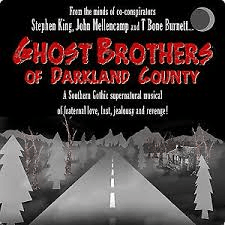
Ghost Brothers of Darkland County

Ghost Brothers of Darkland County


Stephen King, John Mellencamp and T. Bone Burnett have collaborated on a musical entitled “Ghost Brothers of Darkland County” and it has been touring 20 small towns, including the performance on November 3, 2013 at the Adler Theater in Davenport, Iowa.

Only two stops remain on the tour
, one in South Bend, Indiana, and one in Grand Rapids, Michigan. I can’t help but wonder if the troupe will then take the show to Chicago and/or New York and this is their way of working the bugs out.

The 15 singers and 4 musicians who comprise the cast spin the tale of ghosts who cannot be freed until the truth is told.
That device is one King has used before, most recently with passengers at a railroad station who are stranded there, seemingly forever, as ghosts.

Bruce Greenwood as Joe McCandless and Emily Skinner as his wife, Monique, head up the cast of "Ghost Brothers of Darkland County."

Bruce Greenwood as Joe McCandless and Emily Skinner as his wife, Monique, head up the cast of “Ghost Brothers of Darkland County.”


One of the most pleasant surprises of the evening was how good Bruce Greenwood’s singing voice is. This talented character actor has played many, many television and movie role, including a major role in the Denzel Washington film Flight and as Captain Christopher Pike in Star Trek Into Darkness. However, Greenwood apparently played in a cover band 25 years ago, so this was familiar territory. Greenwood’s solo on the song “How Many Days” in Act I is one of the highlights of the entire play.

Two brothers went the Cain and Able route in this story
now set in Mississippi (although supposedly Mellencamp had property in Indiana with a cabin with a similar story that he related to King). The boys fought over a girl, as brothers often do, and things did not go well.

The original brothers are Greenwood’s older siblings, Andy and Jack, but the lead character’s grown sons, Frank and Drake McCandless, are Joe McCandless’ concern now, as they seem to be on the same path to destruction.
The women in the lives of the two pairs of brothers, Jenna and Anna, are well-played (and sung) by Kate Ferber and Kylie Brown. As Anna says, “I’m a whole lotta’ big girl and I know what men like. I want to make damn sure you know what you’ve gotten yourself into now.”

Unless Joe McCandless (Greenwood) tells the truth, the whole truth, and nothing but the truth about a fateful night in 1967, his own sons in 2007 may suffer a similar fate and wind up in the limbo or Purgatory represented by the Dreamland Cafe…”the place where lost people go.”
>
The sets in this touring production were spare, mostly consisting of chairs and a large drop cloth representing the cabin where all the mayhem begins.
If this does go on to Broadway (or Chicago), I hope they drop the Prairie Home Companion spare style and put up a cabin like the house in “Fences,” a Denzel Washington vehicle. It would add a lot to the production.

The ghosts are also pretty cut-rate,
depicted as such by the wearing of raggedy choir robes in off white. “Here we are and here we’ll stay until the truth sets us free” is the familiar unifying message from King.

"The Shape," (aka, the Devil) tempts Jenna (Kate Ferber) or Anna (Kylie Brown).

“The Shape,” (aka, the Devil) tempts Jenna (Kate Ferber) or Anna (Kylie Brown).

There is a figure representative of Satan who acts much like Joel Gray in “Cabaret” and is analogous to the small devil that is the conscience of the main character in “Animal House.” (good angel on one shoulder; bad devil on the other.)

The liner notes for Jake La Botz, who plays “the Shape,” were interesting, describing him as dropping out of high school at 15 and hitting the road for hobo camps. Then Jake was a roofer, boilermaker, graphic factory worker, and obituary writer before he turned to the guitar and became a back-up artist to such greats as Ray Charles, Etta James, Dr. John, Buddy Guy, Junior Wells, and Taj Mahal. His unique outfit, consisting of a vest, no shirt, multiple tattoos and a walking stick, was also unusual.

Greenwood told David Burke of the Quad City Times that the play was about “the corrosive nature of secrets and how elusive redemption can be.” He added, “But with Stephen King, it’s so dark…It’s like Prairie Home Companion on acid.

Supposedly, the production took 13 years to stage. I can only assume that’s because King was churning out more novels (“Dr. Sleep,” the continuation of “The Shining” most recently) because his part in the play seems the easiest. There are a lot of clichés utilized in what is billed as “Libretto by Stephen King.” They start early, when young Joe (Zac Ballard) hears talk of having his “britches tanned” and they continue through such well-worn expressions as “rode hard and put away damp” and lines like, “Does the phrase ‘up shit creek’ ring a bell?'”

Those colloquialisms didn’t scream “original,” to me. King’s words do ring truer on lines like “Too late always comes too early.” There is also a familiar echo to the line, “You can never do the right thing after you just closed up the local honky-tonk.” That struck me as about as original as the old “a motorcycle is an accident waiting to happen” cliché and “Slap my tail and call me Stinky” didn’t strike me as Deathless Prose or Great Writing, either.

But I digress.

The original songs (Mellencamp and T. Bone Burnett) are the real saving grace of this production.
Many sound as though they could become classics. (Any time you put “home” in the lyric, it seems to signal a home run.) There were those in the cast who stood out like a diamond amongst zircons, Greenwood most of all, and the caretaker, sung by Eric Moore, who has previously appeared in Jesus Christ Superstar, Godspell and Man of LaMancha was outstanding.

All in all, it will be interesting to see if the play now goes to a larger venue and, if so, what they charge for tickets. Tickets at the Adler ranged from $39.50 to $59.50 to $69.50. The theater was not full, but the audience gave the cast a standing ovation at the end of the three hours.

On this tour of smaller houses, the 20 cities included Bloomington, Indiana; Louisville, Kentucky; Knoxville, Tennessee; Asheville, North Carolina; Nashville, Tennessee; Evansville, Indiana; Indianapolis, Indiana; Akron, Ohio Columbus, Ohio; Fort Wayne, Indiana; Madison, Wisconsin; Rockford, Illinois; Milwaukee, Wisconsin; Minneapolis, Minnesota; Sioux City, Iowa; Ames, Iowa; Davenport, Iowa; South Bend, Indiana; and Grand Rapids, Michigan, where the tour ends on November 6th.

Opening Night of the 49th Chicago Film Festival at the Chicago Theater

Mayor Rahm Emmanuel with a Festival judge at the 49th Chicago Film Festival.

Mayor Rahm Emmanuel with a Festival judge at the 49th Chicago Film Festival.

Page 64 of 84

Powered by WordPress & Theme by Anders Norén